
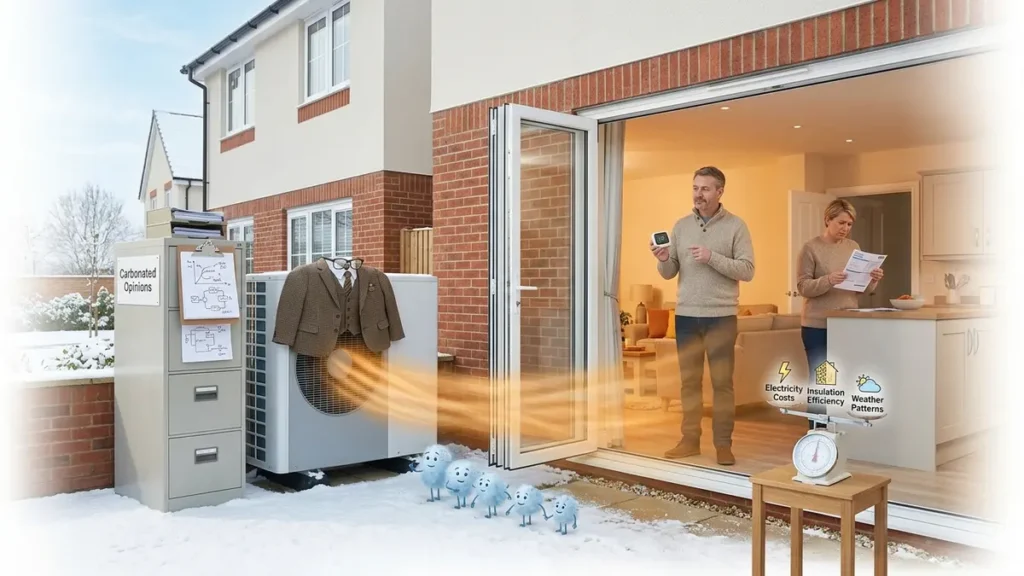
Heat Pumps: The Boring Climate Hero Hiding in Plain Thermodynamics
Heat pumps have the public glamour of a well-insulated filing cabinet, which is unfortunate because heat pumps may be one of climate tech’s most useful pieces of hardware. They don’t produce a dramatic new fuel or promise to reinvent civilization. They relocate warmth while civilization argues about the thermostat. The question isn’t whether that’s exciting. It’s whether moving heat, rather than making it from scratch, holds up once physics, utility rates, and January get their turn with the clipboard.
The Refrigerator Principle, Now Pointed at Your Living Room
A heat pump works on the same basic trick as a refrigerator: it uses electricity to move heat from one place to another. A fridge pushes heat out of its cold interior; a home heat pump pulls available heat from outside air—or sometimes the ground—and delivers it indoors.
That sounds like accounting fraud until you remember that electricity is paying for the moving, not supplying every molecule of warmth. Its coefficient of performance can exceed one, meaning one unit of electricity can deliver several units of useful heat under favorable conditions. Academic overachievement from an appliance, frankly. But physics is the ultimate accountant: as outdoor temperatures fall, extracting heat gets harder, and the grade starts to wobble.
Efficiency Meets the Utility Bill
Efficiency is not the same thing as a bargain. The household energy bill is the referee here, and it cares less about elegant percentages than the final score. Electricity prices, gas or other fuel prices, installation costs, ductwork, insulation, equipment sizing, and local weather all get a vote.
That’s the engineering trade-off nobody advertises in the glossy brochure. A leaky house asks any heating system to perform a rescue mission with the windows open. A well-installed air source heat pump in a reasonably efficient building can cut energy use substantially; a rushed installation in a drafty building can turn a promising machine into an expensive argument. Better insulation and smarter controls aren’t side quests. They’re part of the technology working as advertised.
The Cold-Weather Footnote That Refuses to Stay Small
The terms and conditions arrive in a font everyone ignores until January. Cold-climate models have improved enormously, but severe cold can reduce performance and increase electricity demand just when the grid is busiest. Some homes need backup heat; every region needs enough generation and network capacity to handle the new winter peak.
The climate result also depends on what produces the electricity. A cleaner grid makes electrified heating cleaner; a dirtier grid complicates the ledger. Refrigerant leakage and manufacturing emissions matter too, though they don’t erase the basic advantage of efficiently moving heat.
That broad pattern is already visible in modeling, not merely in thermostat folklore. A study modeling 400 representative single-family homes in each of 55 U.S. cities found that heat pumps could reduce greenhouse-gas emissions across all homes under moderate grid decarbonization, while directly saving energy costs for only about one third of homeowners; the analysis also found that colder-weather operation increased electricity demand by more than 100% in 24 cities, underscoring how heat-pump benefits depend on climate, grid conditions, and local energy prices.
Boring Competence Is Still Competence
Heat pumps aren’t climate magic. They’re thermodynamic appliances with unusually good manners, provided the building, installer, grid, and rate structure cooperate. That conditionality isn’t a flaw in the idea; it’s a reminder that climate technology lives inside systems, not slide decks.
If a machine can move heat more efficiently than a furnace can make it, the useful question isn’t whether it’s thrilling. It’s whether your home, grid, and utility bill are prepared to let it do its job.