
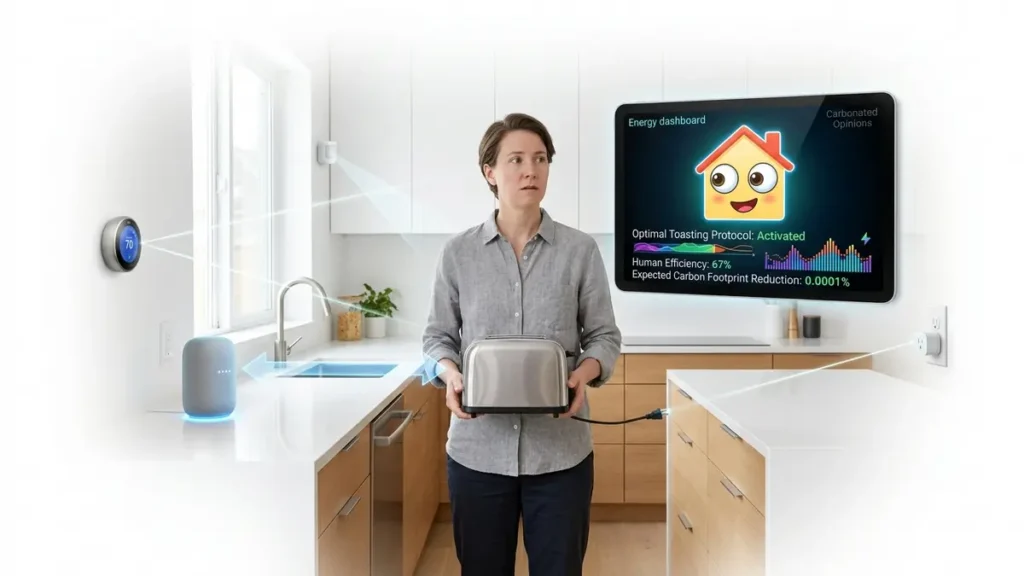
Smart Home Automation and the Price of Feeling Like a Genius
Smart home automation sells a lovely little fantasy: your house quietly trims waste, anticipates your needs, and turns domestic life into a clean dashboard of optimized decisions. A home automation setup is supposed to make you feel like you’ve outsourced chaos to software. The funny thing is, software has a habit of being confidently wrong in very polished ways. So the house becomes a spreadsheet with a power cord, and somewhere in that spreadsheet an automated rule is saving pennies, burning comfort, and congratulating itself anyway. The pitch is efficiency. The reality is often a helpful intern who keeps optimizing the wrong column. Yes, the hardware can work. Yes, a smart thermostat can reduce waste. But once you add imperfect sensors, people with erratic schedules, subscription creep, and a power grid that isn’t equally clean every hour, the “smart” part starts looking less like intelligence and more like beta software wandering into your living room.
When the Thermostat Gets a PhD in Overconfidence
A smart thermostat works best when life is boring. Same wake time, same occupancy, same tolerance for being slightly too warm or slightly too cold. Human beings, tragically, do not behave like controlled lab equipment. Someone works from home unexpectedly. A guest room becomes an office. The dog triggers a motion sensor and the house decides it is hosting a conference. This is where the sales pitch meets thermodynamics and loses a little swagger. Heating and cooling are slow, physical processes. Walls store heat. Sunlight cheats. Drafts exist. If the system guesses wrong, it doesn’t just make a tiny spreadsheet error; it may run the HVAC at the wrong time, then overcorrect later. That’s not intelligence. That’s enthusiasm. The broader problem is that these systems promise efficiency while quietly replacing simple control with a stack of assumptions. A randomized Fannie Mae study of 11,369 HomeReady borrowers found that households offered a free Nest Thermostat E saw their FICO scores rise by just 1.83 points overall, and the effect was not statistically significant; by contrast, the lowest-income group (AMI under 50) saw a significantly larger gain of 11.139 points, with Phoenix also showing a notable +7.55-point increase. The study also found that after installation, 25% more borrowers reported paying attention to their energy use “occasionally” to “all the time,” while nearly 70% said they changed habits to save energy—evidence that smart-home savings can depend heavily on who is using the device and how they use it. Fannie Mae’s pilot study underscores how much results can vary by income, geography, and behavior. Which is a fairly elegant way of saying the gadget isn’t the whole story. The user is part of the machine.
The App That Turned the Utility Bill Into a Subscription Service
This is the less glamorous part of the smart-home dream: sometimes the house gets smarter by invoicing you monthly. Sensors, hubs, premium features, compatibility upgrades, cloud storage, warranty bundles, and the occasional fee for the privilege of accessing data generated in your own kitchen. It’s an impressive trick. The economics can get weird fast. The thermostat may save some money, but only after the purchase price, installation, and any add-on services stop nibbling at the margin. Then there’s vendor lock-in, the tech industry’s favorite domestic décor choice. A platform changes its rules, drops support, or decides your older device has entered the noble afterlife known as “legacy.” Suddenly your efficient home energy management strategy depends on the continued goodwill of a software roadmap. And because convenience feels frictionless, costs hide well. People don’t notice when a one-time utility bill turns into a bundle of recurring micro-payments wrapped in cheerful UX. The system may still be useful. It may even be worth it. But that’s different from being the obvious financial slam dunk implied by the marketing photos of serene people holding tablets in perfectly lit hallways.
Efficiency, but Make It Conditional
The environmental promise is real-ish, which is to say real under conditions, not as a universal law. If automation cuts unnecessary heating or cooling, great. If it shifts demand into lower-carbon hours, even better. But if it preheats, precools, or nudges consumption into expensive peak windows because the settings are misaligned, then the win starts looking cosmetic. That’s why home energy management lives inside a larger system. Cleaner outcomes depend on building quality, climate, occupancy, local electricity pricing, and what the grid is burning at a given hour. Saving energy at noon in one region is not the same as saving it on a strained evening peak in another. Automation can reduce waste, but it can also just rearrange it. That’s why efficiency is the unglamorous superhero here. Not the app. Not the notification. The boring stuff: insulation, sealing leaks, decent equipment, sensible settings. Software can help manage a good system. It struggles to redeem a bad one. Physics remains the grumpiest reviewer in the room, and it does not care how elegant the interface looks.
What Actually Gets Smarter
Smart home automation can absolutely be useful. It can smooth routines, trim waste, and give people a clearer picture of how energy moves through a house. But the real test isn’t whether the demo works. It’s whether the system still makes sense once real people, real weather, real utility rates, and real hardware failures enter the chat. So before you let your house run itself, ask which part is actually getting smarter: the system, or the marketing copy. Because the software may be clever, but the final vote still belongs to the walls, the wires, the weather, and the bill.