
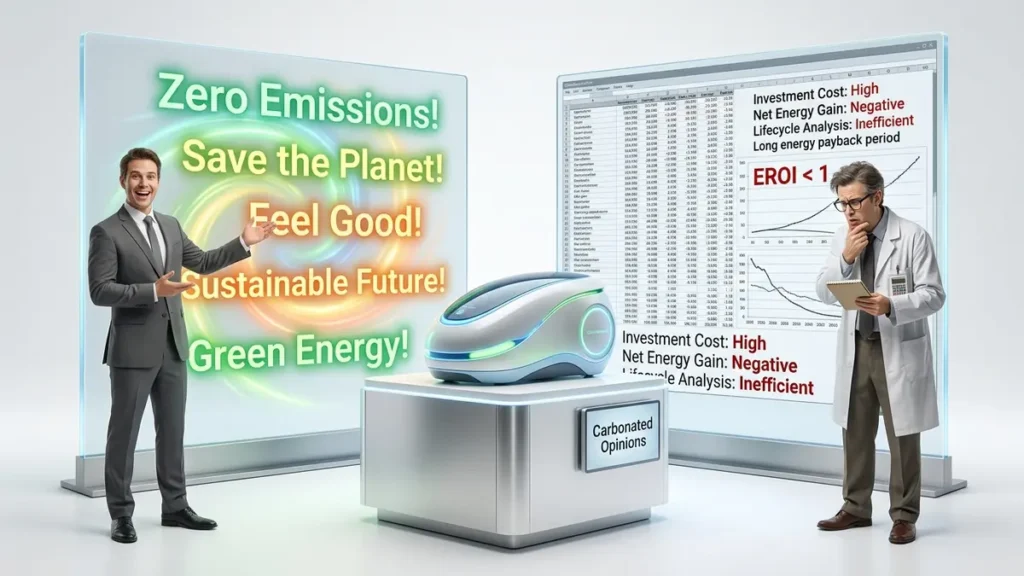
Greenwashing: When “Clean” Needs A Physics Inspection
“Zero emissions” “Up to 80% savings” Marketing loves big round numbers the way a magician loves a dark stage: fewer details to trip over. Physics, unfortunately, keeps the lights on.
If Greenwashing is the art of selling vibes, then climate tech is the place where vibes collide with ledgers: EROI (Energy Return on Investment), or energy payback time, and lifecycle emissions. Think of this as a watt-by-watt inspection—less “feel good,” more “show your work.” We’re not here to boo innovation; we’re here to make sure it survives arithmetic.
Physics Vs. Marketing: A Watt-By-Watt Reality Check
Start by translating claims into units that can’t be charmed.
“80% savings” compared to what baseline, over what duty cycle, in which climate, with what maintenance? Percentages are a haircut: impressive, but meaningless without knowing what you started with.
A cleaner way to interrogate the claim:
- Energy payback time: If a device took 1,000 kWh to make and saves 200 kWh/year, it’s “in the black” after 5 years—assuming it actually lasts.
- Avoided emissions per unit: Saving 200 kWh/year is not the same as avoiding 200 kWh/year of coal. Grid mix matters.
- EROI mindset: If the energy you invest to manufacture, transport, install, and power the thing is close to what it returns in savings, “green” becomes a paint color, not a property.
Physics vs. marketing is mostly a translation problem: marketing speaks in adjectives; physics speaks in denominators.
Materials And Embodied Costs: What’s Behind The Gloss
Every “clean” gadget arrives with invisible baggage: the energy used to mine, refine, manufacture, ship, and eventually replace it. Embodied energy is the upfront debit on the bank ledger. Operational savings are the credits. You don’t get to claim profit while you’re still paying interest.
Lifecycle thinking is where the shiny coating starts to look like a spreadsheet. A proper life-cycle assessment asks uncomfortable but normal questions:
- What materials are constrained, energy-intensive, or geopolitically awkward?
- How often does the product need replacement parts—or full replacement?
- Does performance degrade, turning your “80% savings” into “it was a great year, once”?
Think of it like building a house. Embodied energy is the cost of laying the foundation before you’ve even moved in. The promise of efficiency only pays off if you actually live there long enough to enjoy the savings. A product that wears out quickly but demands years to balance its energy debt is less an investment and more a mortgage you’ll never quite pay down.
The Irony Meter: When Saving Energy Costs Energy
The universe has a sense of humor, and it bills by the kilowatt-hour.
First: installation and overhead. The energy and emissions from installers’ travel, specialized equipment, retrofit waste, and packaging can be small—or surprisingly not. “Efficient” doesn’t mean “free.” It means “less per unit,” which still adds up when scaled.
Second: the rebound effect. Make something cheaper to run and people often run it more. The thermostat creeps up. The bigger screen “feels fine.” The efficient car becomes the excuse for the extra trip. Economics hugs efficiency and accidentally squeezes out some of the benefit.
Third: upstream emissions. A gadget that saves electricity is only as clean as the system making that electricity—and the system making the gadget. This is where greenwashing thrives: the claim focuses on the clean moment of use while quietly ignoring the messy prologue.
Irony, in climate tech, is often just accounting with stage lighting.
Take-Away
If a climate claim can’t survive a watt-by-watt audit, it’s PR dressed as engineering. Ask for four numbers: EROI mindset, energy payback time, lifecycle emissions, and avoided emissions per dollar (or per ton).
Treat embodied energy like a loan: you’re not “clean” at purchase—you’re clean after you’ve repaid the principal with real, measurable savings under real-world conditions. Innovation is welcome. Marketing is welcome to watch from the hallway, where it can’t touch the calculator.