
Corporate Sustainability Meets Brand Purpose—and Mayonnaise
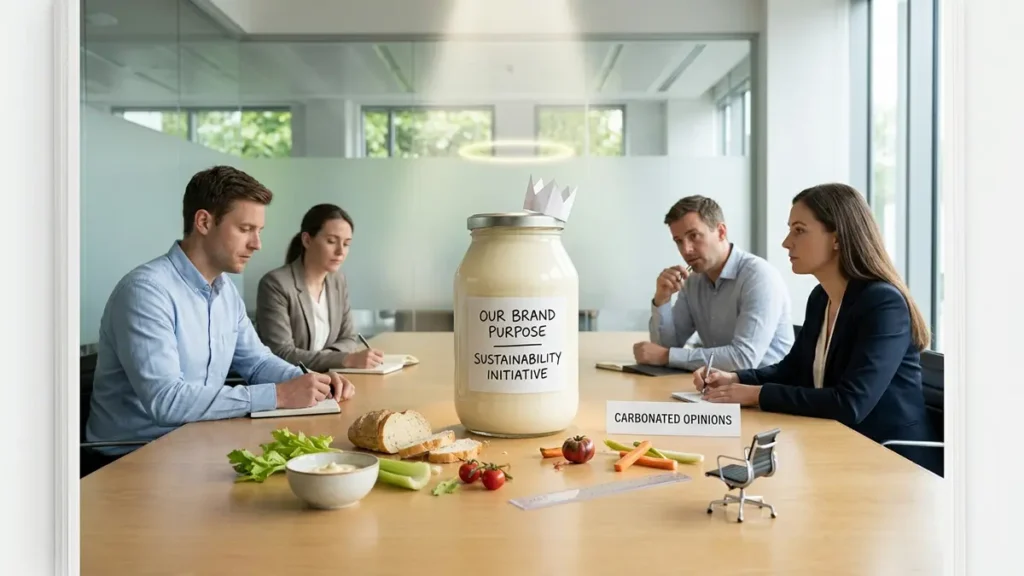
Corporate sustainability has given many familiar products a second career as moral philosophers. In 2018, Unilever, a global consumer-goods group decided every brand needed a “purpose”—which is how a mayonnaise label, established in 1913, found itself contemplating food waste with the seriousness of a senior manager updating a LinkedIn bio. The underlying issue was real: food waste is an environmental and household-cost problem wherever you live, even if the leftovers in question vary wildly from one kitchen to the next. The slightly comic question was whether a jar of mayonnaise needed a higher calling to encourage people to use them.
When Mayonnaise Found Its Calling
The brand’s campaigns, including “Turn Nothing Into Something”, “Cook Clever, Waste Less” and “Make Taste, Not Waste”, encouraged consumers to turn leftover ingredients into meals rather than send them to the bin. That is a perfectly sensible message. A condiment can make yesterday’s vegetables less depressing; humanity has survived on weaker interventions. But a food-waste campaign is not automatically a food-waste solution. The campaign’s stated aim was to inspire more resourceful home cooking, not to prove that every viewer changed behaviour or that household waste fell by a measurable amount. Those are different achievements, though marketing decks can make them sit very close together. This is where greenwashing becomes less a simple accusation than an awkward lighting problem. A legitimate environmental concern can be brightly illuminated while the evidence behind the claimed impact remains somewhere near the catering table.
The Shareholder Who Read the Mission Statement
Terry Smith, a major shareholder, was unimpressed by the corporate purpose programme. He called it “ludicrous” and asked why a brand that had existed since 1913 required someone to explain its purpose. His point was not that reducing food waste was foolish; it was that a familiar product did not necessarily become more valuable by acquiring a mission statement. Smith later objected to the use of “purpose” as an explanation for sales growth. He also criticised the purpose language attached to Lux soap. Those were his judgments, not independently settled findings, but they exposed a useful corporate-office habit: when a strategy performs well, every adjective in the strategy document suddenly wants a bonus.
Purpose Marketing Enters the Correlation Department
The central dispute was pleasingly unglamorous: causation. Sales can rise after a purpose campaign for all sorts of reasons—distribution, pricing, advertising reach, consumer tastes, post-pandemic routines, or simply better execution. A campaign may help. It may help a lot. But “after” is not a receipt for “because of.” Hellmann’s reported double-digit year-on-year sales growth for three consecutive years, but the figure does not by itself establish that its 2018 anti-food-waste purpose caused the increase; as the documented debate illustrates, the absence of a comparison group leaves the campaign’s measurable commercial and sustainability effects unresolved. Double-digit growth arrived at the scene; the control group apparently missed the invitation.
Double-Digit Growth, Single-Digit Certainty
The company kept its purpose strategy, and later growth was presented as evidence that the approach worked. Smith remained unconvinced, largely because the available comparison could not isolate the campaign from everything else happening around the brand. Both stories are plausible. A food-waste message may have made the product more relevant in kitchens where stretching ingredients matters. It may also have been one element among many, with no clean way to assign it a percentage of the applause. Markets are rarely laboratory experiments, however much a quarterly presentation may prefer them to be.
The Condiment With a Conscience
Purpose can be sincere, useful, commercially effective and theatrical at the same time. The useful test is not whether a brand has chosen a worthy issue. It is whether it can show what changed, how it measured that change, and how far its claim actually reaches. When a familiar product announces its higher calling, ask three questions: What changed, how was it measured, and what evidence separates cause from convenient coincidence? Corporate sustainability deserves more than cheerful kitchen imagery and a jar with unusually strong opinions about itself. Sometimes the greenwash is not a lie; it is a conclusion wearing better lighting than the data.