
Corporate Sustainability Is Easy When the Camera Is On
Corporate sustainability has become the awards-show acceptance speech of modern business: glossy, emotional, and oddly short on specifics once the music starts playing. Patagonia is the awkwardly prepared guest who arrived with receipts while much of the market brought a mood board, a leaf icon, and a pledge to “do better” sometime before the heat death of the universe. That doesn’t make every company a cartoon villain twirling a plastic straw. It does mean the performance deserves a closer look. Environmental responsibility is an operational discipline; greenwashing is what happens when the marketing department borrows its clothes.
Patagonia Brought Receipts to the Sustainability Potluck
Patagonia isn’t flawless, because no company that makes physical products gets to float above material costs, transport, energy, and waste. But it has made its values inconveniently visible: repair, reuse, resale, activism, and public scrutiny aren’t tucked into a cheerful footer below a 20% discount code. That distinction matters. A business can make environmental principles part of how it designs, sells, and accounts for products—or it can attach a leaf to a product page and hope nobody asks whether the leaf has a methodology. The first approach creates friction: longer-lasting goods may reduce replacement sales; repair programmes require actual infrastructure; public commitments invite public questions. The second creates a campaign. One is work. The other is an adjective wearing a lanyard.
The Corporate Green Fog Machine
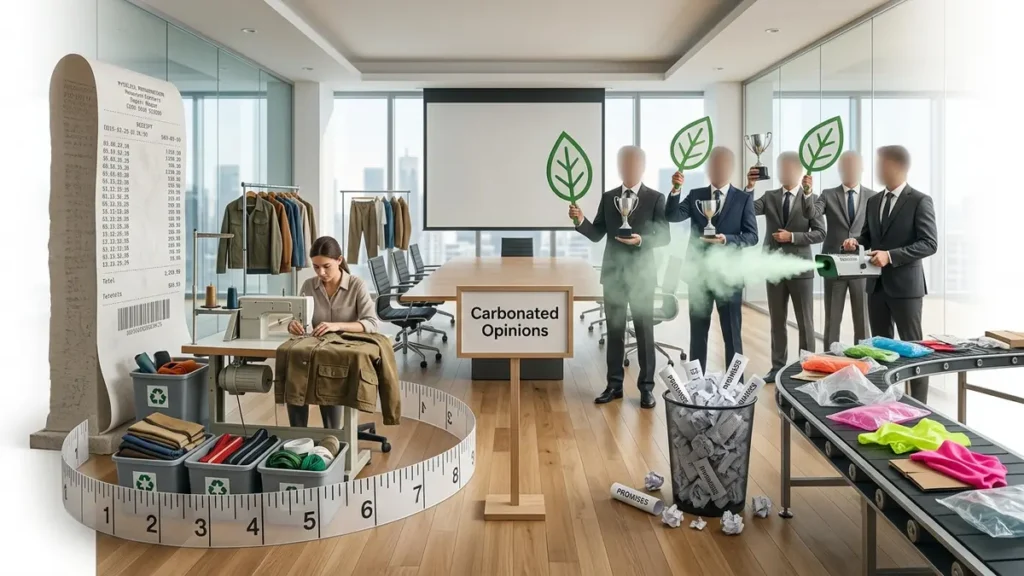
“Eco-conscious.” “Responsibly made.” “Better for the planet.” These phrases have the soft, forgiving edges of an advertising slogan designed by committee. They sound comforting precisely because they rarely tell us what changed, compared with what baseline, and at whose expense. The green leaf icon is now the universal symbol for “please ask no follow-up questions.” It functions like a diplomatic passport: handsome at the border, potentially useful, and not necessarily proof of good behaviour. The funny thing is, clarity isn’t a cruel request. If a product uses less water, say how much. If a supply chain has improved, explain where. If a claim covers only the packaging while the product remains disposable, perhaps don’t let the carton accept the trophy on everyone’s behalf.
Sustainable Fashion, Now With Convenient Fine Print
Sustainable fashion cannot be built solely from a limited-edition “conscious” collection released into a business model that depends on constant novelty and rapid disposal. If the production cycle still moves at the speed of a panic-buying trend, the olive-green label is doing some heroic emotional labour. Meaningful change looks less glamorous but travels better: durable construction, repairability, recycled inputs where they genuinely reduce impact, fewer wasted materials, and fewer products made merely to become clearance-bin archaeology. Packaging that appears to have completed a mindfulness retreat is not nothing, but it is also not the whole thing. A compostable mailer cannot redeem a system that treats clothes as short-term content. Who benefits from calling that sustainable? Usually the seller. Who pays when it isn’t? Usually the buyer, the waste system, and eventually everyone sharing the atmosphere.
The Annual Report’s Favorite Magic Trick
A distant environmental target is not an accomplishment because it has been printed in a handsome PDF. It’s a New Year’s resolution written by committee, complete with excellent typography and no requirement to attend the gym. Companies can make progress look enormous by selecting a convenient metric, a narrow part of the business, or a flattering starting year. None of that proves bad faith; it does prove why commitments need outcomes beside them. The gap between sustainability language and verifiable performance is measurable: a 2020 EU study found that 53% of environmental claims examined were vague, misleading, or unfounded, while 40% lacked supporting data entirely. The finding reinforces that corporate sustainability claims are most credible when they are tied to specific, measurable, and independently verifiable changes rather than aspirational wording alone. That’s not a demand for perfection. It’s a request to distinguish an achieved reduction from a beautifully staged intention.
If Everyone Is Sustainable, Nobody Has to Prove It
The practical test is pleasantly unfashionable. What changed? How is it measured? Who checks it? What trade-offs remain? And does the company explain those answers before a customer has to excavate three reports and a brand manifesto to find them? Patagonia’s advantage is not moral sainthood. It’s that its environmental positioning is attached to visible choices that can be examined, criticised, and improved. That’s what credibility looks like: not a perfect halo, but a record. The rest of the market may catch up. First, though, it will have to survive the radical ordeal of explaining what its claims actually mean. Before applauding the next planet-friendly campaign, ask the unfashionably practical question: What changed—and where is the receipt?