
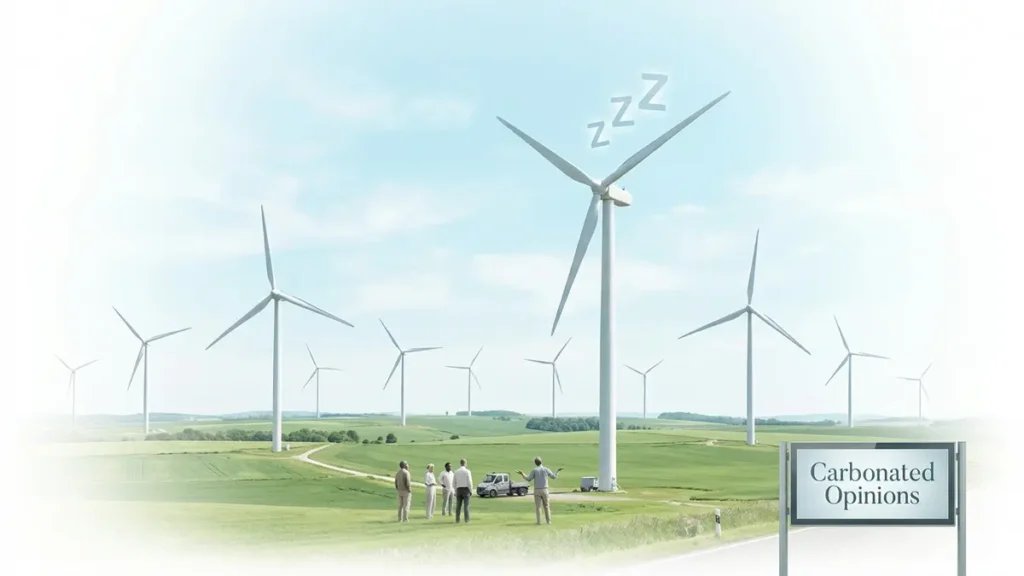
Wind Energy Intermittency: Why Turbines Take Unexpected Naps
Wind energy intermittency is the part of the sales pitch that arrives like a footnote, then moves into your guest room. The brochure shows a turbine’s nameplate megawatts—the “can do” number. Physics shows up with a clipboard and asks, “Cool. How often?” That second number is the capacity factor, and it’s the difference between a grid asset and a very tall outdoor ceiling fan with mood swings. Calm weather isn’t a public-relations hiccup. It’s a power-balance problem: the lights don’t dim politely just because the atmosphere decided to meditate.
Physics vs. Marketing: That Shiny Nameplate Isn’t a Promise
Marketing loves peak. Grid operators love averages. Take a 1,000 MW wind farm. That’s the nameplate: the “maximum, under ideal conditions” rating. The average output is roughly:Average power = Nameplate × Capacity factor.If capacity factor is 35% (a respectable ballpark), then:1,000 MW × 0.35 = 350 MW average.So the “1 GW” project behaves, on average, like a 0.35 GW project—with the added personality trait that it can be 900 MW at 3 a.m. and 40 MW at 6 p.m. when everyone’s cooking dinner. Physics isn’t being rude; it’s being literal. Wind has to exist at the right speed, at the right times, across enough of the rotor’s swept area, and then survive conversion losses and curtailment. Even before grid constraints, you’re negotiating with fluid dynamics and hard limits like the Betz law’s reminder that you can’t vacuum the sky clean.
The Suitcase Problem: Storing Calm Weather for a Rainy Day
Think of batteries as if they were suitcases. You can pack a lot into them, but when taking a flight, you pay per kilogram, you lose a little on every transfer, and at some point the overhead becomes the trip. Let’s do a back-of-envelope calculation for that 1 GW wind farm. Suppose you want to cover 24 hours of “wind took a nap” for a 1 GW output farm. Energy needed = 1 GW × 24 h = 24 GWh. And if you want 72 hours—a long weekend of atmospheric indifference: Energy needed = 1 GW × 72 h = 72 GWh. That’s the suitcase pile. But suitcases aren’t magic boxes; they’re toll roads. A decent grid battery might have ~85–90% round-trip efficiency. Translation: to get 24 GWh back out, you may need to stuff ~27–28 GWh in. Congratulations: your energy-saving device now requires overhead energy—like buying extra plane tickets for your luggage. Economics joins the conversation next. Grid-scale storage is improving, but “multiple days at gigawatt scale” is still expensive in dollars, minerals, land, and equipment. None of that makes storage bad. It makes storage a planned purchase, not a vibes-based accessory.
Grid Gymnastics: How Operators Smooth the Nap (and What It Really Costs)
A reliable grid isn’t a single resource—it’s choreography. When wind drops, operators don’t panic; they juggle. They call on flexible generation, import power through interconnections, use demand response, and sometimes curtail wind when there’s too much of it at the wrong time. It’s like a homeowner trying to keep the house comfortable by turning down one thermostat, turning up another, firing up a backup kettle, and asking everyone to “maybe not use the oven for the next hour.” This is where wind energy intermittency becomes a system cost, not just a turbine trait. To cover uncertainty, grids carry reserves—capacity that’s ready to ramp. Ramping isn’t free: part-loaded plants can be less efficient, and frequent cycling can increase wear and emissions per delivered kWh compared to steady operation. The irony is sharp: we burn extra energy and money to make our energy-saving portfolio behave like a grown-up. Interconnection helps because weather isn’t identical everywhere, but “not identical” isn’t “never correlated.” That’s why wind is classified as an intermittent power source—not a moral failing, just a statistical one.
Take-Away
Don’t demonize wind. It’s a strong low-carbon tool—when the atmosphere cooperates. The fix isn’t cynicism; it’s honest math: capacity factor expectations, storage sized for real calm spells, and grid reliability planning that prices the choreography. The punchline is simple: heroically marketed nameplates don’t keep the lights on. Physics does. Capacity factors do. And yes—sometimes the world’s tallest ceiling fans still take naps.