
Plastic Bag Ban: The Great Ban That Wasn’t
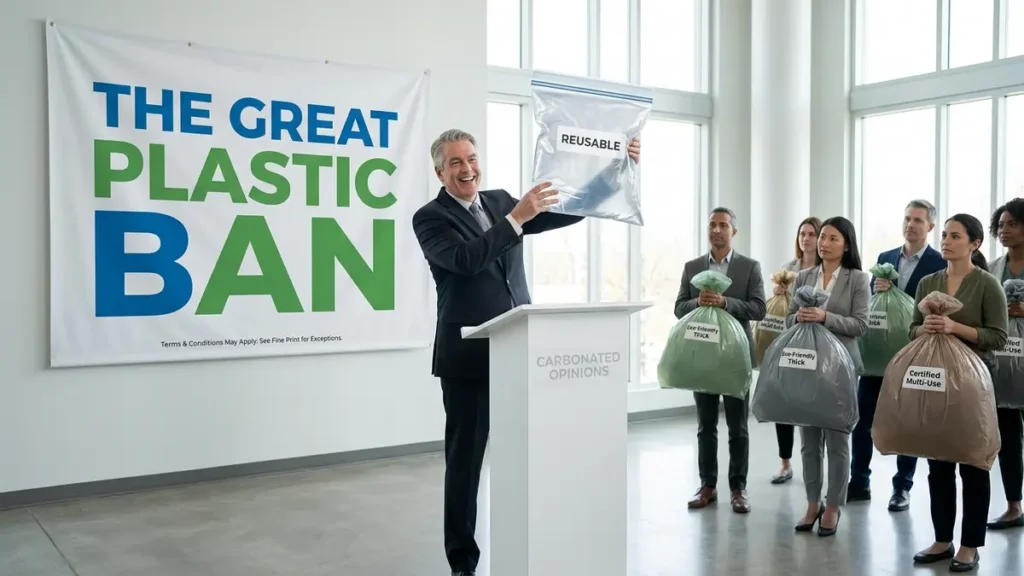
The plastic bag ban arrived like opening night on a well-funded stage: ribbon cut, cameras fed, a politician beaming into a reusable tote like it was a championship trophy. The applause said “history.” The policy text said “depends.” Somewhere between the photo-op and the footnotes, the ban quietly turned into a casting call for substitute plastics—bigger, thicker, and somehow still acting surprised to be here.
Opening Night: The Photo-Op That Passed for Policy
If legislation had a red carpet, this one used it. Everyone hit their marks: the tote bags (props), the microphones (spotlights), the solemn vow to end waste (monologue). The plastic bag ban was sold as a clean plot: villain exits, ocean applauds.
Then you open the script. The policy text is less “final act” and more “pilot episode.” Definitions get squishy. Exemptions wander in like understudies. “Bag” becomes a choose-your-own-adventure, and “single-use” starts meaning “single-use, unless we really want it to be two uses, in which case it’s practically a family heirloom.”
The contrast is the whole show: the photo-op is a simple moral tale; the statute is a dense program nobody reads until the set collapses. By the time the public sees it, the stage managers have already handed out tote bags while the stagehands quietly rewrite the script so the props can return for encore performances.
Rulebook Vs Reality: The Fine Print Fouls
Welcome to the match where the ref is hypnotized by halftime fireworks and misses the offside that lets plastics score.
On paper, the rulebook tries to bench the classic plastic bag. In practice, the loopholes sub in like fresh legs: thicker “reusable” bags that are technically not the banned kind, and alternative materials that sound wholesome until you meet them in a landfill. The crowd chants “ban!” while the scoreboard updates to “more plastic, but with better branding.”
It reads like plastic regulation written by a PR firm, and treats single-use plastics as a shape-shifting villain that can be excused with a thicker seam or a lovelier label.
Unintended consequence #1: the reusable bag boom. When the law defines virtue by microns of thickness, manufacturers don’t discover ethics—they discover a measuring tape. Thicker bags proliferate, used once, then tossed with a clearer conscience and a heavier bin.
Unintended consequence #2: the packaging shuffle. If checkout bags are the villain, businesses don’t stop moving goods—they just re-cast. More pre-bagging, more wrap, more secondary packaging: a shell game where the pea is always polymer.
It’s sports commentary politics: the announcers praise “tough defense,” but the replay shows the real action happened in the fine print.
The Afterparty: When Regulations Have Side Effects
After the confetti settles, regulation becomes a genre of theater all its own: enforcement theater.
Municipalities interpret the script differently—some go strict, some go soft, some punt to “guidance” that reads like a polite shrug. Inspectors get asked to be referees, mind-readers, and public relations staff at once. Consumers become unpaid compliance officers, holding up checkout lines to debate whether this bag is “allowed” or merely “emotionally reusable.”
Meanwhile, the waste stream doesn’t care about speeches. Plastic pollution doesn’t pause to applaud. If the policy nudges behavior but accidentally increases material use per bag, the environment gets a new problem wearing the old problem’s hat.
The weary punchline is that good intentions, when translated into brittle definitions, produce busywork and confusion—plus a fresh pile of “technically compliant” trash. We didn’t end the prop; we upgraded it.
Take-Away
The ban taught the predictable lesson: if policy is stagecraft, the props will always find a way back onstage. Real change needs rulemakers who read the script before opening night—and write it like they expect clever actors to improvise.
Read the fine print with your reusable tote—subscribe for the next episode of Policy Popcorn where we fact-check the applause.