
Battery Storage: Hope, Hype and Kilowatt-Hours
Battery storage is the climate-tech promise with the cleanest sales pitch: bank sunshine at noon, spend it at midnight, and never notice the difference. The brochure version is massive, cheap, long-lasting storage—quietly stapled to the assumption that physics, economics, and end-of-life logistics will politely step aside. They won’t. Not because batteries are fake (they’re very real—see Battery (electricity)). But because every “breakthrough” still has to pass a units-of-energy audit, a cost curve, and a lifecycle bill. And batteries, like all respectable accounting, are allergic to wishful rounding.
Physics Vs. PR: Where The Watt-Hours Hide
Marketing loves adjectives: “game-changing,” “ultra-dense,” “grid-ready.” Physics loves nouns: watt-hours, kilograms, percent losses, hours of duration. When the two argue, the watt-hour usually wins. Start with energy density. A battery is not a magical box; it’s a chemical arrangement that stores a finite amount of energy per mass and volume. So when someone implies you can scale today’s tech to cover not just tonight—but a cloudy week, or a calm winter—you can ask the rude question: “How many boxes, exactly?” Seasonal storage is where optimism goes to meet arithmetic. Then round-trip efficiency: you put energy in, you get less out. That loss is not a moral failing; it’s heat, resistance, side reactions—reality collecting a small toll on every cycle. For short-duration balancing, paying that toll can be worth it. For long-duration or seasonal storage, the toll compounds like a tiny tax applied to every plan that starts with “just store it.” Finally, power vs. energy. You can build a system that delivers a lot of power quickly (great for smoothing a spike) without storing much energy total (not great for a long outage). PR quietly swaps these concepts the way a recipe swaps “cups” and “gallons” and then acts surprised when dinner doesn’t fit in the pot. So yes: Energy storage is essential. But the claim you’re really buying should be stated in units: “X megawatt-hours for Y hours at Z efficiency, with A% capacity fade.” If the pitch can’t survive that translation, it wasn’t a pitch; it was performance art.
Suitcases, Recycling, And The True Price Tag
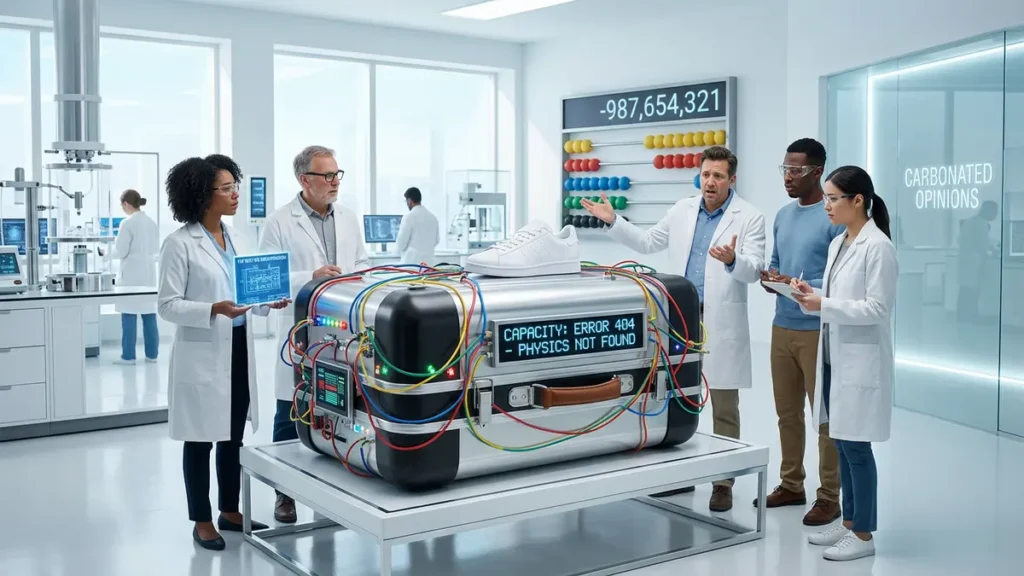
Think of batteries as suitcases for electrons. You care about (1) how much they hold, (2) how heavy they are, (3) how many trips they survive, and (4) what happens when the zipper dies. Cycle life is the suitcase warranty. A grid-scale battery that cycles daily is doing hard travel: pack, unpack, repeat. Over time, capacity fades—like a suitcase that still rolls but mysteriously fits fewer socks every month. That fade sets a replacement cadence, which is where “cheap storage” meets the ongoing subscription fee of chemistry. Now the hidden price tag: materials, processing, and recycling. Even if operating emissions are low, the embodied energy can be hefty—mining, refining, manufacturing, transport, then end-of-life handling. Here’s the irony boundary condition: installing an “energy-saving” gadget that takes so much energy to build and redo that it’s like buying a bigger fridge to hide the old one. Sometimes the suitcase costs more energy to sew than it saves on the trip. None of this means “don’t build batteries.” It means “price the whole suitcase,” including replacement and recycling energy, and compare it honestly to alternatives for that specific job—fast frequency response, short backup, daily shifting, or rare long-duration resilience.
Take-Away
Waiting for one mythical breakthrough battery is like waiting for a single shoe to fit every foot, every sport, every decade. Better: benchmark each storage use-case with a physics-and-economics checklist—duration, cycles, losses, materials, replacement cadence, and end-of-life. The future is a toolbox: different chemistries, different durations, and sometimes solutions that aren’t batteries at all.