
The Incandescent Light Bulb Ban: A Small Policy, a Long Afterglow
The incandescent light bulb ban had a curious effect in Europe: the familiar household bulb began disappearing, while remarkably familiar-looking bulbs survived under labels such as “special purpose.” If you’ve ever watched a rulebook get revised because somebody found an unexpectedly creative way to play, you know the feeling. The EU wanted less electricity spent making heat in people’s lamps. Some sellers, for a while, found that changing the description on the box was easier than changing what was inside it. The bulb was mundane. The question it raised—whether a policy governs a product or merely its name—wasn’t.
The Ban Arrives in Stages
The EU’s household incandescent phase-out began in 2009 and reached the remaining conventional household bulbs by 2012. It wasn’t a sudden raid on the cupboard under the stairs. Retailers and consumers had time to move toward energy-efficient lighting, while product standards pushed manufacturers away from a design that spends much of its electricity producing heat rather than useful light.
That’s the logic of ecodesign: change what can be sold, and the ordinary purchase gradually changes with it. It’s a powerful approach when buyers aren’t inclined to compare energy use every time a bulb fails. People generally want the room lit before dinner, not a seminar on watts.
But a product standard needs a boundary. Household lighting was the target; specialist applications weren’t necessarily playing the same game. Once the rule distinguished between them, someone had to decide which bulb belonged on which side. That sounds administrative. It’s also where the plot starts.
Same Filament, Different Costume
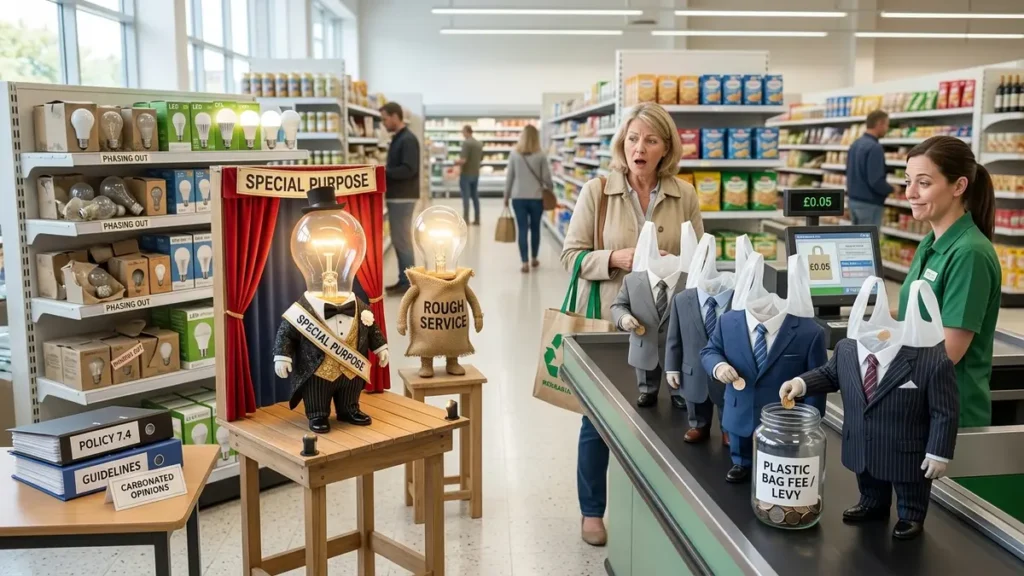
The weakness wasn’t that the efficiency case collapsed. It was that a rule written around categories gave similar bulbs a way to remain available under another category. Although the EU’s gradual phase-out began in 2009, exemptions for “special purpose” bulbs allowed retailers for a time to sell incandescent lamps labeled “rough service” for industrial use; a 2016 directive further classified those categories and closed the loophole, illustrating how label-based exceptions can delay a product rule’s effect.
There are legitimate reasons to exempt equipment built for unusual conditions. A workshop lamp and a bedside lamp needn’t meet identical requirements just because both screw into a socket. The trouble comes when the exception is easier to claim than to verify. Then the label becomes a costume change, not a change of character.
This is the unglamorous part of environmental politics: writing a definition narrow enough to permit genuine specialist uses and firm enough to prevent the household aisle from quietly relocating. Announcing a ban is the easy move. Maintaining its boundaries is where the rule earns its electricity.
The Bag Charge: A Nudge at the Checkout
The UK’s plastic bag charge takes a different route. Instead of trying to make every disposable plastic bag unavailable, it puts a price on taking one. The shopper can still have the bag. The retailer can still supply it. But that tiny automatic gesture at the checkout becomes a choice, even if it’s a choice made while holding a loaf of bread and looking for your keys.
A charge sidesteps some of the definitional drama of a ban. It doesn’t need to persuade anyone that a bag has become a specialist industrial bag after a quick meeting with the packaging department. It does, however, depend on the price being noticeable enough to affect habits. Too low, and it becomes a modest fee for doing exactly what people did before.
Neither tool is culturally or economically neutral. What feels like a trivial charge to one shopper may feel irritatingly real to another. Practical policy has to notice that without treating every inconvenience as a reason to abandon the effort.
When the Rule Becomes the Story
Bans and charges solve different problems. A ban says the product, as defined, shouldn’t be sold for a particular purpose. A charge says people may still use it, but its cost shouldn’t be invisible. Both can change behavior. Both can also produce excellent paperwork instead.
The bulb episode exposes the first risk: if an exemption is based largely on a stated purpose, sellers may discover purposes the rule’s authors didn’t quite have in mind. The bag charge exposes the second: if paying is painless, the checkout routine may survive intact, only now with a receipt proving it was priced.
So what should lawmakers target—the material, the intended use, or the behavior? There’s no single answer. A product standard can steer manufacturing toward better designs; a charge can interrupt a disposable habit without removing the option altogether. But each needs a reality check after it takes effect. Are people using less energy or fewer bags? Or have they simply learned the new rules well enough to carry on?
The Afterglow
A ban can clear one shelf and leave an almost identical product waiting on another, wearing a more respectable label. A charge can be less theatrical, though it still has to be high enough to register in ordinary life. Neither deserves applause just for surviving a press conference.
The useful measure is what happens after everyone has adjusted: what gets made, bought and used. Policy is rather like a board game in that respect. The printed rules matter, but so do the moves players discover once the game begins. When a policy targets a product, should lawmakers ban it, charge for it, or first make sure a new label won’t give it a second act?