
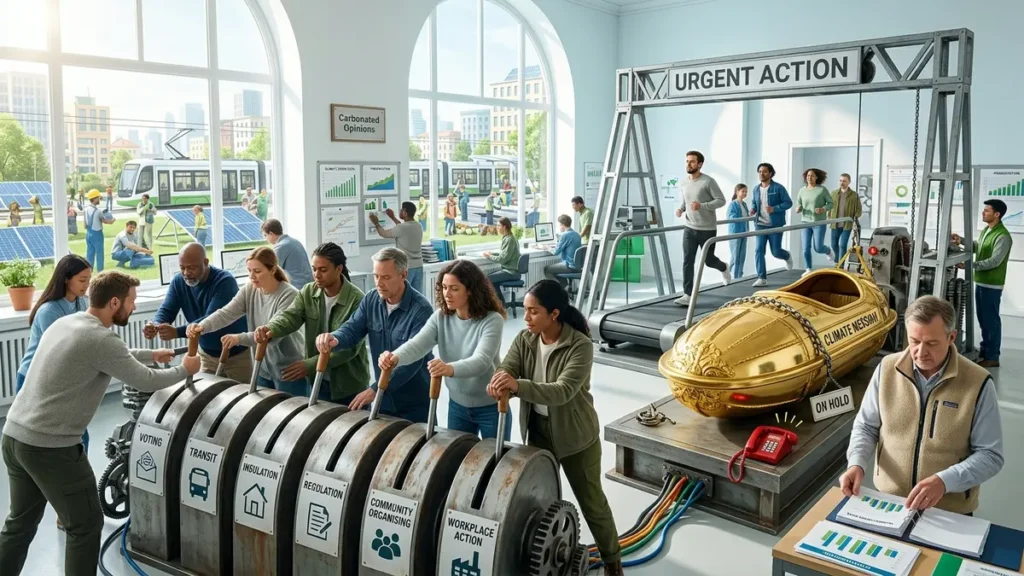
Climate Action Is Not a Spectator Sport
The comforting fantasy around climate action is that somebody, somewhere, is handling it. Government has a plan. A billionaire has a prototype. Corporations have hired enough people in beige fleeces to turn emissions into a tasteful slide deck. The experts, presumably, are in a windowless room preparing climate change to be solved between lunch and the next election.
Meanwhile, the rest of us treat the crisis like a customer-service ticket: submitted, escalating, and surely about to receive a reply. It won’t. Political attention spans are short, disasters are getting louder, and the mythical climate savior is still on hold, occasionally asking whether we’ve tried turning democracy off and on again.
The Great Rescue Fantasy
There are two equally soothing ways to avoid responsibility. One says powerful institutions must fix everything, so ordinary people may as well remain spectators with strong opinions and a reusable tote. The other says individual choices are pointless because the system is enormous, so everyone can carry on as if buying, voting, commuting, working, and demanding things have no political afterlife.
Convenient, isn’t it? One version lets citizens outsource their agency. The other lets institutions point at consumer behaviour whenever they’d rather not build cleaner transport, regulate pollution, or change the rules that make high-emissions choices feel normal.
Climate politics has become a group project where everyone waits for the one student with a printer, a grant, and a moral conscience. But systems don’t float above society on a little cloud. They respond to pressure, permission, votes, habits, and the sustained nuisance of people refusing to be managed into silence.
Everyone Wants a Villain, Nobody Wants a Receipt
The current trend is climate discourse as reality television: find a villain, freeze-frame their lifestyle, and let the audience vote on whether their water bottle is morally acceptable. Climate purity becomes an online game where the winner receives a medal made of recycled guilt and absolutely no policy influence.
Look, personal choices matter. But the culture-war obsession with private virtue is a remarkably efficient distraction from public failure. It’s easier to sneer at somebody’s flight, car, dinner, or heating bill than to ask why safe public transit is patchy, why homes are expensive to retrofit, or why elected officials can make grand promises without supplying a route map.
That’s the receipt nobody wants to examine. Climate change solutions require infrastructure, regulation, investment, and political consequences. They also require people willing to make those demands inconveniently hard to ignore. A fight over the morally pure water bottle is cheaper than a functioning transit system. It is also, rather suspiciously, much easier for the people with power to survive.
No Savior, Just Leverage
The personal-responsibility-versus-systemic-change argument is a treadmill labelled “URGENT ACTION,” powered by people yelling about who gets to press the button. Both sides are partly right; neither gets to use that fact as an excuse to clock out.
Effective action needs institutions to change the machinery and the public to keep its hands on the controls. The IPCC’s mitigation findings show that climate action is neither solely a matter of personal consumption nor something institutions can postpone: options exist across every sector to at least halve emissions by 2030, while lifestyle changes require systemic shifts across society and effective mitigation demands coordination between government and the public. The report also notes that zero-emissions targets have been adopted by at least 826 cities and 103 regions, underscoring how organized public participation can reinforce, rather than replace, structural change.
That’s leverage, not sainthood: votes, local campaigns, unions, neighbourhood fights, workplace demands, and attention that doesn’t evaporate after the applause. Climate change mitigation is not a solo performance. It’s a crowd refusing to leave the theatre until the set gets rebuilt.
Stop Waiting for the Climate Messiah
Nobody is coming to save us in one clean, cinematic reveal. That doesn’t mean every person must personally reverse a planetary crisis before breakfast. It means the perfect hero is a useful fiction for a broken system, because waiting is the system’s favourite renewable resource.
Forget purity. Find the pressure point: your community, workplace, ballot, or timeline. Then push—organized, persistent, gloriously inconveniently. The point isn’t to become the savior. It’s to make inaction too costly for everyone pretending they are.