
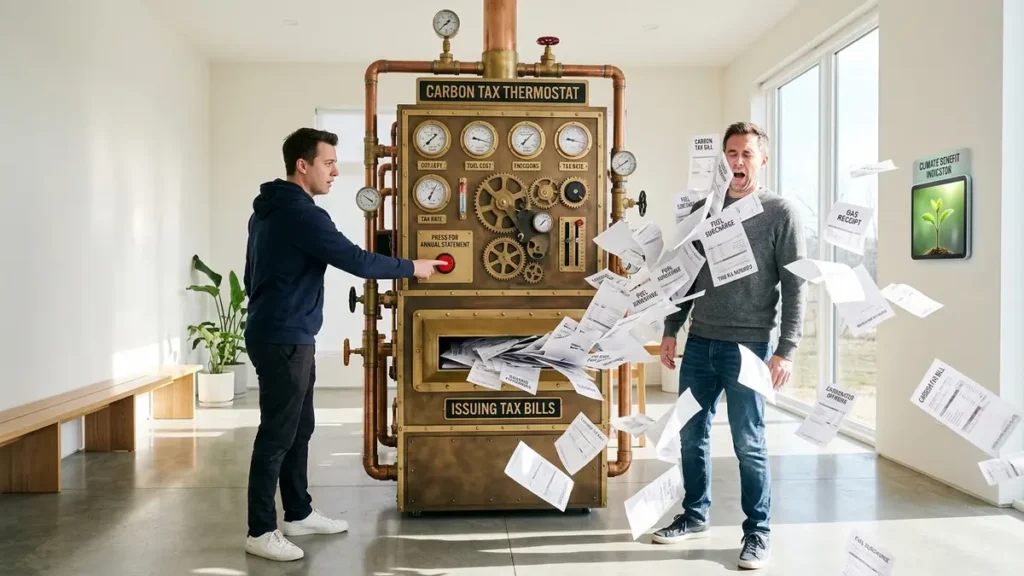
Why Carbon Tax Policy Keeps Getting the Last Word
Carbon tax fights have a way of exposing what countries think government is for. Some treat carbon tax as basic civic plumbing: if pollution causes damage, you put a price on it and move on. Others behave as if emissions pricing is an exotic surcharge dreamt up by people who’ve never seen a heating bill. The funny thing is, the policy itself isn’t especially mysterious. It’s the politics around the thermostat that send everyone lunging for the exits.
The Price of Pollution, Apparently
At the policy level, a carbon tax is almost suspiciously tidy. Pollution creates costs that don’t show up on the original receipt, so the state adds them back in. Suddenly the cheap option looks a little less cheap. Markets, being markets, then do what they always do: complain theatrically and adapt selectively. That’s the sales pitch anyway. Make fossil-heavy choices more expensive, nudge cleaner ones into the mainstream, and recycle the revenue so households don’t feel like they’ve been mugged by a spreadsheet. Some governments cut other taxes. Some send rebates. Some fund transit, insulation, or industrial upgrades. Others pair a tax with emissions trading, because if one pricing tool starts an argument, two might as well turn it into a full matinee. In plain terms, it’s the landlord finally charging the couch for rent after years of pretending the living room occupied itself.
When Politics Meets the Thermostat
Here’s where the clean logic walks straight into dirty democracy. Countries part ways on carbon taxes less over climate science than over who eats the cost, when they feel it, and how publicly they object. And they object quite publicly. A carbon tax lands in the most emotionally loaded corners of daily life: fuel, heating, electricity, transport, groceries after transport. Voters don’t experience it as an elegant correction to a market failure. They experience it while standing at a pump, staring at a bill, or listening to an opposition politician explain that this is all proof the ruling party hates normal people. An Analysis of Washington state’s first state-level carbon tax initiative, I-732, lost with 40.8% support in 2016, and a revised version in 2018 still failed at 43.4%—a concrete reminder that the debate often turns less on climate science than on how the policy is framed and who it is seen to burden. In the same analysis, the author notes that ideology was the strongest predictor of vote choice, while pocketbook concerns alone explained little of the difference, suggesting that carbon-tax politics are as much about distribution and political messaging as about emissions math. Timing is brutal. The climate payoff is gradual, statistical, and collective. The political pain is immediate, local, and available for television before dinner. If energy prices are already high, trust in government is weak, or compensation is badly explained, the whole thing becomes a national group scene built around one line: why am I paying first? Climate policy, in other words, is the thermostat everyone wants adjusted, but nobody wants to stand near when the room starts shouting.
Different Kitchens, Different Recipes
And this is the part that gets flattened in the usual debate. Countries aren’t choosing from one neat menu. They’re cooking with different pantries, different appliances, and wildly different tolerance for smoke. A country powered heavily by coal, with energy-intensive industry and thin social protections, sees more political risk in carbon taxes than a country with cleaner electricity, stronger welfare systems, and a public that believes rebates will actually arrive. If you rely on heavy manufacturing, long driving distances, or cheap fuel as part of the social contract, raising carbon costs feels less like reform and more like picking a fight with your own foundation. Administrative capacity matters too. A government that can measure emissions, collect revenue, and compensate households quickly has a better shot than one that can barely process the paperwork without creating a fresh scandal. Then there’s political culture: some states tolerate tax-based nudges; others hear the word tax and reach for the constitutional holy water. So no, not every country reaches for the same spoon. Some prefer subsidies, regulations, fuel standards, industrial mandates, or vague speeches about innovation delivered with ceremonial sincerity.
The Bill That Shows Up First
We’ve seen this movie often enough to know the plot twist isn’t scientific confusion. It’s political sequencing. The climate bill arrives later. The political bill arrives now, itemized, highlighted, and waved around at a press conference. That’s why some countries adopt carbon taxes and keep them, while others retreat, rebrand, or never try. Not because the math failed, but because the coalition did. If you want to understand the split, follow the money trail before the outrage trail takes over. That’s usually where the real script is hiding.