
Does Turning Off Lights Actually Matter?
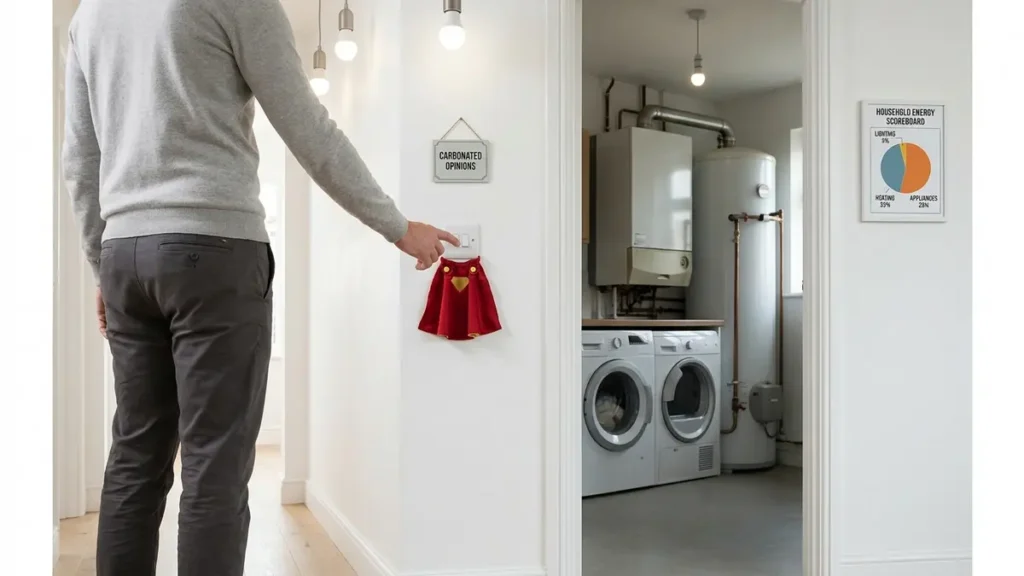
Few household rituals carry quite the moral weight of turning off lights. Someone leaves an empty room, reaches back for the switch, and briefly feels as though they’ve negotiated peace with the atmosphere. The instinct is sound: turning off lights reduces electricity consumption. But the size of that saving depends on the bulb, the hours involved and what else is quietly drawing power around the house. A light switch is a useful supporting actor, not the superhero of household emissions.
The Small Switch With a Surprisingly Modest Cape
An unused light consumes electricity for no useful purpose. The empty room isn’t enjoying the ambience, conducting research or even paying rent. So yes, switch it off.
The intuition trap is assuming every forgotten lamp is a miniature climate emergency. A modern LED left on for five minutes is a tiny waste; an old incandescent glowing for several hours is a more noticeable one. Neither deserves melodrama, but both follow the same arithmetic: watts multiplied by time equals energy used.
One lapse won’t transform the electricity bill into a Victorian tragedy. Repeated habits, though, are where small actions become real ones. Lights left on overnight, rooms illuminated all day out of inertia, and several fittings doing it at once can create a steady trickle of avoidable demand. Household energy use is rather like kitchen clutter: one mug is nothing; somehow, by Friday, the counter has disappeared.
LED Bulbs: Efficient, Not Magical
Light-emitting diodes changed the calculation dramatically. LEDs generally use far less electricity than incandescent or halogen bulbs to produce similar light, and they tend to last longer. Replacing older bulbs is often a bigger win than policing every brief trip to the kettle.
That efficiency has produced a slightly peculiar counter-myth: LEDs use so little power that leaving them on simply doesn’t matter. Efficient, yes. Magical, no. An LED still uses energy whenever it is lit, and a light that is unnecessary for hours remains unnecessary however impressive its specification sheet may be.
The scale matters. Turning off an LED while popping into another room may save very little, especially if you’ll return almost immediately. Turning it off when leaving for work, going to bed or abandoning a rarely used space for the afternoon is plainly sensible. The aim isn’t to make domestic life feel like an energy audit with cushions. It’s to avoid paying for light nobody needs.
The U.S. Department of Energy estimates that LED adoption saved 1.3 quadrillion Btu of energy in 2018—about 5% of total building electricity use—and reduced consumer costs by $14.7 billion, demonstrating that lighting efficiency and avoided operating time can produce meaningful savings at scale; the report also notes that the greatest potential is in commercial and industrial fixtures with high light output and long operating hours.
Where the Bigger Energy Savings Are Hiding
Here’s the missing perspective: lighting is only one line on the household energy ledger. Heating, air conditioning, hot water, clothes drying, cooking and older appliances often consume much more energy than a collection of efficient bulbs. In many homes, the thermostat is doing the heavy lifting while the light switch receives all the moral applause.
That doesn’t make lighting irrelevant. It makes it part of a hierarchy. Use LEDs. Turn lights off when rooms will be empty for a while. Make good use of daylight. Then give equal—or preferably greater—attention to draughts, heating settings, hot-water use and appliances that run for long periods.
This is the practical spirit of energy conservation: not heroic gestures performed under interrogation, but a clear view of where energy actually goes. The most satisfying environmental habit is the one that survives contact with ordinary life.
A Sensible Switch, Not a Solo Rescue Mission
Turning off lights matters most when the light would otherwise stay on for hours, when the bulb is inefficient, or when the habit is repeated across a household. It’s worthwhile housekeeping, and it costs almost nothing to do.
Just don’t ask it to carry the entire climate conversation on its little plastic shoulders. Before leaving a room, make the small switch. Then look around for the heater, cooling system or appliance quietly consuming far more energy—and give that one your next myth-busting moment.