
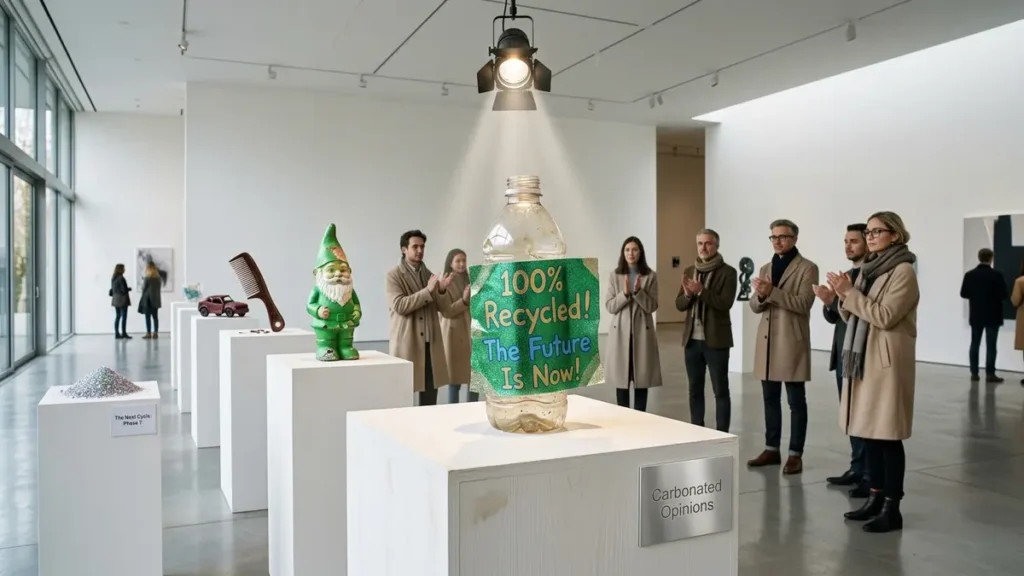
Recycled Plastic: The Eco-Upgrade That Sometimes Skips the Upgrade
Recycled plastic has become the makeover reel of sustainable packaging: new lighting, softer music, a greener label, and suddenly everyone’s acting like the old problems have left town. The funny thing is, plastic recycling often improves the optics faster than it improves the system. Yes, using recycled content can be better than making more virgin plastic. No, that doesn’t magically turn a deeply messy material stream into a tidy environmental redemption arc. Sometimes it’s less of a transformation and more of a professional rebrand.
The Green Label’s Favorite Costume
In corporate sustainability, recycled content has terrific headshot energy. Put “made with recycled plastic” on packaging and the product instantly looks like it’s been to media training. Never mind that the underlying process may involve mixed feedstocks, contamination, intensive sorting, and enough caveats to make a legal team feel alive.
That’s the part worth translating. “Recycled” can mean post-consumer waste, or it can mean factory scraps that never reached a customer in the first place. It can refer to a small percentage of content while the rest remains conventional plastic. And depending on the resin, converting old material into usable new packaging may still demand significant energy, water, and transport.
A tuxedo, in other words, on a deeply complicated process. Better dressed, certainly. Morally simplified, not so much.
Recycling: A Very Polite Game of Telephone
Here’s the missing context: plastic usually doesn’t recycle like glass or metal fans imagine it does. In many cases, each round of processing degrades quality. Polymers break down, contamination creeps in, color options narrow, and the material becomes harder to turn back into the same thing again. So the dreamy vision of endless circular rebirth often looks more like gradual career downsizing.
That’s why plastic recycling often leads to downcycling, where a bottle becomes a lower-value item rather than another bottle, and then eventually reaches the end of the line anyway. The circular economy pitch sounds elegant because, frankly, it is elegant. Reality is more like an office plant getting praised for surviving while still sitting in a plastic pot under bad fluorescent lighting.
Recycled plastic can still be useful. It’s just not infinitely renewable because someone printed a green leaf on the label. Even recycled plastic has limits, and pretending otherwise is how people end up selling a paragraph instead of a system.
The Part They Don’t Put on the Packaging
Now for the numbers perspective nobody puts in the hero shot. A package can “contain recycled content” and still belong to a waste-heavy, emission-heavy system. The material has to be collected, sorted correctly, cleaned, processed, and shipped. If local infrastructure is weak, or the packaging is multi-layered, dark-colored, or otherwise hard to sort, the sustainability story starts losing its makeup in daylight. Here’s the number nobody puts in the hero shot. According to the OECD’s Global Plastics Outlook, only 9 percent of plastic waste worldwide actually gets recycled once you account for everything lost along the way. Even the plastic that does get collected for recycling loses 40 percent of itself to processing residue before it becomes anything at all. Recycled content, meanwhile, still makes up just 6 percent of total plastic production globally. The green leaf on the label is doing a lot of work for a single-digit percentage.
And then there’s the comparison trick. “Better than virgin plastic” is a meaningful claim. But it isn’t the same claim as “sustainable,” “circular,” or “problem solved.” Those are very different trophies, though they’re often displayed on the same shelf.
So yes, recycled plastic may reduce impact in the right context. But context is doing an awful lot of lifting here.
Before You Applaud the Label
The sensible position isn’t to sneer at recycled plastic or pretend it has no role in sustainable packaging. It does. The issue is the performance gap between incremental improvement and full environmental absolution. Brands love that gap. It’s roomy, flattering, and forgiving.
So before you applaud the label, ask what happened before the label got its spotlight: what kind of plastic, what percentage is actually recycled, how repeatable the process is, and whether the system around it works at all. Recycled plastic may be better than virgin plastic. But “better” isn’t the same thing as “done.” Polite applause is fine. A standing ovation feels premature.