
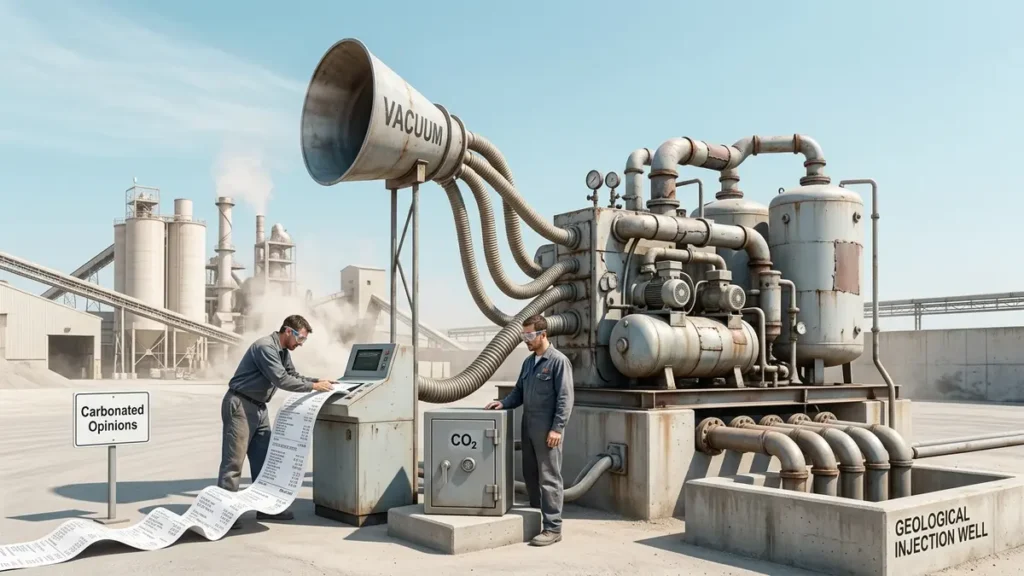
Carbon Capture: Technology, Trade-Off, or Very Expensive Air Filter?
Carbon capture isn’t magic, but it isn’t nonsense either. It’s a laundry service for molecules: separate CO₂, concentrate it, move it somewhere, then make sure it stays put for a very long time. Every tonne collected arrives with an invoice for energy, equipment, pipelines, monitoring and storage. The real question isn’t whether carbon capture technology can work. It plainly can. It’s whether it can reduce emissions at useful scale without becoming an elaborate way for industrial ambition to sound environmentally articulate.
The Physics Department Has Entered the Chat
Carbon capture and storage begins with separation. At a cement kiln, steel plant or chemical facility, CO₂ is relatively concentrated in an exhaust stream. You still need solvents, heat, compressors and rather a lot of plumbing, but at least the molecule has had the decency to gather in one place.
Direct air capture is harder. Atmospheric CO₂ is dilute, so extracting it is less like vacuuming a workshop floor and more like picking one grain of sand from a beach—repeatedly, at industrial scale. That doesn’t make direct air capture pointless; it makes energy efficiency and cheap clean power non-negotiable.
Then comes the unphotogenic part: compression, transport and storage. CO₂ must be injected into suitable geological formations and monitored so it remains there. The planet is a closed system with strict budgets. Moving carbon from the sky into a rock formation can help; moving it briefly into a press release cannot.
The Energy Bill Arrives Wearing Safety Goggles
Capture equipment uses energy, often a great deal of it. If that energy comes from high-emitting sources, the machine can spend its working day cleaning one mess while quietly helping create another. Lifecycle analysis is the technology’s receipt: it records the electricity, heat, materials, transport, leakage risk and eventual fate of the CO₂, rather than accepting the headline capture rate as a character reference.
Scaling also means building infrastructure before the climate benefit appears: clean generation, transmission, capture units, pipelines or ships, injection wells, verification systems and trained operators. A pilot can tuck most of that complexity behind a tidy ribbon-cutting photo. Deployment cannot. The geological store is effectively a long-term security deposit, and someone needs to keep checking that it hasn’t wandered off for centuries.
That’s why cost curves matter, but physical limits matter first. Cheaper equipment is welcome. It cannot repeal thermodynamics, conjure low-carbon heat, or make a poorly chosen storage site emotionally reliable.
Useful Tool or Corporate Permission Slip?
The sensible case for carbon capture sits in sectors where emissions are genuinely difficult to avoid, particularly processes such as cement production, where CO₂ comes not only from fuel but from chemistry. There, capture may be one of the few practical routes to deep reductions while cleaner processes mature.
A 2025 techno-economic analysis found that carbon capture and storage is especially relevant to cement, where it could deliver emissions reductions at an estimated €50–150 per tonne of CO₂ if large-scale infrastructure is available, while capture-based steelmaking reduced only about 60% of emissions relative to a fossil baseline and required additional carbon removal to address the remainder. These findings support using carbon capture selectively in hard-to-decarbonize industries, while treating it as a supplement to—not a substitute for—direct emissions reductions and broader system changes, as the study’s sector-specific analysis shows that costs and effectiveness vary substantially by application.
That distinction is the whole game. A credible project should show additional emissions cuts, low-carbon energy, robust monitoring and durable storage. It should also answer the awkward question: could the emissions have been avoided more cheaply in the first place? If yes, capture starts to resemble a corporate permission slip—very sophisticated stationery, admittedly, but still stationery.
Carbon capture can earn a place in the toolkit, especially where alternatives are thin. It just shouldn’t audition as the replacement for cutting emissions at source. Bring the energy budget, the lifecycle receipt and the storage plan. The elegance of the machine is interesting; the honesty of its accounting is what the atmosphere notices.