
Ocean-Bound Plastic: What’s in the Promise?
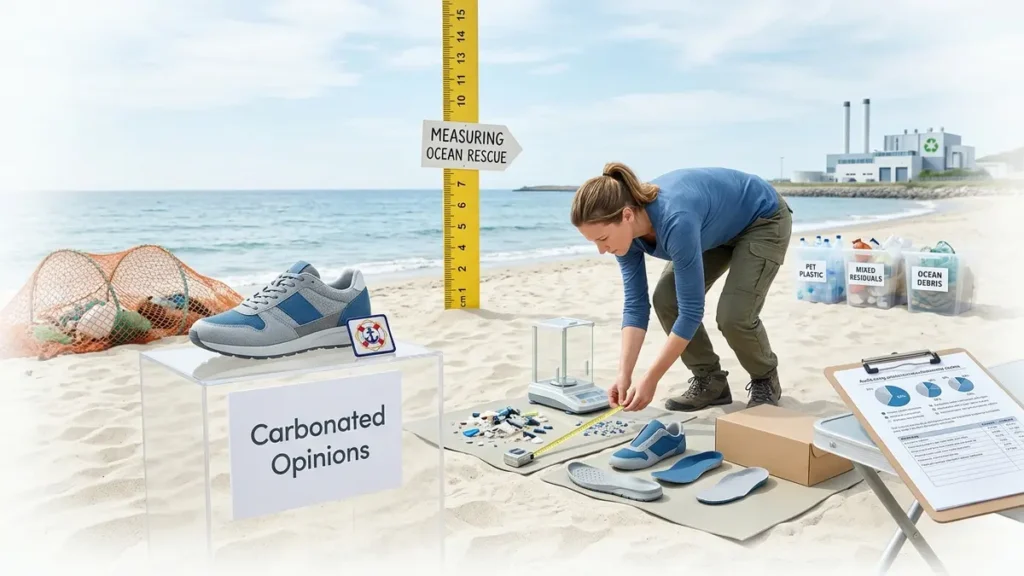
A pair of trainers made from ocean-bound plastic comes with a tiny rescue badge built into the label. Buy the shoes, picture a cleaner shoreline, enjoy your walk. It’s an appealing story, especially when plastic pollution is so visible that nobody needs help imagining the problem. But a good product description can do a lot of work with very little information. “Ocean-bound” tells you where the story is headed, not necessarily where the material was found. And “made from” leaves plenty of room between a small component and most of the product. Before granting the trainers a starring role in an environmental turnaround, it’s worth asking what the label actually accounts for.
“Ocean-Bound” Is a Direction, Not a Definition
The first question is less glamorous than the sea imagery: what does the seller mean by ocean-bound? Plastic collected near a coast might qualify under one scheme; another might draw the boundary differently. Distance matters, but so does the likelihood that the material would have reached the water. A map pin alone can’t tell you that. The label also needs to carry more than its own confidence. A November 2024 report commissioned by Fauna & Flora found that ocean-bound plastic has no widely accepted definition; it also found no standardized method for quantifying how much plastic is collected or processed, while existing plastic-credit standards do not credit reductions in plastic production. These findings underscore why an “ocean-bound plastic” label alone does not establish the material’s precise origin, the amount used in a product, or whether it replaces newly made plastic. That doesn’t make every collection effort worthless. It does mean the definition belongs beside the promise, not backstage with the paperwork.
How Much Plastic Gets the Hero Treatment?
Next comes the arithmetic that marketing copy tends to leave out of the trailer. How much plastic was collected? How much was processed into usable material? And what share of this particular trainer or bottle does it represent? Those are different numbers, even if an ocean photograph makes them feel like one accomplishment. A product can contain recycled material without being mostly recycled. Its upper, sole, lining and packaging may tell different stories. For a bottle, the body and cap may, too. That’s why a recycled-content percentage is more useful than a sweeping “made from” claim, provided the seller makes clear what the percentage covers. Traceable sourcing matters as well. Can the seller explain the collection location, the route through processing and how the finished material was accounted for? Plastic recycling involves steps between picking something up and putting it into a new product. Nobody needs a documentary about every bottle. A credible material claim should, however, survive a request for quantities.
A Second Life—or a Pass for Making More?
Here’s the question the rescue badge can’t answer on its own: did this material replace newly made plastic, or did it become an attractive feature on a product that still uses plenty of it? Collection and recycling can be useful without automatically shrinking demand for virgin material. The distinction is important precisely because the original effort may be real. Imagine a trainer with a recycled-plastic component and several newly made plastic components. The recycled part deserves an accurate description. It doesn’t turn the whole shoe into evidence that less new plastic was produced. To judge the broader claim, we’d need to know what material would otherwise have been used, whether the recycled share is replacing it and whether overall use of new plastic is changing. That’s not an impossible standard designed to ruin anyone’s shopping trip. It’s the difference between reporting a material choice and letting that choice imply a result the numbers haven’t shown. The label is an advertisement; the reduction, if there is one, needs its own accounting.
Keep the Badge, Ask for the Report
“Ocean-bound plastic” may describe a meaningful choice. It may point to material that was collected and given another use. But the phrase alone can’t show how close that plastic came to the ocean, how much reached the product or what happened to demand for new plastic afterward. So next time a trainer or bottle offers you an ocean-bound origin story, ask for the definition, the quantities and the new-plastic math. A neat rescue badge is charming. The route, the numbers and what changed at the factory would be better.