
Textile Recycling: The Clothes We Throw Away Don’t Magically Become Something Useful
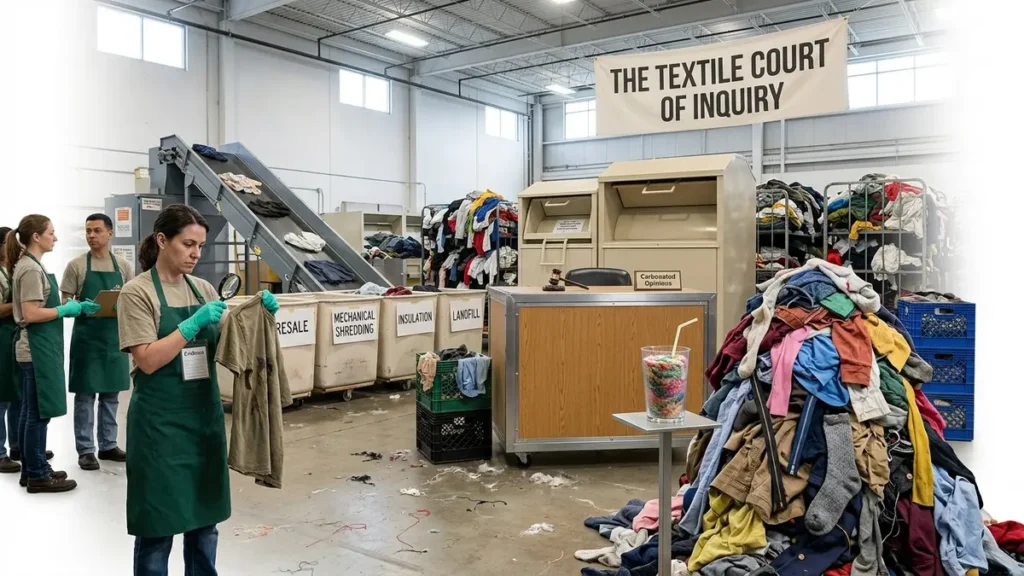
Textile recycling is sold as a pleasing little fantasy: toss in the tired shirt, receive moral clearance, somewhere a fresh sweater is born. Cute. In reality, that bin is more like a tiny green courtroom, and every garment has to account for its fiber content, dye history, zipper situation, mystery stains, and past crimes. Recycling textiles exists, and it matters. But the route from closet castoff to useful material is crowded with sorting failures, cheap fabric, mixed fibers, and markets that don’t particularly want the result.
The Donation Bin Is Not a Portal to Textile Heaven
A donation bin is an airport, not a guarantee of a return flight. Clothes leave your home, then enter a sorting system where some can be resold, some get turned into lower-grade materials, some are exported, and some are simply trashed. “Donated” means collected. It does not mean wanted, wearable, recycled, or whisked toward a noble second life.
The scale is the awkward part. Fast fashion has trained us to treat a shirt like a temporary mood rather than an object made from land, water, energy, chemicals, and somebody’s labor. Sorting operations can’t wave a wand over mountains of low-value garments. They have to identify what is usable, what is contaminated, and what is too damaged or too unfashionable to move. The bin isn’t a moral laundromat; it’s the first stop in a very selective triage line.
Cotton, Polyester, and the Unholy Fiber Smoothie
To us, a shirt is one thing. To a recycler, it may be cotton blended with polyester and elastane, coated with finishes, dyed several colors, and decorated with thread, labels, buttons, prints, and a zipper that refuses to participate. Congratulations: a fiber smoothie nobody ordered.
That construction is terrific for stretch, softness, durability, or whatever the hangtag was trying to seduce you with. It’s dreadful for separating materials afterward. A garment designed for rapid cutting and cheap assembly is rarely designed for disassembly. Even clean, unworn clothing can be difficult to process if nobody can efficiently tell what it is made of or pull its parts apart.
This is where “recyclable” starts behaving like a dating-profile adjective: technically possible under ideal circumstances, wildly misleading in practice. Better design—fewer fiber blends, removable trims, clearer labels—would make textile recycling less of a forensic exercise. But that requires the system to value an afterlife when it makes the garment’s first life.
Mechanical Recycling: Turning Old Clothes Into New-ish Stuff
Mechanical recycling does the blunt physical work: textiles are sorted, shredded, and pulled back into fibers. It’s a real recovery route, not green fairy dust. Yet shredding has consequences. Fibers get shorter and weaker, which limits what they can become without adding new material. Old clothes often emerge as rags, insulation, stuffing, padding, or other products that are useful but not exactly a triumphant return to the clothing rack.
That doesn’t make the process pointless. Keeping material in use is generally better than burying it immediately. But it does expose the public story’s missing footnote: many clothes recycling pathways are closer to a downgrade than a loop. The garment doesn’t reincarnate. It gets a less glamorous job and, eventually, still faces the landfill.
A 2025 review of textile-waste management found that, in the United States in 2018, only 15% of textile waste was recycled, compared with 66% sent to landfill and 19% incinerated, illustrating how limited collection systems, material complexity, and recycling capacity constrain the sector’s ability to address overproduction and disposable clothing; the review also notes that mechanical recycling often shortens fibers, with up to 95% of mechanically recycled fibers used in nonwovens or as additives rather than respun into new yarns.
Chemical Recycling’s Big Promise and Even Bigger To-Do List
Chemical recycling aims higher. In principle, it can break certain textiles down into raw materials or separate fibers that mechanical methods can’t politely untangle. That is promising, especially for materials that currently arrive at recycling facilities as a cursed blend of useful ingredients.
But a lab result is not a nationwide system. Chemical processes need dependable feedstock, collection networks, sorting, energy, investment, and buyers for the outputs. They also need scrutiny: “advanced” is not automatically cheap, low-impact, or available at meaningful scale. A process can be technically impressive while remaining commercially rare, which is a familiar trick in the waste world.
The useful question isn’t whether chemical recycling is good or bad. It’s whether it can handle the volume and mess of real wardrobes without becoming another excuse to keep pumping out disposable clothes. Technology may help clean up the kitchen. It can’t justify leaving every cabinet open and throwing dinner on the floor.
The Bin Is Not a Confession Booth
The uncomfortable answer is that recycling helps most when it follows longer use, repair, resale, swapping, and garments built to be recovered. It cannot absorb endless overproduction and make the consequences disappear underground, overseas, or into someone else’s sorting shed.
Before tossing a barely worn shirt into a bin and declaring the garbage problem somebody else’s job, check whether it can be repaired, reused, or kept in service longer. Then donate only what is clean and genuinely wearable, and use textile collection where it actually exists. The bin can be part of the answer. It is not an absolution machine with a slot in the lid.