
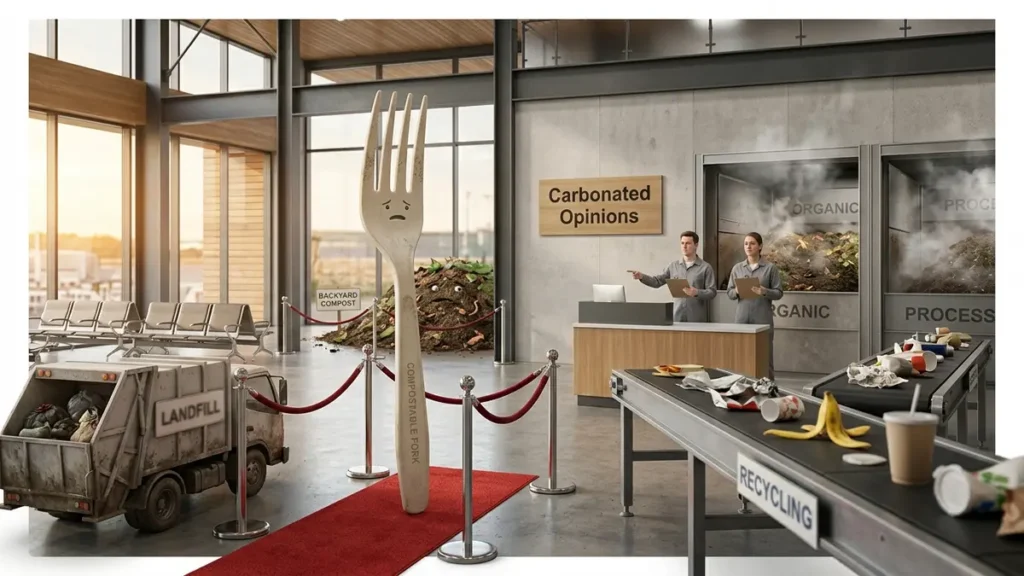
Compostable Plastics: The Trash Bin’s Most Confusing Impostor
A fork labelled compostable plastics can still end up parked in landfill for decades, or jammed into a recycling load it was never invited to. That little green badge doesn’t mean “vanishes on contact with nature.” It means the item has a very particular appointment: right facility, right temperature, right moisture, right microbes. Miss any of that and it’s just disposable cutlery with better public relations.
We like packaging that lets us buy lunch and retain the moral high ground. Sadly, a roadside ditch, a backyard compost heap and the ordinary rubbish bin aren’t enchanted portals. They’re just places where stuff goes when we’ve finished with it.
“Compostable” Is Not a Magic Word
The terms are doing far too much work with far too little supervision. Biodegradable plastic means a material can break down through biological activity, but that says nothing useful about how fast, under what conditions, or what remains behind. “Recyclable” means a system may be able to recover it—assuming it is collected, sorted and actually accepted.
Compostable is narrower. These materials are typically designed to break down into compost-like outputs under managed conditions: heat, moisture, oxygen and microbial activity working together like a cleaning crew with a strict rota. That is not the same as dissolving in a garden bed because someone feels hopeful near a worm bin.
A compostable cup is less like a banana peel than a theatre ticket. Valid at one venue, under specific conditions, and useless when shoved into the wrong queue.
The Industrial Composting Waiting Room
Industrial composting facilities can maintain the temperatures and processing times many compostable products require. They can also turn, aerate and monitor material at a scale no kitchen caddy can manage. The catch, naturally, is that these facilities and their collection systems aren’t everywhere.
So the product’s real journey often goes: café counter, optimistic customer, confusing bin, general waste, landfill. A landfill is not a spa treatment for plastics. It is a crowded, airless storage unit where optimistic labels go to die quietly.
Calling an item compostable without building a way to collect and process it is like handing someone a submarine and pointing vaguely toward the desert. Technically impressive. Practically a bit rude.
Put It in the Wrong Bin and Everybody Gets Fined
Waste sorting is already a grim little obstacle course. Compostable plastic can look much like conventional plastic, which makes it hard for people and sorting equipment to distinguish. Put it in recycling and it may contaminate a stream intended for standard plastics. Put ordinary plastic in food-waste collection and it can leave processors picking filthy wrappers out of rotting scraps.
The contradiction is almost elegant: a label intended to simplify an environmental choice can make disposal harder. Consumers are asked to identify materials, understand local rules and locate a suitable bin while holding a leaking takeaway container on a busy pavement. Then we act surprised when the bin gets it wrong.
The problem isn’t that people are uniquely careless. The problem is a system that sells a specialist product into a general-purpose rubbish economy.
The Green Costume Party
Compostable plastics only achieve their intended advantage when collection and processing match the material. Otherwise, they can become landfill fodder or foul up recycling and organic-waste streams.
A 2021 University of Georgia life-cycle assessment found that, for each kilogram of highly biodegradable PHA straws modeled, landfilling produced an estimated 1.53 kilograms of CO₂-equivalent emissions, compared with 0.0583 kilograms when the straws were processed through composting—illustrating that compostable plastics’ environmental benefits depend on access to the appropriate waste infrastructure and end-of-life pathway.
That gap matters. It also exposes the leafy costume party happening on shelves: replace one single-use object with another, print reassuring words on it, and hope nobody asks where it goes after lunch. Compostable materials may be useful in tightly managed settings, especially where food scraps are collected together. They are not permission to keep treating convenience as a waste-management strategy.
The Least Bad Ending
The least bad option is boring, which is why it rarely gets the glossy label. Use reusables when practical. If compostable packaging is unavoidable, check whether your local system explicitly accepts it with organics. Not whether the package features a leaf, a seedling or a shade of green designed by someone who has never visited a transfer station.
Compostable plastics have a place when the collection route and facility are real, not merely implied. Before tossing that “compostable” cup into a bin, check what your local waste system actually accepts. If the answer is “nothing with a suspiciously green label,” believe the bin—not the packaging.