
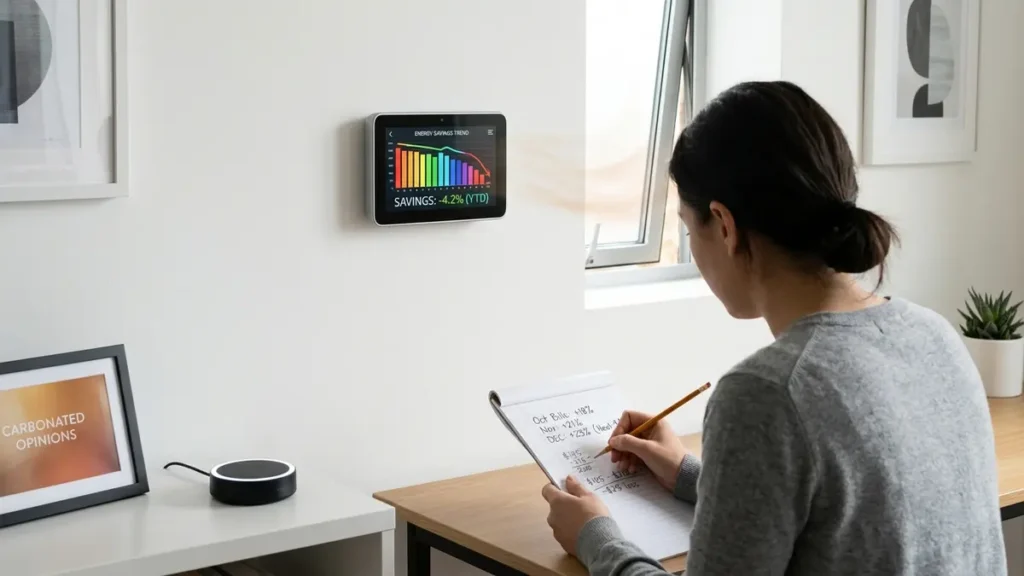
Smart Home Energy Savings: Promises Vs. Physics
Smart home energy savings are usually sold like a magic trick: wave an app, vanish a bill. The demo looks great—charts swoop downward, leaves appear, everyone applauds. But physics is the party guest who reads the receipt. Your house doesn’t care about vibes; it cares about temperature gradients, insulation, air leaks, and how long you keep demanding “cozy.” So let’s test the promise the unromantic way: with heat transfer, a pencil, and the mild suspicion that “smart” sometimes just means “always on.”
Thermostat Theater: Marketing Claims Meet Heat Transfer
Marketing: “Set it back 3°C and save 10–20%!”
Physics: “Maybe. For some houses. Some of the time. Under conditions your brochure didn’t RSVP to.”
A home loses heat roughly in proportion to the difference between inside and outside temperature (the classic “bigger gap, bigger leak” story). So yes—lowering the setpoint reduces that gap and should reduce losses. But the savings aren’t a universal coupon; they’re more like a conditional discount code that expires when your house is weird.
Enter hysteresis: thermostats don’t hold a perfect line; they cycle. The system overshoots, undershoots, and lives in a tiny band of “good enough.” A “smart” thermostat is basically your home’s mood ring: it reads the room, changes color, and sometimes just makes you feel like you’re in control.
Now the non-glamorous math: if it’s 0°C outside and you’re at 21°C inside, your temperature gap is 21°C. Drop to 18°C and the gap is 18°C. In the simplest model, losses scale by 18/21 ≈ 0.86—about a 14% reduction during the setback period. Not 14% off the whole day, not 14% off your entire existence. If you only set back for 8 hours, the all-day savings might be closer to 14% × (8/24) ≈ 5%. Still real. Just… less cinematic.
And then the plot twist: many systems “recover” by heating hard later. If your heating is efficient across its operating range, recovery doesn’t erase savings. But if your house is drafty, your schedule is inconsistent, or you keep overriding the algorithm like a nervous parent adjusting a blanket, the difference between “smart thermostat savings” and “smart thermostat vibes” shrinks fast.
The Phantom Appliance And The Energy Cost Of ‘Smart’
Automation has a villain nobody put on the packaging: the phantom load. The always-awake hub. The sensors listening for your presence like a polite household nag—never sleeping, never complaining, always drawing power.
Here’s the irony buffet: the energy spent saving energy.
Back-of-the-envelope time. Suppose your smart ecosystem averages 5 watts continuous (hub + router overhead + a couple of chatty devices). That’s 0.005 kW × 24 × 365 ≈ 44 kWh/year. If the setup is 10 watts, you’re at 88 kWh/year. Not apocalyptic—but it’s the quiet tax on “convenience.”
Now compare it to a claimed win. If automation saves you 1 kWh/week, that’s 52 kWh/year—barely ahead of a 5-watt background hum, and potentially worse than a 10-watt one. Congratulations: your home energy automation just reinvented the treadmill.
Storage gets marketed as the grand finale: “Store energy! Beat the bill!” Batteries are often treated like a kitchen remodel for your grid relationship. In practice they’re more like lunchboxes: great for one meal—an outage, a short peak period, a brief backup—but you still need the kitchen to do the cooking. If your daily usage is big, the lunchbox doesn’t replace the refrigerator, the stove, and the suspiciously hungry teenagers.
And yes, batteries have round-trip losses. Some of the electricity you “save” comes back as heat—literal warm irony. Energy efficiency is still the kingpin here, not gadget density. (See: Energy efficiency.)
If you want the core concept of smart homes without the brochure perfume, start with what a Smart home actually is: sensors, controllers, and networks. Those networks aren’t free. They’re tiny, constant, and relentlessly modern.
Take-Away
Smart features can absolutely nudge you toward better behavior—timers beat forgetfulness, setback schedules beat chaos, and alerts can catch the “why is the heater on with the window open” genre of disaster. But “smart” doesn’t repeal baseline measurement, and it doesn’t renegotiate heat transfer.
Do the unsexy thing: run a one-week baseline energy log. Then change one variable—one schedule tweak, one automation rule—and measure the delta. If it saved more than the time you spent arguing with the app, you’ve earned a victory latte.