
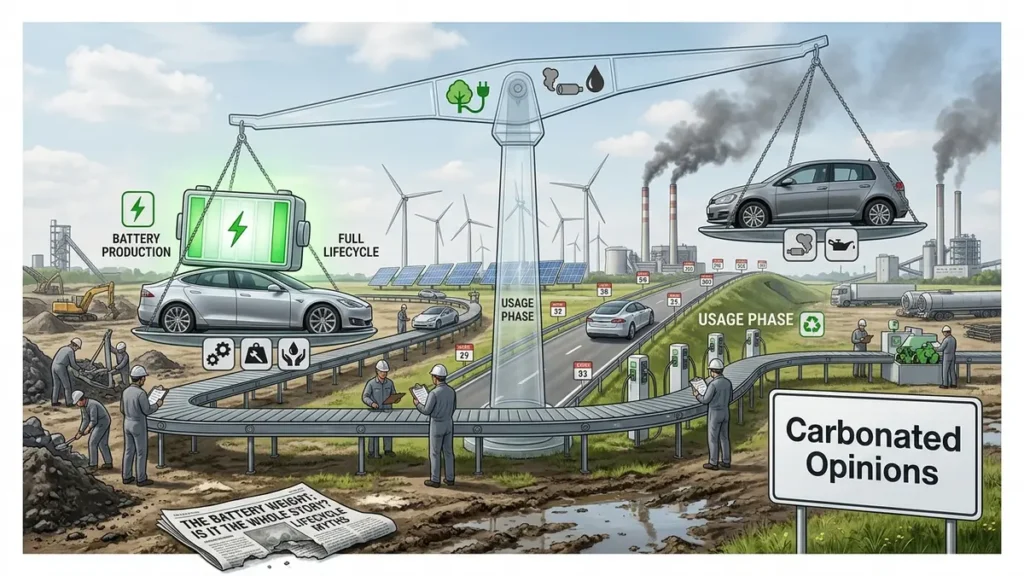
Electric Vehicles: What Powers Their Climate Benefits?
The familiar objection to electric vehicles goes like this: making the battery causes emissions, so driving the car can’t possibly help the climate. The first part is true. The second doesn’t follow.
It’s rather like declaring a journey pointless because the first mile was difficult. To compare an electric car with a petrol car, you need to count what it takes to make each one and what happens over years of driving. The battery belongs in that calculation. It just doesn’t get to be the entire calculation.
The Battery Question, Without the Fog
Making electric car batteries takes materials and energy. Mining and processing those materials have environmental costs, and battery manufacturing can give an EV a larger emissions footprint before it reaches the road than a comparable petrol car. Pretending otherwise would make this a very short, and rather useless, conversation.
But there isn’t one universal figure for that upfront impact. Battery size matters. So do the materials used and the energy powering the factory. A large, heavy electric vehicle is not interchangeable with a smaller one simply because both plug in. The same applies when comparing either with a petrol car: size and design affect what must be manufactured and how much energy it takes to move around.
So yes, ask about the battery. Just don’t stop asking questions the moment you get an answer.
Where the Electricity Comes From Matters
An EV has no exhaust emissions while it’s being driven, but the electricity used to charge it has to come from somewhere. A grid with more low-carbon power generally improves the car’s climate advantage. A grid that relies heavily on fossil fuels can narrow it. Neither statement requires us to pretend that every charging socket draws from an identical power system.
This is where an appealingly simple slogan becomes less useful than a map. The same model can have a different driving-related emissions footprint in different regions, and that footprint may change as the local grid changes. Meanwhile, a petrol car continues to burn fuel whenever it’s driven. The two cars have different patterns of emissions, not one shared number that can be pasted onto every place and every year.
The Lifetime Comparison Is the Useful One
The important shift is from the factory gate to the whole trip. A life-cycle assessment considers stages such as production, use and eventual disposal rather than treating one stage as the final score. For cars, years of driving are too significant to leave off the page.
Across many like-for-like comparisons, EVs come out with lower lifetime greenhouse gas emissions, though the margin changes with grid electricity, battery production and vehicle choice. Insufficient source material: that’s the diagnosis for a headline that offers a battery figure and calls the case closed.
The reverse shortcut isn’t much better. Saying an EV has no tailpipe doesn’t establish that it has no emissions. The useful question is whether a particular electric car, charged in a particular place, produces less over its lifetime than the petrol car it would actually replace. Less tidy than a slogan, admittedly. Considerably more informative.
Not a Magic Wand—and Not a Myth
A fair comparison doesn’t turn electric vehicles into a solution for every cost of car use. They still need materials, energy, roads and space. Extracting battery materials has impacts worth scrutinising, and generating electricity isn’t automatically harmless. Replacing a petrol car with an electric one can reduce transport emissions without erasing those other costs. Both ideas fit comfortably in the same sentence.
Nor does pointing out those costs make a petrol car disappear from the comparison. If the question is which vehicle to use for a journey that will happen either way, compare vehicles that could realistically do that job. If the question is how to reduce the wider impacts of transport, it’s reasonable to ask whether some journeys need a car at all. That’s a different question, not a clever rebuttal to the first one.
Before the Next Battery Headline
An EV’s battery is a real part of its environmental footprint, not proof that the rest of the footprint doesn’t count. Check the vehicle being compared, the electricity used for charging and the years of driving included in the estimate. Then ask whether the headline has compared the full lifecycle—or merely found its favourite mile of the trip.
Before sharing the next definitive-sounding verdict on EV emissions, that one check is worth the extra minute.