
The Electric Grid Wasn’t Built for This Future
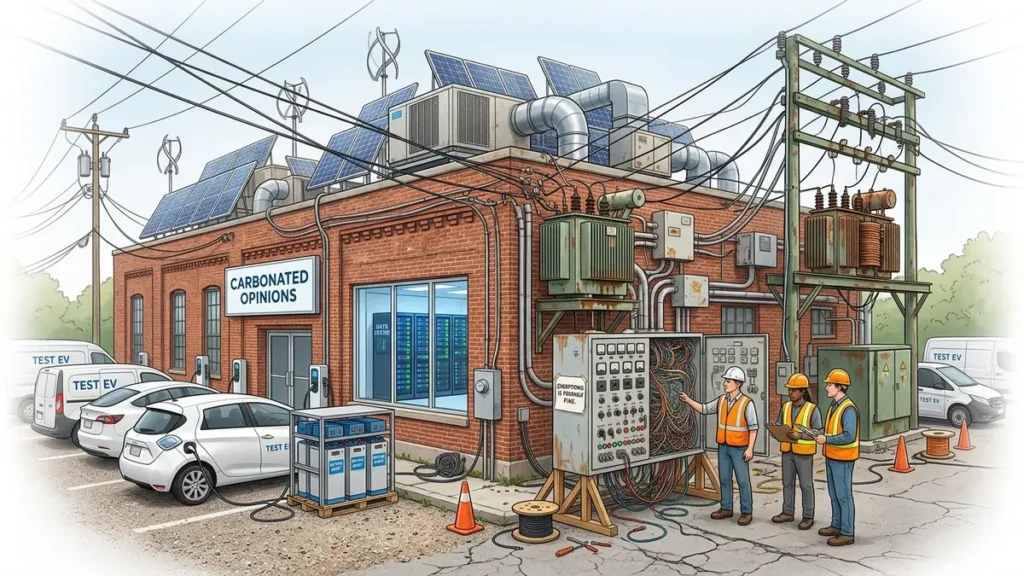
The electric grid is being asked to become several things at once: a cleaner power system, a transport fuel station, a heating network, a weatherproof refuge and, somehow, a bargain. It resembles a century-old office building being converted into a data centre while everyone assures you the electrical panel is “probably fine.” Clean-energy hardware is improving quickly. But renewable energy integration is only as fast as the wires, substations, rules and operators that connect it. The infrastructure gap is the invisible machine between announcing a target and delivering electricity at 7pm on a cold, windless evening.
The Grid’s Original Job Description Was Surprisingly Short
The old arrangement was elegantly simple: a few large generators produced predictable power, which travelled one way to mostly passive customers. Planning was not easy, exactly, but it had the comforting geometry of a river. Now electricity can flow in several directions. Rooftop solar exports at noon. Home batteries charge and discharge. Electric vehicles may become mobile loads, or occasional tiny power plants. Factories, buildings and communities can respond to price signals. The grid is becoming less like a river and more like a logistics network whose parcels occasionally decide where they’d prefer to go. That’s progress, not chaos. But it requires sensors, communications, upgraded local equipment and operating rules designed for millions of participants rather than a manageable club of large power stations.
Renewable Energy Arrives With a Calendar Problem
Wind and solar are not failures because they vary; their fuel is free and their emissions are low. Their complication is scheduling. The sun remains stubbornly unwilling to attend the evening demand meeting. Managing that mismatch takes a portfolio: short-duration storage for daily shifts, longer-duration reserves for extended gaps, transmission to share weather across regions, flexible demand, backup generation and, sometimes, more renewable capacity than the annual spreadsheet strictly requires. None is magic. Batteries use materials and capital; transmission loses some energy and takes time; backup must be paid for even when it sits politely in the corner. Energy and power are different questions. Energy is the bathtub’s total water. Power is the fire hose filling it fast enough when everyone turns on the kettle, heat pump and charger at once.
Electrification Is Going to Ask for More Than a Polite Upgrade
Electrifying vehicles, heating and industry can cut fossil-fuel use, but it moves pressure onto the electric grid. Data centres add another concentrated demand source, often arriving with the urgency of a tenant who has already bought the furniture. The crucial constraint is frequently local capacity, not national annual generation. A region may produce enough electricity over a year yet lack the transformer capacity to support a street of evening vehicle charging or a cluster of winter heat pumps. Peaks occur at particular places and particular moments. Copper, transformers and substations care deeply about both. This is why grid modernization can feel uneven across countries. Dense cities, rural networks, fast-growing industrial zones and islanded systems each inherit different constraints. A policy that looks tidy on a national chart may meet an entirely different electrical reality at the neighbourhood level.
Transmission: The Necessary Infrastructure Nobody Wants in Their Backyard
The best wind and solar resources are often distant from where power is used. Connecting them means more high-voltage lines and stronger links between regions, so a calm patch or local outage does not become everyone’s problem at once. Unfortunately, transmission has a talent for turning broad agreement into highly specific disagreement. Permitting, land rights, visual impact, wildlife concerns, construction labour and arguments over who pays can stretch projects across years. The line may benefit millions of customers while passing directly through the view of several hundred very attentive ones. That does not make opposition irrational. It means planning must be honest about trade-offs, compensation and alternatives. But avoiding every new wire is also a decision—usually one that leaves clean generation stranded and reliability more expensive.
The Future Grid Needs Better Math, Not Just Better Gadgets
A smart grid is not merely a grid with more apps attached. It is a system that forecasts supply and demand, values flexibility, coordinates storage, protects against failures and makes sensible choices across seconds, hours, seasons and emergencies. The central transition challenge is therefore bigger than building low-carbon generation. The system must simultaneously handle variable supply, growing loads, distance between resources and customers, and the non-negotiable expectation that the lights work. A 2024 NYSERDA briefing illustrates that grid modernization is a systems challenge rather than a simple generation buildout: from 2007 to 2023, its Smart Grid program issued 13 funding notices and awarded more than $107 million across 174 projects, spanning distributed-energy-resource integration, storage, monitoring, demand response, and advanced system modeling. That list is revealing. Reliability does not emerge from one heroic device. It comes from matching many imperfect tools to the timescale and failure mode in front of them.
Treat Wires and Flexibility as Climate Technology
The clean-energy transition is systems engineering in work boots: timing, geography, regulation, materials and money, all arguing over the same circuit diagram. New generation matters enormously. So do the supposedly less glamorous parts: substations, transmission corridors, demand response, skilled crews and market rules that reward availability when it is actually useful. The grid can support an electrified, lower-carbon future. It just cannot do so by being treated as an extension cord from yesterday. Is the grid ready for tomorrow’s appliances—or are we still hoping the panel is probably fine?