
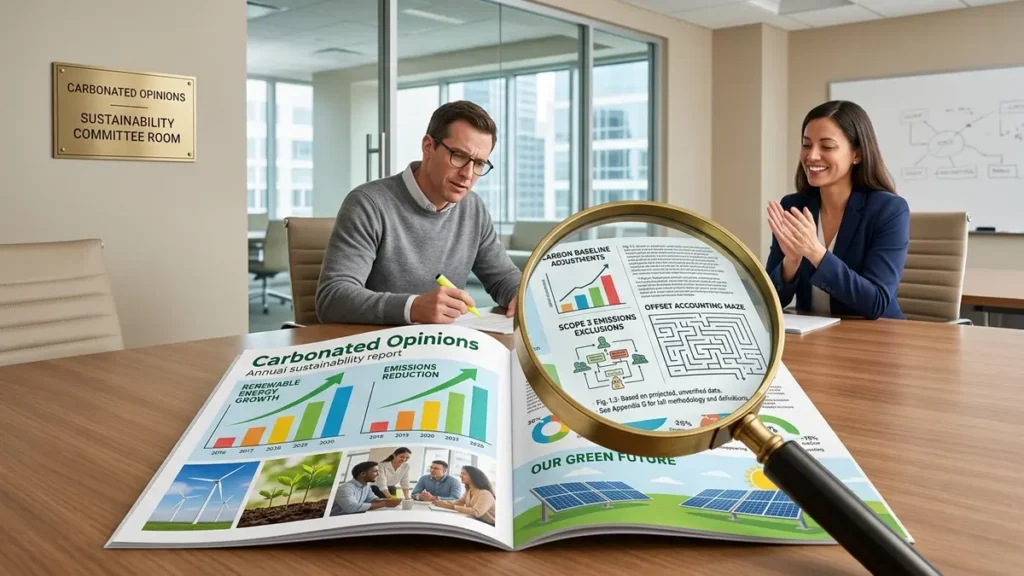
Sustainability Report: Welcome to the Annual Green Fairy Tale
The annual sustainability report arrives like a polished office yearbook: heroic rooftop photos, smiling employees near a sapling, charts ascending with the confidence of a motivational speaker. Corporate sustainability is presented as both serious work and an excellent reason to use a full-bleed image of a wind turbine. By page 14, though, a reasonable reader may wonder: what actually changed, by how much, and compared with what?
That doesn’t make every report nonsense. Corporate social responsibility can involve real commitments, real spending, and real operational improvements. But a PDF is not a certificate of virtue. It’s a communications document, which means its natural habitat is the gap between “we did something” and “this made a measurable difference.”
The Executive Summary Has Entered Its Inspirational Era
The opening pages usually bring the big promises: net-zero ambitions, circular dreams, bold targets with dates far enough away to qualify for their own forwarding address. Milestones appear, selectively bright and scrubbed for presentation. The company has reduced this, launched that, partnered enthusiastically with somebody on something.
Fine. Activity matters. But activity isn’t the same as outcome, a distinction the executive summary sometimes treats like an awkward colleague who wasn’t invited to the retreat. A target is only useful beside a baseline, a deadline, and a clear account of what sits inside the reporting boundary. Otherwise, “reduced emissions” can mean almost anything, including emissions falling while the business’s overall footprint found a larger room.
Think of it as an annual performance review written by the employee. It may contain accomplishments. It will also, somehow, make the difficult project sound unusually collaborative.
Metrics, but Make Them Mysterious
ESG reporting has legitimate complexity. Different emissions scopes, changing data sources, offsets, supplier estimates, and regional rules don’t squeeze neatly into one cheerful percentage. Carbon accounting can resemble financial accounting performed in a room where the calculator is allowed to choose its own buttons.
The trick is noticing when necessary complexity turns into convenient fog. Targets, offsets, baselines, scopes, and reporting boundaries can create a dashboard that looks impressively busy while leaving the central question unresolved: are environmental impacts actually declining in a meaningful, comparable way?
A study of environmental disclosures from thousands of companies headquartered in 46 countries between 2005 and 2008 identified selective disclosure as a pattern in which firms highlighted relatively inconsequential environmental indicators while omitting more consequential ones, potentially creating an overly optimistic impression of environmental performance.
That’s the issue with a curated sustainability story. Targets and favorable boundaries can make progress look tidier, or larger, than the underlying evidence warrants. Not necessarily a lie—just a very practiced arrangement of the furniture.
The Footnotes Are Where the Carbon Goes to Hide
The footnotes are the report’s understudy: quiet, diligent, and often carrying more plot than the headline claims taking their bows. This is where postponed targets, limited coverage, recalculated baselines, exclusions, and changes in methodology tend to wait patiently for readers who brought snacks and a highlighter.
A company may technically tell the truth while arranging it like a flattering family portrait. The solar panels are in front; the inconvenient emissions category has been asked to stand near the curtains. That isn’t automatically greenwashing, but it is why readers should resist treating glossy disclosure as self-executing proof.
Look for the boringly valuable things: year-on-year figures using the same method, absolute as well as intensity-based emissions, coverage of major operations and supply chains, independent assurance, and a plain explanation of what changed. If a number can’t survive comparison with last year’s number, it may be more decorative than informative.
A Second Reading Is the Real Applause
A sustainability report isn’t useless because it’s glossy, optimistic, or written in the dialect of the annual leadership summit. It can be a useful starting point. Just don’t confuse the invitation with the investigation.
Read the report. Then read the methodology, the footnotes, and the parts set in smaller type. Ask what the baseline is, what has been excluded, whether progress is absolute, and who checked the maths. If the sustainability story still holds together after that, it may finally be ready for a second reading. The planet, regrettably, does not accept beautifully formatted intentions as payment.