
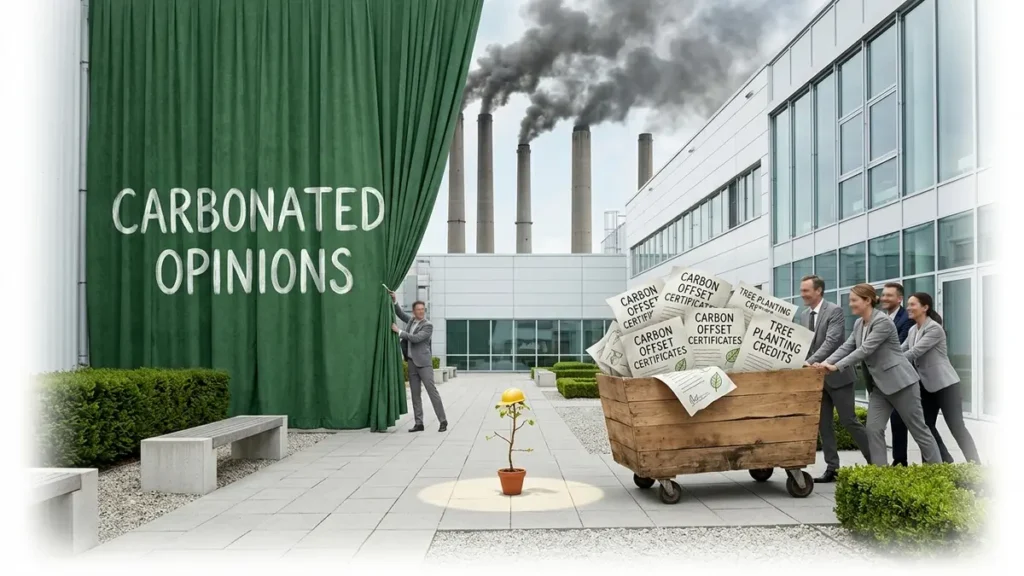
The Greenwashing Behind Carbon Offset Programs
Carbon offset programs offer an irresistibly tidy little bargain: emit here, fund a forest, clean-energy project, or community initiative somewhere else, and—presto—the climate ledger looks less awkward. It’s sustainability’s favorite administrative shortcut, complete with leafy imagery and the faint glow of a well-designed annual report. But a carbon offset is not a tiny “I’m sorry” sticker that magically settles a very large emissions invoice. Pollution is released now. The promised benefit may arrive later, somewhere else, and under conditions that deserve more scrutiny than a smiling stock photo of a sapling.
The “Pay to Pollute” Economy, Now With a Leafy Filter
In principle, carbon offsetting directs money toward projects that avoid, reduce, or remove greenhouse-gas emissions. That can be useful. Funding worthwhile climate work is not the problem; pretending the transaction makes the original emissions emotionally disappear is. The timeline is doing some remarkably heavy lifting. A flight, factory process, or supply-chain decision puts emissions into the atmosphere immediately. A tree takes years to grow. A renewable project may take years to build. Yet the marketing claim often arrives right on schedule, polished and ready for the campaign launch. That’s how continued emissions can be reframed as environmental initiative. “Carbon neutral” starts to resemble balancing a checkbook by moving the expenses into another tab—technically organized, spiritually adventurous. Carbon credits can finance real reductions, but they shouldn’t become a permission slip for avoiding the tougher job: cutting pollution at the source.
Additionality: The Climate Project That Was Already Happening
The central question is almost impolitely simple: did this project happen because someone bought credits, or did the buyer merely arrive in time to take credit for it? That’s additionality, the decidedly unglamorous test beneath many glamorous climate claims. Carbon offset programs can contribute to climate action when reductions are genuinely new, reliably measured, durable, and independently checked. Without those conditions, an offset can become less of a climate intervention and more of a receipt for activity that was already planned, funded, protected, or financially sensible. Carbon offset programs can support climate action, but their value depends on whether the claimed reductions are additional, measurable, and lasting: an article that reports on investigations by MIT Technology Review and ProPublica, found carbon credits issued for Massachusetts Audubon forests that were never in danger of being cut down, may have produced no emissions reduction beyond what would have occurred anyway. This example underscores why using offsets without first reducing in-house emissions can turn sustainability claims into greenwashing, regardless of how reassuring the marketing sounds (additionality concerns in carbon offsetting). The funny thing is, paperwork can make “nothing new” look astonishingly productive. Give an existing forest a baseline, attach a methodology, issue a certificate, and suddenly the status quo has acquired a sales department.
Permanence, Leakage, and Other Fine Print With Excellent Publicists
Even a genuinely additional project has to survive the next round of complications. Forests can burn, be cleared later, or fall prey to disease. Emissions avoided in one place can simply move somewhere else—a problem known as leakage. Monitoring varies. Measurement assumptions vary. Credit quality varies. None of this is especially photogenic, which may explain why it receives less airtime than the soothing phrase “climate positive.” Uncertainty, in other words, gets dressed in a crisp green blazer and introduced as “verified impact.” That doesn’t mean every credit is worthless. It means the label alone is doing a suspicious amount of work.
A Better Use for the Applause
Offsets may have a role after serious emissions cuts, particularly where reductions are genuinely difficult. But they are not a magic eraser, and treating them as one turns operational change into a purchasing decision with excellent branding. Before applauding a carbon-neutral claim, look past the leafy logo. Ask how much pollution was actually reduced, what would have happened anyway, how long the benefit lasts, and who checked the receipt. Then, by all means, offer polite applause—just not a standing ovation for an emissions strategy that mainly learned how to accessorize.