
Offshore Wind Cost: When the Breeze Gets a Price Tag
Offshore wind cost sounds like it should be simple: put tall fans in windy water, collect clean electrons, applaud. But the moment you ask “How many kilowatt-hours show up on a bill, at what price, and with what hidden energy tab?” the brochure starts sweating.
This is the fun part: not dunking on the tech—just running it through the world’s least negotiable peer reviewers: physics, logistics, and accounting. Marketing sells capacity. Reality invoices delivered energy.
Turbine Torque Vs. Sales Torque
A wind turbine is basically a very polite mugger of moving air: it can only take so much before the air needs to keep moving. Physics calls this the Betz limit—an upper bound on energy extraction from wind—meaning even in the best-case universe, you don’t get to “harvest” the whole breeze.
The easy hype move is to lead with nameplate capacity: “This turbine is 12 MW!” That number is like the maximum weight limit on a suitcase handle. It’s real, but it’s not what you actually carry through the airport.
Power in wind scales with swept area (bigger rotor, more intercepted wind) and with the cube of wind speed (a little more wind, a lot more power). Marketing hears “cube” and starts writing poetry. Physics hears “cube” and starts writing disclaimers: variability matters, turbulence matters, maintenance matters. Those glossy gigawatts only appear when the wind cooperates and the machine is available.
So yes, wind turbine efficiency improves, rotors get bigger, controls get smarter. But the arithmetic stays stubborn: average output is capacity multiplied by capacity factor, not by optimism.
Suitcases, Cranes, And Cold Steel: Hidden Costs Of Moving The Breeze
Now for the part where electrons become a moving problem.
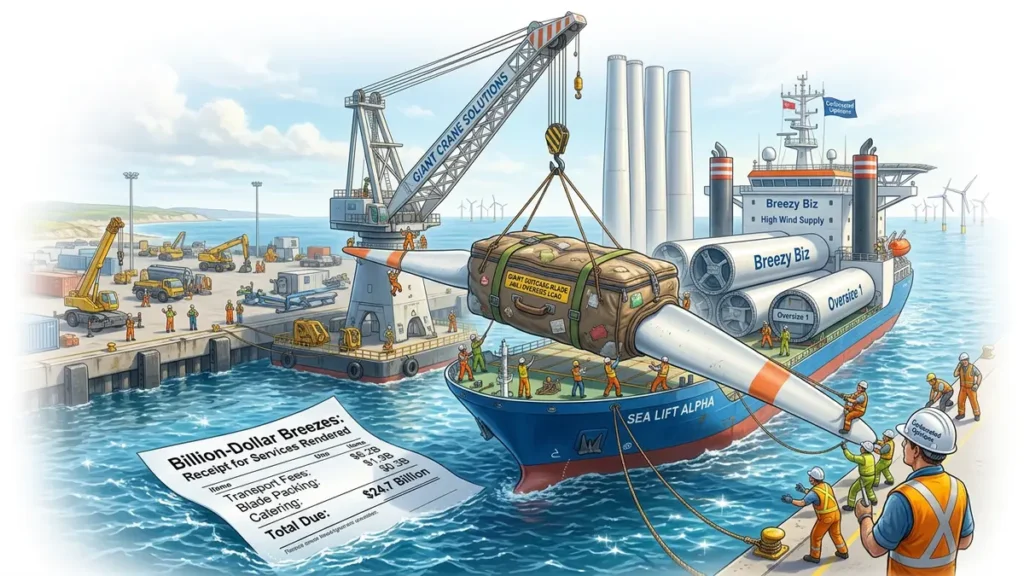
Picture a turbine as an overstuffed suitcase: gorgeous, aerodynamic, and absolutely not fitting in your car. Blades are comically long; towers are heavy; foundations are “just a bit of steel” in the way a ship is “just a bit of metal.” Installing one is the offshore version of trying to carry a couch up a staircase—except the staircase is the ocean and your friends are specialized cranes with hourly rates that could fund a small library.
Ports need space, reinforced quays, and storage yards. Vessels need calm weather windows. Crews need training. Spare parts need logistics. All of that is capital expenditure with a side order of schedule risk.
And here’s the irony diet we keep pretending not to be on: the energy cost of energy-saving. Steel, cement, ship fuel, manufacturing heat—offshore wind is clean at the plug, but it arrives with embodied energy like packing foam in a “minimalist” online order. The climate math still can work out—often does—but only if you count, not wish.
The Billion-Dollar Breeze: Capacity, Curtailment, And Who Actually Pays
The industry headline is offshore wind capacity. The grid operator’s headache is offshore wind integration.
Start with capacity factor: offshore sites can be excellent, but “excellent” still means output swings. That variability has a price in transmission upgrades, balancing services, and sometimes storage—your luxury ceiling fan problem. It looks fantastic in photos, but when dinner’s on the table you still need a reliable stove.
Then comes curtailment: the awkward moment when turbines could produce, but the grid can’t use it—because demand is low, transmission is constrained, or stability limits bite. Curtailment turns theoretical clean energy into a non-event, while the project’s financing costs keep ticking like a metronome.
This is where metrics matter: LCOE (see Levelized cost of energy) is useful, but only if it includes the real-world extras—grid connection, offshore substations, long export cables, and the system costs of variability. The question “Who pays?” has multiple correct answers: sometimes ratepayers through bills, sometimes taxpayers through policy support, sometimes investors through painful revisions. Economics is just physics wearing a spreadsheet.
None of this means offshore wind is a scam. It means offshore wind power is a serious industrial bet, not a meme with blades.
Take-Away
Offshore wind can absolutely belong in the climate toolbox—especially where winds are strong and coastal demand is close. But the glamour of “billion-dollar breezes” fades fast when you translate offshore wind capacity into kilowatt-hours actually delivered, then divide by dollars spent and energy embodied.
If we want nerdy honesty instead of brochure math, the core metric isn’t how big the turbines are. It’s delivered clean energy per dollar and per unit of real, counted effort. The breeze is free. Everything else has a receipt.