
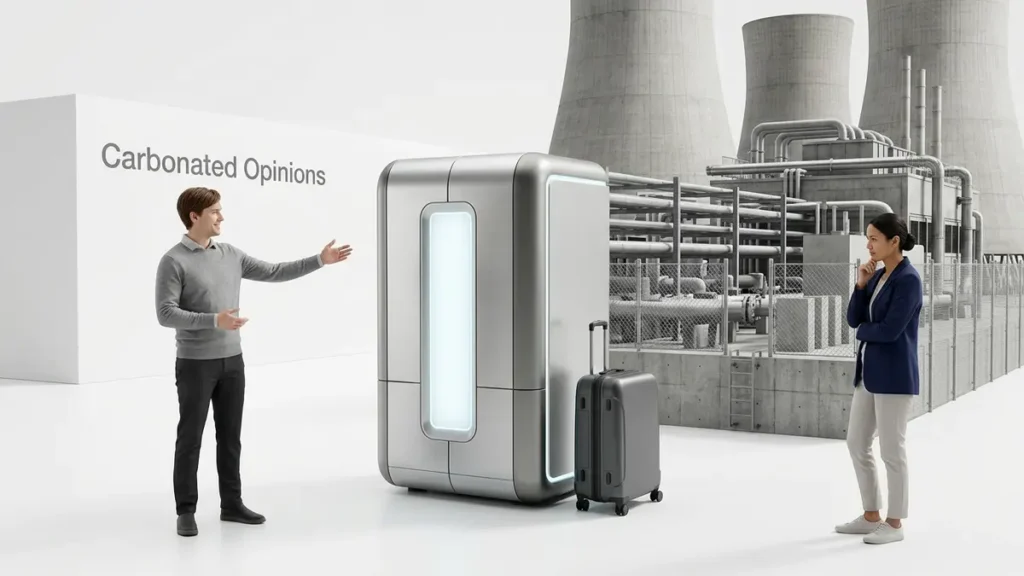
Small Modular Reactors: Can tiny reactors fix big climate math?
Small modular reactors show up in brochures like travel-sized climate heroes: neat, compact, allegedly “plug-and-play.” But physics is the kind of auditor that doesn’t accept vibes as documentation. If an SMR is going to earn its place on a decarbonized grid, it has to clear three stubborn hurdles: thermodynamics (where the heat goes), siting (where people will let it go), and integration (how it plays with a grid that’s increasingly variable). The pitch is simple: smaller reactors mean faster builds, lower costs, and easier deployment. The counterpitch is also simple: you can shrink the box, but you don’t get to shrink the laws of nature—or the paperwork.
Physics Vs. Marketing: What An SMR Actually Delivers
Marketing: “Small means efficient.”Physics receipt: “Small means still a heat engine.” Nuclear plants turn heat into electricity, and the leftover heat must be rejected to the environment. That means cooling water, cooling towers, air cooling, or some other non-magical exit strategy. The reactor can be compact; the heat-rejection system often can’t.Marketing: “Modular means scalable.”Physics receipt: Modularity helps manufacturing, not thermodynamics. Add units, and you add not just megawatts but also concrete, steel, control systems, security, transmission upgrades, and the unglamorous architecture of safety.Marketing: “Factory-built means predictable.”Physics receipt: “Predictable” depends on materials, supply chains, and licensing. Reactor pressure boundaries, corrosion, embrittlement, and fuel handling don’t care that the brochure used a friendly font. If you want a clean reference point start with the basics of a Small modular reactor. The concept is real. The constraints are realer.
The Household Test: Is An SMR More Like A Suitcase Or A Refrigerator?
The suitcase story is seductive: a tidy unit you roll into town, unfold, and voilà—carbon-free power. But most grids don’t need a suitcase. They need a refrigerator. A refrigerator is “just an appliance,” until you remember it needs: a dedicated circuit, a stable place to sit, ventilation, maintenance, and someone responsible when it leaks. SMRs are similar: the “module” is the eye-catching part, but the real-world system includes site prep, emergency planning, trained operators, physical security, waste logistics, and a decommissioning plan that politely waits decades before sending the invoice. And here’s the irony the grid keeps pointing out: the energy cost of energy-saving. You decarbonize with low-carbon electrons, but you also spend a lot of industrial effort to get them—cement, steel, specialized components, and long-lived infrastructure. Marketing hands you a glossy brochure; the plant hands you a bill for heat rejection, materials, and eventual cleanup. None of this is a deal-breaker—just a reminder that “small” doesn’t mean “effortless.” It means “different trade-offs.”
Dollars And Trust: Economics And Public Perception That Determine Comeback Speed
Even a technically solid reactor can lose to a spreadsheet. Nuclear is capital-heavy: you pay a lot upfront to buy decades of output. That makes financing terms—interest rates, risk premiums, construction schedules—feel less like accounting trivia and more like the steering wheel. SMRs aim to reduce that risk by standardizing designs, shortening build times, and allowing capacity to be added in steps. But unit costs can rise when you lose economies of scale, and first-of-a-kind projects tend to be “educational,” which is a polite word for “expensive.” Then comes trust. Nuclear reactor safety is not only engineering; it’s communication under uncertainty. Public acceptance often hinges on whether safety claims sound like transparent math or like the beginning of a press release. Public perception nuclear power matters because it shapes licensing timelines, siting feasibility, and political durability—each of which has real economic weight.
Take-Away
Nuclear’s comeback won’t be decided by slogans or nostalgia. It will be decided by the boring, beautiful trio: physics that closes its heat balance, economics that survives financing reality, and safety narratives that read like engineering—not marketing. Small modular reactors can help: standardization could reduce risk, and staged deployment could match grid needs. But SMRs aren’t a magic wand. They’re a proposal that still has to clear the same exam every energy technology eventually faces: show the work, pay the costs, and earn the trust.