
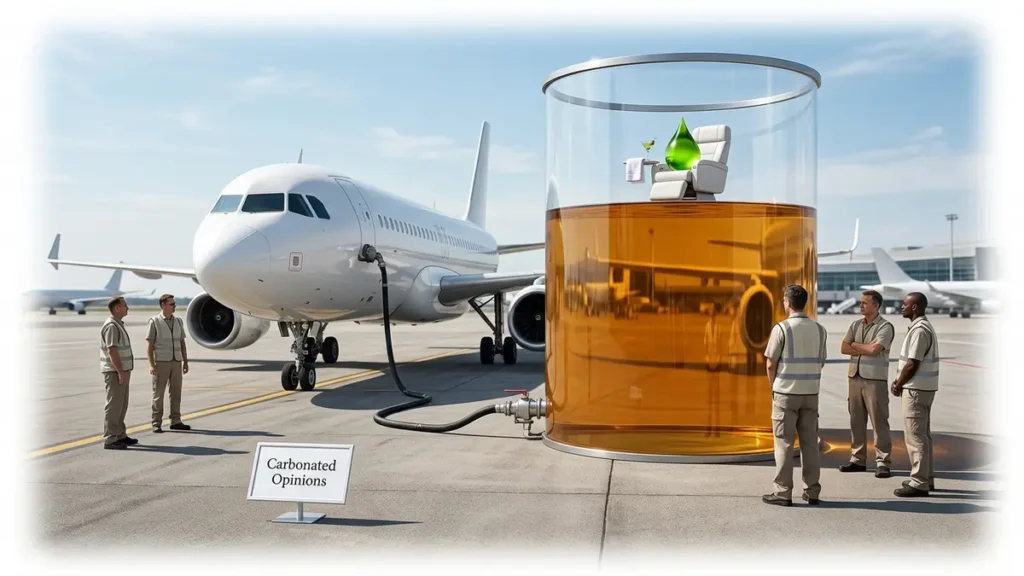
Sustainable Aviation Fuel: A Drop in the Fuel Tank
The greener flight is already beautifully packaged. There’s a photograph of a plane against a blue sky, a hopeful phrase about the future, and sustainable aviation fuel placed where the eye lands first. You might reasonably assume the tank has changed as much as the advertising.
It hasn’t. The fuel has a generous window seat in airline messaging while occupying very little space in aviation’s overall fuel supply. That doesn’t make it fake or useless. It does make the distance between a promising option and an industry-wide solution worth measuring before we admire the label.
The Green Glow of a Very Small Pour
Sustainable aviation fuel, or SAF, is aviation fuel made from sources other than conventional fossil crude. Depending on how it’s produced and what goes into it, it can reduce lifecycle greenhouse gas emissions compared with conventional jet fuel. That’s a genuine reason to pursue it, especially in an industry where replacing the fuel in long-distance aircraft isn’t as simple as changing a battery.
It’s also an unusually convenient thing to advertise. An airline can point to a fuel purchase and tell a story about progress without asking passengers to picture fewer flights or major changes to its business. The story fits neatly on a booking page. The supply, less so.
That distinction matters because potential describes what SAF might achieve if production expands under the right conditions. Current use describes what’s available for aircraft now. One belongs in a plan; the other belongs in the tank. Putting them in the same glossy package doesn’t make them interchangeable.
The Numbers Boarding in Economy
The airline industry’s enthusiasm for SAF is much larger than the amount currently produced. A 2026 perspective in Environmental Research Letters reports that global sustainable aviation fuel production reached 500,000 tonnes in 2023—just 0.1% of aviation fuel demand worldwide—illustrating the gap between SAF’s prominence as a decarbonization option and its current scale of use.
That figure compares production with demand; it isn’t a reading from every aircraft’s fuel tank. But it gives the missing denominator a boarding pass. Without it, a large-sounding purchase or an announcement about increased SAF use can seem to describe a transformation of flying. With it, you can see the difference between making a start and changing the fuel system.
Percentages are especially good at wearing oversized labels. An airline might say it has increased its SAF purchases, and that increase could be real. The useful follow-up is: increased from what, and what share of its total fuel does the new amount cover? If the answer is hard to find, the headline may be doing more work than the fuel.
A Promising Ingredient Is Not the Whole Recipe
Scaling SAF means making far more of it, paying for it and finding suitable materials to make it from. Those materials aren’t an unlimited drawer of leftovers: different production routes bring different questions about feedstocks, energy and environmental impact. A fuel’s climate benefit depends on those details, not merely on the word sustainable appearing beside it.
Cost matters too. If the lower-emissions option is harder to obtain or more expensive, a public commitment doesn’t automatically become routine purchasing across an airline’s operations. Someone has to supply the fuel, and someone has to pay the difference. The passenger reading a cheerful booking-page banner usually gets neither figure.
None of this is an argument for abandoning SAF. Aviation’s environmental impact is a substantial problem, and a fuel that can help reduce it deserves serious development. It also deserves serious accounting. The most persuasive case for SAF won’t be made by pretending today’s scarce supply is already doing tomorrow’s job.
Check What’s in the Tank
A useful climate tool can still be an overworked marketing prop. SAF may become an important part of lower-emissions aviation, but its promise doesn’t turn every flight advertised alongside it into a greener one. That claim needs quantities, context and a clear account of what’s actually being used.
Next time an airline presents a greener flight, look for the SAF share behind the headline. Check the date, check whether the figure refers to a purchase, production or fuel used, and see whether the denominator made the trip. The future can have the window seat. For now, it shouldn’t get the whole cabin.