
Wind Turbine Blades: Where the Giant Fiberglass Limbs End Up
Wind turbine blades look elegant from a distance. Up close, a retired one is an enormous object that nobody particularly wants delivered. It spent years catching the wind; now someone has to get it down, cut it up, load it onto trucks and find somewhere willing to take it. The glossy picture of a wind turbine rarely includes that part. Fair enough—nobody puts a disposal invoice on a postcard. But once blades wear out, their size and stubbornness become somebody else’s daily problem. The awkward question isn’t whether wind power produces waste. It does. It’s what happens when hardware built to survive punishing weather has to leave the site without becoming a permanent feature of the local landscape.
Built to Take a Beating—and a Long Time to Break Down
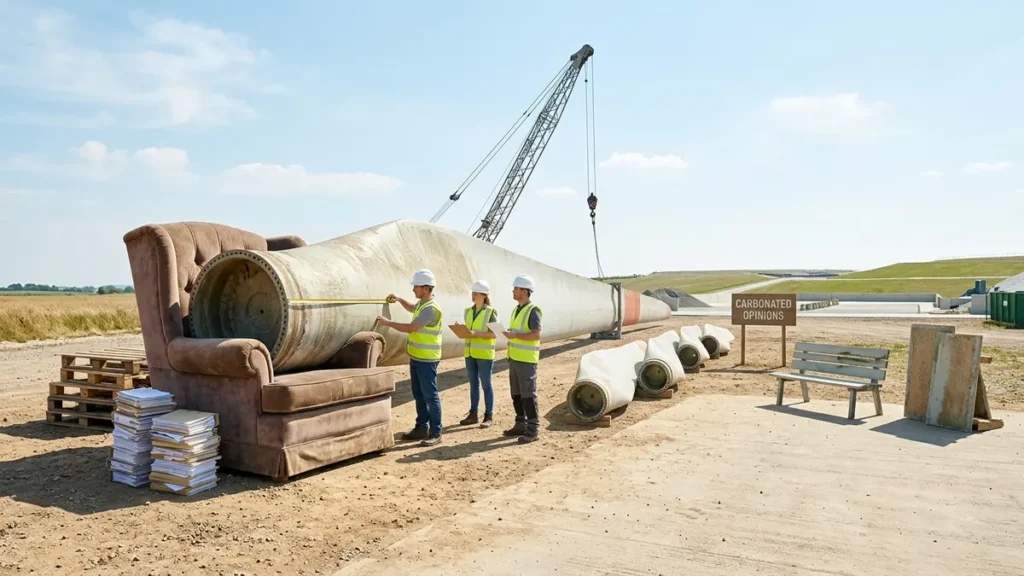
A blade isn’t one tidy material waiting to be melted into another blade. It’s typically made with reinforcing fibers, including glass fiber, set in resin. That combination helps it stay strong and relatively light while wind, rain and years of rotation do their best to wreck it. Excellent qualities while it’s working. Annoying ones when the job’s over. Think of moving house with a sofa that’s been glued together inside the room. You can’t just fold it, and the door isn’t getting bigger. Retired blades have a similar problem at a less charming scale: they’re bulky to move, hard to separate into useful ingredients and not something an ordinary recycling facility can casually swallow. None of this makes wind energy a con. It means a material can be a clever answer to one problem and a deeply inconvenient answer to the next. We tend to notice that second problem only when it’s blocking the driveway.
The Landfill: A Final Resting Place, Not a Recycling Plan
Once a blade comes down, getting it to its next destination is its own operation. It may need cutting into sections before transport. Those sections still need equipment, trucks, people and a receiving facility. Every extra journey costs money, and the nearest practical option isn’t always the one featured in the circular-economy slideshow. The scale of the coming pile is not exactly reassuring. Researchers at the University of Cambridge estimates put worldwide blade waste at 43 million tonnes by 2050, with China expected to account for 40% of it. In the United States, estimates put blade waste at approximately 2.2 million tons, equivalent to 0.2% of remaining landfill capacity. Those numbers are projections, not a receipt for every blade’s final destination—but even the forecast comes with a rather large disposal invoice. That’s why retired blades can end up in landfills, particularly where facilities able to handle them or buyers for the recovered material aren’t accessible. Practices vary by location; burial isn’t the only route, and it isn’t a law of physics. But it can be the route that wins when a difficult material meets a tight budget. The landfill is where the circular-economy pitch goes when the transportation budget runs out. That’s not an argument for pretending the blade never generated useful electricity. It’s an argument for asking who was supposed to pay for its exit. A retirement plan that begins after the crane arrives is less a plan than a very large scheduling surprise.
Cutting, Crushing, Reusing: The Messy Search for Plan B
Some blades can be cut into pieces for new uses. Other approaches process the composite material for use in different products. Both sound better than burial, and both deserve a proper look. But finding a use for a blade section isn’t the same as finding a use for every blade section, everywhere blades are being retired. A repurposed piece still has to fit a real need, meet whatever standards apply and reach someone prepared to use it. Processed material needs facilities and customers, too. Otherwise we’ve just moved the enormous awkward object to a different yard and called it innovation. A retired blade can start to resemble a fiberglass canoe that got promoted beyond its storage space. The honest picture is that wind turbine waste can end up in landfills where workable alternatives are scarce, while wind turbine recycling and material recovery are developing without making disposal disappear. Want a tidy global scorecard that settles how often each option wins? Insufficient source material. That uncertainty isn’t permission to call the problem solved—or to announce that every blade is headed for a hole in the ground.
Plan for the Blade That Comes Down
Wind power’s waste problem is real, not a verdict on wind power itself. The useful test is whether blade retirement gets designed and paid for before a project reaches the awkward goodbye. That means treating transport, processing capacity and a destination for the material as part of the job, not an unpleasant sequel. We love clean energy most when it’s standing majestically on a horizon. The less photogenic commitment is making room for what happens after. So what should happen to a wind turbine blade when its working life is over—reuse, recycle, or something else? Tell us what you’d accept in your own backyard.