
Whale Oil: The Bright Idea That Nearly Darkened the Ocean
Whale oil once meant modernity: brighter lamps, steadier candles, lubricated machinery and the modest luxury of not conducting every evening by firelight and guesswork. It was progress, or at least what progress looked like when the ocean seemed too large to inconvenience. Nobody setting a lamp on the table imagined they were participating in a planetary inventory crisis. They thought they were improving the commute from darkness to slightly better-lit darkness. Hindsight, as usual, is the one technology that reliably improves with time.
The Industrial Revolution, Now Featuring Harpoons
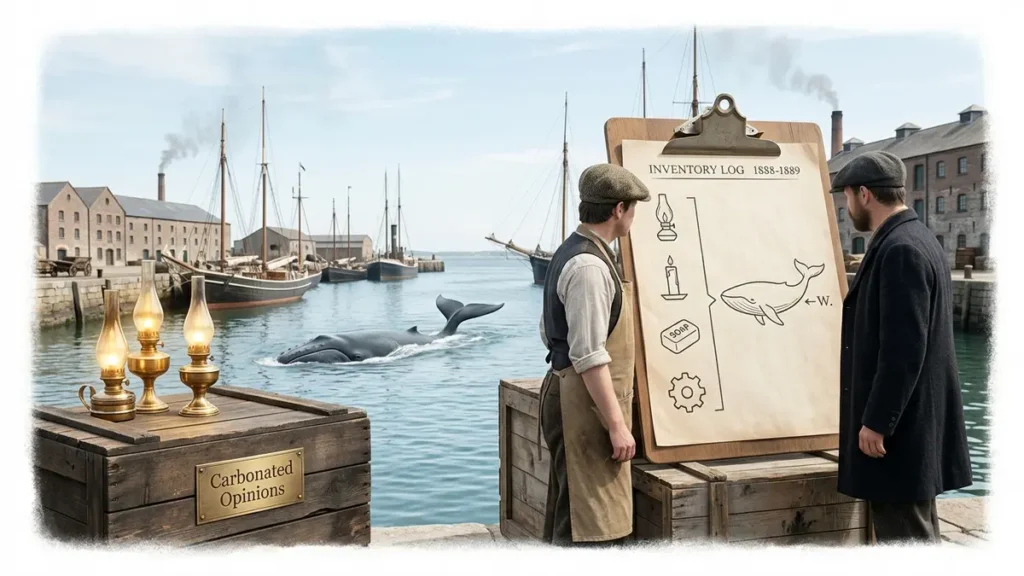
The history of whaling is partly the story of an animal becoming an industrial input. Whale oil burned cleanly enough in lamps, could be made into candles and soap, and helped lubricate the machinery that was making the nineteenth century noisier, faster and rather pleased with itself. A whale was no longer simply a vast creature crossing an ocean; it was inventory with fins.
That transformation made grim commercial sense. Ports, ships, processing yards and markets connected distant waters to households that would never see a whale, except perhaps as a label on a tin or a faint smell in a workshop. From a city street in Europe to a trading hub in Asia, the practical appeal was obvious: dependable light and useful materials were worth paying for. The animal at the far end of the supply chain was easier not to picture. Supply chains have always been very good at that.
Humanity treated the sea as its first great warehouse: no inventory system, no replenishment policy and a manager who, inconveniently, happened to be alive.
When “Abundant” Meant “Not Yet Counted Properly”
Whales appeared inexhaustible partly because they were difficult to count and largely out of sight. A few successful voyages could reinforce the belief that the ocean simply kept producing. This was less a carefully argued ecological theory than an assumption with excellent commercial timing. If the next horizon still contained whales, why spoil the mood with arithmetic?
Commercial whaling expanded, vessels ranged farther, and populations fell under sustained pressure. The logic of extraction was brutally tidy: when nearby grounds yielded less, go farther; when one species became scarce, pursue another; when costs rose, improve the equipment. It resembles an old map whose blank spaces are labelled “probably more resources.” The mapmaker is eventually corrected, usually by reality.
There was limited understanding of marine ecosystems and even less institutional appetite for restraint. That does not make the result mysterious. It makes it familiar. “Surely there are plenty” became “perhaps we should count them,” which eventually became the sort of silence that arrives after a resource has stopped volunteering for the role.
Petroleum Enters, Whales Exit—Progress Takes a Bow
The escape from it was not a simple morality tale in which society suddenly developed excellent principles. Petroleum offered cheaper, scalable alternatives such as kerosene and lubricants, while later conservation pressure and regulation gave whale populations more room to recover. The original clean-energy transition, one might say: cleaner-burning lamps, less cleanly removing whales from the future.
The rise and decline of whale oil shows how often environmental change follows a substitute becoming convenient, rather than a timely recognition that limits exist. The shift away from it illustrates how technological substitution can make conservation economically practical: as petroleum-based kerosene and lubricants replaced whale oil in major applications, U.S. whaling output fell from 320,000 barrels in 1854 to 1,800 barrels in 1905, a decline documented in the historical production data.
Petroleum did reduce the immediate incentive to hunt whales. It also opened another, much larger chapter in humanity’s relationship with buried energy. Progress took a bow before anyone had checked whether the next act had been rehearsed.
We’re Still Doing This, Just With Better Packaging
Whale oil was not an eccentric error from a less enlightened century. It was an early draft of a workflow we know well: discover something useful, scale extraction enthusiastically, mistake availability for permanence, then call the consequences unforeseen. When a substitute arrives, we congratulate ourselves for moving on, even if we have merely moved sideways.
The useful lesson isn’t that technology is the villain. It’s that technology can delay wisdom by making avoidance feel like insight. A practical solution should still prompt practical questions: what does it require, who bears the cost, and what happens when everybody wants one?
Future generations will have their own museum label for our confidence. What modern resource will they regard as our whale oil? Share your best—or most ominous—candidate.