
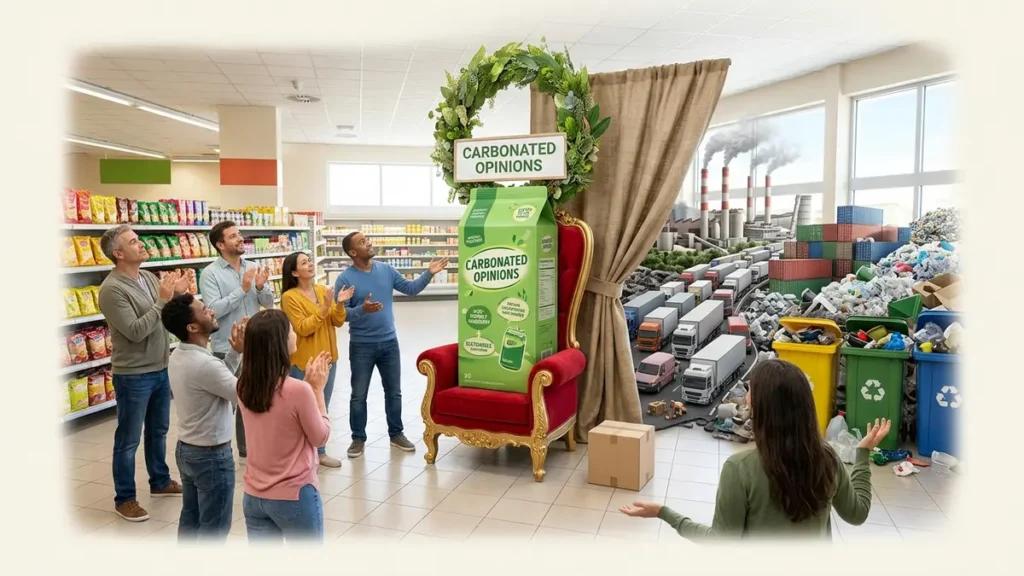
Eco-Friendly Products, Terms and Conditions Apply
Eco-friendly products have mastered the soothing first impression: a little leaf, a creamy beige label, perhaps a promise to be “kind to the planet.” It’s the retail equivalent of someone arriving at dinner with flowers and hoping nobody asks about their politics. Before we know what has changed—materials, emissions, sourcing, transport, disposal—we’re invited to enjoy the warm glow of having made a responsible choice.
That glow is the product. The object inside is sometimes merely there to support the campaign. Greenwashing works because nobody wants to be the person squinting suspiciously at a cheerful green bottle in aisle seven. We all have errands to run. The leaf knows this.
The Green Label’s Fine Print
Words such as “natural,” “clean,” “conscious,” and “planet-friendly” are wonderfully accommodating. They suggest moral effort without the administrative burden of saying precisely what was done. “Natural” may describe an ingredient, a colour palette, or a general yearning for moss. It doesn’t automatically explain the product’s footprint.
A useful environmental claim should survive basic follow-up questions. What material is used? Compared with what? How much recycled content is there? Where did it come from? Can it actually be recycled where most customers live? What happens when the thing is emptied, worn out, or abandoned beneath a bathroom sink?
If the answer is another soft adjective, we’re not looking at evidence. We’re looking at environmental marketing doing its little presentation deck, complete with stock photos of hands holding seedlings.
When Packaging Becomes the Environmental Hero
Packaging is often the sustainability spokesperson: highly photogenic, carefully rehearsed, and unavailable for follow-up questions. It wears earthy typography, a tasteful scattering of leaves, and the expression of something that has just returned from a forest meditation retreat.
Sometimes a package genuinely uses less material or includes recycled content. Good. That can matter. But a smarter-looking wrapper doesn’t settle the larger question of what the product is made of, how often it is replaced, or whether its end-of-life plan amounts to “hope someone has the right bin.”
This is the missing context reveal: one visible improvement can be promoted as though the entire product has undergone an environmental conversion experience. The box may have changed. The supply chain may still be backstage, declining interviews.
Sustainability, Now Available in Convenient Slogans
Broad promises work because modern shopping is already an exhausting referendum on our values. Buy this, feel better, carry on. It’s a wonderfully efficient moral shortcut, especially when the alternative is comparing sourcing, durability, energy use and waste while standing under fluorescent lights.
Environmental language can function like a fog machine: technically present, visually impressive, and remarkably good at hiding the machinery. The commercial incentive is obvious enough. Specific claims invite measurement; vague claims invite a feeling. Feelings are easier to print in a large friendly font.
A behavioural study by the Danish Competition and Consumer Authority involving more than 1,000 Danish consumers found that 54% believed a product with a packaging-related climate claim had a lower carbon footprint than a comparable product without a claim, while only 4% chose the product without a claim—evidence that a limited environmental improvement can create a broader impression of sustainability than the available information supports. The study also found that most respondents reported low trust in and limited understanding of companies’ climate claims, underscoring the importance of specific, transparent information rather than broad language or visual cues. The study’s findings on consumer responses to green claims show why an eco-friendly label should be evaluated against the product’s total environmental impact.
Give the Leaf a Follow-Up Question
A polished eco-friendly claim isn’t automatically a lie. Plenty of businesses do make real improvements, and those improvements deserve more than a cynical shrug. But polish is not proof, and a calming shade of green is not an environmental audit.
Before the next “planet-friendly” purchase, read the label like a tiny environmental detective with limited patience and a very good eyebrow. Ask one specific question: what, exactly, is better here? If the claim can name a material, a reduction, a standard, or a disposal route, it may have earned some credit.
If it responds with “conscious,” “clean,” and a leaf doing emotional support work, polite applause is probably enough.