
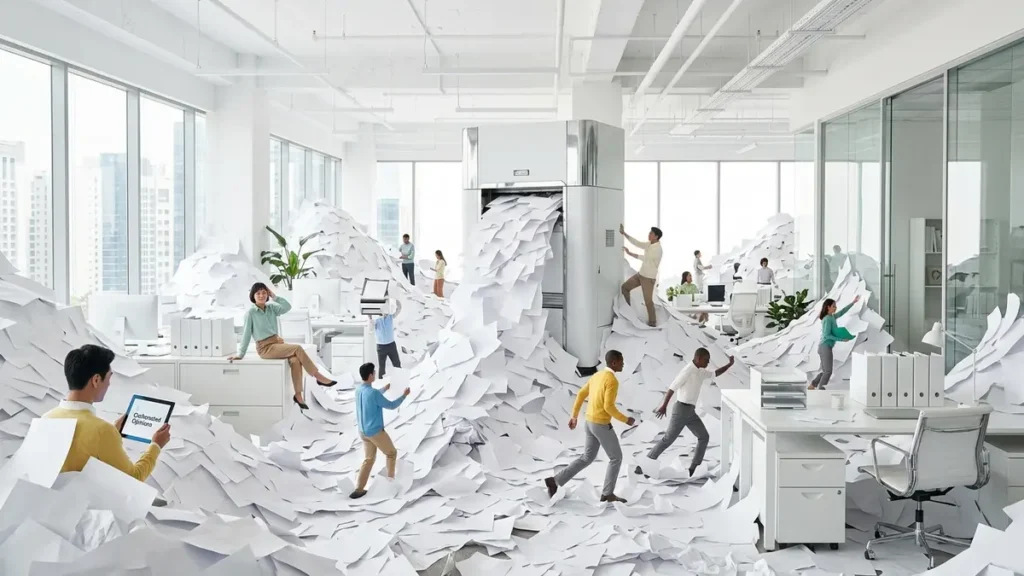
Paperless Office: The Great Fiber Free Dream That Printed Itself Anyway
The paperless office was one of those sleek modern promises that arrived dressed like a cure. No more filing cabinets, no more leaning towers of memos, no more forests quietly converted into meeting notes nobody read. A tidy future, elegant on paper, which was perhaps the first warning sign. Then humans entered the scene, glanced at their glowing screens, and printed the email, the attachment, and, for moral support, the cover page.
The funny thing is, the paperless office wasn’t a scam. It was a forecast made in the confident tone people use right before history clears its throat.
The End of Paper, Announced With Great Confidence
For a while, the paperless office was treated like one of those museum exhibits about the future that now look charmingly wrong. Here was the modern workplace at last: documents digitized, workflows streamlined, clutter banished by software menus and optimistic consultants. Paper would become a relic, a workplace ancestor, discussed the way we discuss floppy disks or medicinal leeches: important in its day, best left there.
And on paper, again, it made sense. Digital document management meant instant copying, instant sharing, instant storage. Which also meant, inconveniently, instant opportunities to print. New systems produced drafts, confirmations, backup copies, annotated versions, and the office classic, something printed “just in case.” Efficiency did remove friction. It just removed it in both directions.
When Digital Convenience Met Human Anxiety
This is where the family resemblance in human behavior becomes hard to miss. Every generation claims it has finally adopted a cleaner, saner habit. Then it keeps the old one in a drawer. Offices did the same. Screens were fine, databases were marvelous, and cloud storage was apparently revolutionary. But when signatures mattered, when audits loomed, when a manager wanted to “see it properly,” out came the hard copy like a secret inheritance nobody had the heart to throw away.
Office printing became less a technical necessity than a comfort ritual. The printer sat there like a fossil-fuel-adjacent altar to uncertainty, humming out reassurance one sheet at a time. People trusted digital systems right up to the point where they didn’t, which was usually five minutes before a deadline. The result was duplication at industrial scale: one version in the inbox, one in the shared drive, one on the desktop, and one in a folder thick enough to survive a small flood.
The Rebound Effect: Less Paper in Theory, More in Practice
Then came the part history specializes in: the neat solution that expands into a larger mess. The logic of digitization said less paper. The behavior around digitization said more of everything. More documents because they were easier to create. More storage because nothing had to be deleted. More devices to access the growing pile. And, thanks to all that abundance, more office printing when the abundance became mildly overwhelming.
The industry’s own research backs this up, which is the most damning part. AIIM, the association that has spent two decades cheerleading the paperless office, ran a survey asking information professionals a simple question: is your organization’s paper and photocopy consumption going up, down, or holding steady? A majority, 56 percent, said it was increasing or flatlining. Only 44 percent could honestly say it was going down. Two decades of keynote speeches, and the coin flip still favors more paper.
This is the rebound effect in office attire: a gain in efficiency that quietly invites more consumption somewhere else. The paperless ideal turned into a workplace diet everyone applauds right until the dessert tray arrives in PDF form and someone prints twelve copies for the meeting. The office became paperless in the way a drawer becomes organized after you shove everything in and close it with conviction.
The Receipts, Unfortunately, Are The Lesson
So yes, digital document management changed the office. It did reduce some waste, remove some clutter, and spare many a forest from at least a few pointless duplicates. But the larger lesson is older than the modem and less flattering. Human beings rarely meet a tool and use it with the elegant restraint promised in keynote speeches.
The paperless office was never exactly a lie. It was a historical misunderstanding: the belief that better systems automatically produce better habits. They don’t. They just give our old anxieties newer buttons. If you’ve ever printed a document you could have sworn you’d never need, come sit with the receipts.