
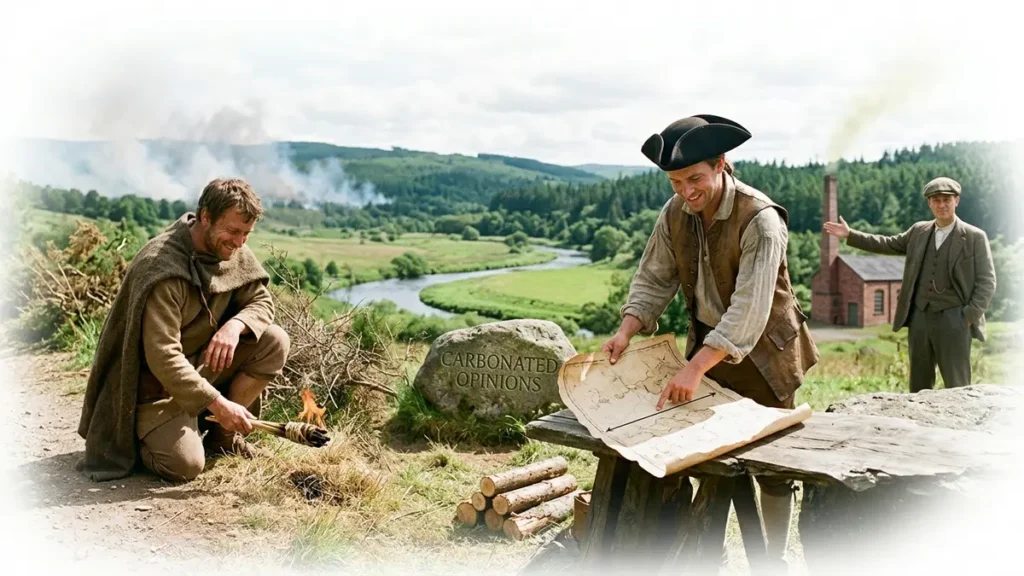
Environmental History: A Timeline of Eco-Oops
Environmental history reads less like a noble epic and more like a group project where everyone confidently wrote their section in pen—then discovered the rubric was “planetary limits.” If they only knew, right? The comforting part is that most past decisions weren’t made by cartoon villains twirling mustaches over smokestacks. The less comforting part is that “well-intentioned” and “ecologically disastrous” have always been able to share a table.
If you want the clean definition, Environmental history is basically the study of how humans and nature have been side-eyeing each other for centuries. And if you want the modern punchline, the Anthropocene (formal epoch or not) is the term we reach for when we notice we’ve become a geological event. Normal stuff.
Bronze-Age Bonfires And The First “If They Only Knew”
Picture a Bronze-Age council meeting: serious faces, practical sandals, a lot of fired clay. The agenda is simple—clear some land, burn some brush, make the area workable. Early landscape management wasn’t “environmental policy,” but it definitely had policy vibes: repeat the method that works, scale it to what your arms and weather can handle, and call it wisdom.
Today, we’d look at those burns and wince—soil loss here, habitat disruption there, the slow creep from “managed clearing” to “why is the hillside gone?” Not because fire is inherently evil, but because repeated disturbance stacks up like unpaid tabs.
Now imagine handing them an environmental impact statement dated 2126. It’s full of charts, carbon math, and words like “biodiversity services.” They read it politely, nod, and ask the only reasonable question: “So… can we still plant barley?” If they only knew they were beta-testing a land-use playbook we’d spend millennia trying to rewrite.
Colonial Can-Do And The Map That Forgot Soil
Colonial expansion loved a clean line on a map. Rivers became highways, forests became “timber,” and everything else became “resources,” which is a convenient word when you’d rather not say “living system with recovery time.” The optimism was almost admirable—if you ignore how often it treated ecosystems like they were infinite warehouses.
From a modern sustainability lens, the blind spot is obvious: extraction without regeneration is just borrowing with no repayment plan. But back then, the basic mental model was: if the land looks big, it must be durable. If the soil grows something once, it’ll surely do it again. Forever.
If they only knew what we now understand about erosion, nutrient depletion, and the way monocultures invite collapse like an open-door party. The irony isn’t that people were industrious—it’s that they were industrious with the confidence of someone who’s never had to read the fine print.
Industrial Age: The Great Acceleration Of Regrets
Then the Industrial Age shows up like a loud teenager who just discovered speed. The machine becomes a personality: bigger, faster, smokier. Humanity tries on this new identity—powered by fossil fuels, fed by deforestation, and cheersquad-ed by an economy that adored “growth” the way a teen adores volume.
It wasn’t one mistake. It was a succession of choices that looked perfectly rational inside their moment: burn the dense fuel, build the factory, pave the road, drain the wetland, push the smoke “somewhere else.” Each step was small enough to defend. Together, they became a lifestyle.
History’s cruel trick is that consequences don’t arrive at the same speed as inventions. So the soot, the polluted rivers, the stripped hillsides—those were future problems, filed under “later,” which is where societies love to store inconvenient truths.
If they only knew they were engineering not just prosperity, but a long-term relationship with atmospheric chemistry. And like many teenage rebellions, it came with a hangover and a permanently altered family home.
The Take-Away: Hindsight Isn’t A Judge, It’s A Tutor
This timeline of eco-oops is less a roll-call of villains than a catalog of ecological mistakes. It’s a record of limited information, short time horizons, and the endless human talent for mistaking “can” for “should.” Hindsight is 20/20, sure—but it’s also the only lens we’ve got for spotting patterns before we repeat them with better tools and worse consequences.
The wise move now isn’t to sneer at the past or romanticize it. It’s to treat environmental history like the world’s most expensive coaching session: learn faster than our predecessors did, and stop pretending the planet will politely absorb whatever phase we’re going through.