
Pizza Box Recycling: Why Your Pizza Box Is A Liar
Your pizza box shows up like a slick con artist in a “100% recyclable” suit, smiling wide, winking hard—and sweating oil like it’s hiding a warrant. Pizza box recycling sounds clean and satisfying, a neat little ending to a messy meal. Then you lift the lid and the truth slides out: cheese fossils, crust shrapnel, and grease stains spreading like gossip. That box isn’t evil. It’s performative. And it’s about to drag your good intentions into the sticky back room of waste management.
Grease And Gossip: What Actually Happens To Your “Recyclable” Pizza Box
At the sorting facility, your pizza box doesn’t walk in as “cardboard.” It walks in as a suspect.
Dry, clean cardboard is basically a hardworking citizen: boring, stackable, easy to process. But your box? It’s an informant who can’t stop talking—except its secrets are soaked into the fibers. That translucent blotch in the corner isn’t “a little oil.” It’s a slick, shiny confession letter. Recycling paper products depends on fibers bonding with water in a pulping process. Grease is the bouncer at the door, arms crossed, refusing to let water do its job.
And grease doesn’t travel alone. It brings friends.
That browned cheese smear? That’s food residue. That means bugs, bacteria, and a smell that’s not “Italian night,” it’s “rancid whisper in a warm dumpster.” When a bale of cardboard is being made, contamination isn’t a philosophical debate—it’s triage. Recyclers look at a load like an ER nurse looks at a waiting room. Clean stuff gets processed. The questionable stuff gets quarantined. The gross stuff gets rejected because nobody wants to pulp a greasy mystery and pretend it’s office paper.
Here’s the part people hate, because it ruins the comforting sticker logic of life: one greasy box can mess with a batch. It’s not that recyclers are delicate. It’s that the system is engineered for certain inputs, and your pizza box is freelancing.
So when you ask “Can I recycle pizza box?” the honest answer is: you can try, but the box is a liar with oily hands.
Compost Or Landfill? The Messy Math Of Finite Space And Infinite Takeout
We live in an economy that wants infinite growth: infinite orders, infinite apps, infinite “just one more slice.” But landfill space is not infinite. Compost capacity isn’t either. The planet doesn’t have an expanding closet where our leftovers magically hang themselves up.
Landfills are basically a hoarder’s basement with heavy machinery. Every extra-large pepperoni box is another object shoved into the stack, another “I’ll deal with it later” that turns into decades. And the thing about hoarder basements is they don’t get roomier just because you keep shopping.
So what’s the least-wrong move when you’re staring at a box that’s half respectable and half crime scene?
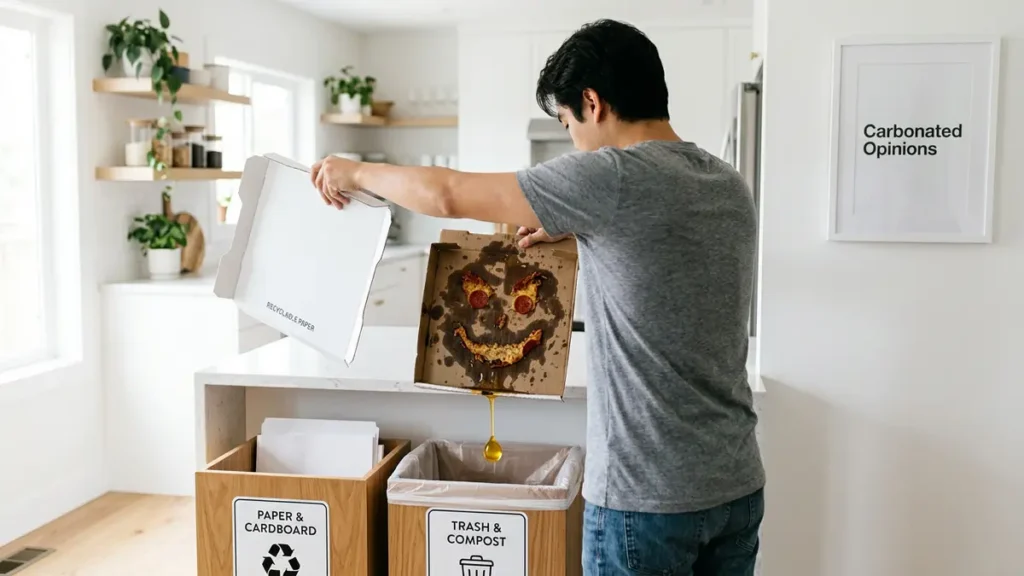
- Do a two-part interrogation. Open the box. Smell it. Look at it. If the top is mostly clean and the bottom looks like it lost a fistfight with a pepperoni puddle, don’t treat it as one object.
- Tear out the greasy parts. The greasy, stained sections are the oil-soaked alibi. Those are the parts most likely to get rejected in recycling.
- Recycle the clean parts (if allowed locally). Some places accept lightly soiled cardboard, some don’t. Your municipality is the judge, not the vibes.
- Consider composting pizza box pieces—carefully. If you have access to composting (home or municipal), the clean-ish, uncoated cardboard can be a decent “brown” material. But compost isn’t a magical redemption spa. Too much greasy food residue can attract pests, slow decomposition, and make your pile smell like a regret you can’t Febreze. For the basics—and the reality check—see composting.
- When in doubt, trash the worst of it. Not because you’re a bad person. Because sending contaminated material into recycling can turn “recycling” into “sorting-and-dumping with extra steps.”
This is the messy math: a million greasy boxes don’t become a million recycled wins. They become a million stress tests on a system with limits.
Take-Away
Your pizza box isn’t a villain. It’s that messy roommate who swears they’ll do the dishes, then leaves a skillet “soaking” for three days. Treat it accordingly: strip off what ruins the system, compost what actually breaks down, and stop assuming “recyclable” means “harmless.”
Try a two-minute triage next time: peel off the greasy slice liner, tear the stained corner, and send a photo of your heroic, slightly oily cardboard to the internet. Tell us whether you composted, recycled, or mercifully trashed it.