
Paris Agreement Explained: a Climate Contract with a “Frequent Loophole” Rewards Program
If you’ve ever signed a “simple” phone contract and later discovered a hidden fee for “breathing near the device,” you already have the emotional skillset for Paris agreement explained. On paper, it’s the world’s most earnest group project: keep warming well below 2°C and try for 1.5°C. In practice, it’s also an international choose‑your‑own‑adventure where the villain is fine print and the hero is creative accounting with excellent posture.
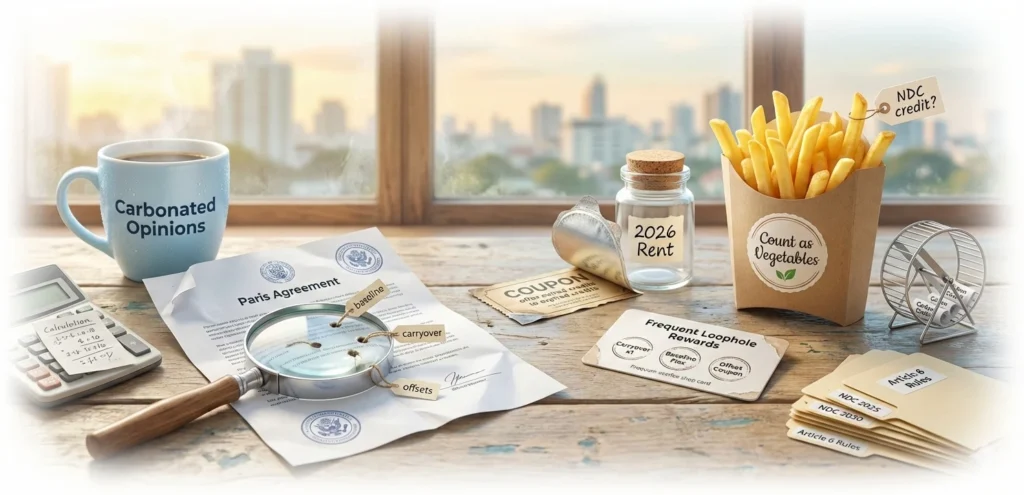
Think of it like a family diet plan: everyone vows to eat kale, but reserves the right to “count fries as vegetables” if deeply motivated. The Paris Agreement is that—except the family is 190+ countries, the kitchen is the entire atmosphere, and the fries are emissions.
What Paris Promised (and What It Quietly Left to Interpretation)
The Paris Agreement’s elevator pitch is disarmingly wholesome: global cooperation, national plans, progress over time, and a shared goal of not turning Earth into a slow‑roasted terrarium. The mechanism for all this is the nationally determined contribution (NDC): each country submits its own climate plan, then updates it every five years with “increased ambition,” ideally.
This is where the Agreement’s charm and its chaos share a studio apartment. Because NDCs are nationally determined, they’re flexible by design—like a dress code that says “business casual” and then pretends not to notice the guy in pajama pants holding a briefcase. Countries can choose their targets, timelines, sectors covered, and (crucially) how they define success. The result is a framework that’s politically achievable… and also a little like approving a restaurant safety policy that says, “Cook chicken until it feels emotionally ready.”
If you’re asking what is the paris agreement in functional terms, it’s a pledge‑and‑review system: promise, report, update, repeat. That repetition is the point. The problem is that repetition can also become a lullaby.
The Art of the Loophole: Accounting, Baselines, and Creative Math
Every climate pledge begins with a baseline—the “starting weight” before the diet. And as anyone who has ever “started Monday” knows, the baseline is the most spiritually flexible part of the endeavor.
Countries can frame targets in different ways: absolute emissions cuts, reductions relative to GDP, cuts versus a business‑as‑usual forecast, or sector‑specific goals. Each approach can be legitimate, but it also creates room for what accountants call “methodology” and what the rest of us call “how did you get that number?”
Here’s the loophole energy in plain language:
- Baselines can be massaged: If your “business as usual” projection is generously high, then “reducing” from it can look heroic while reality barely budges.
- Inventories can vary: Different methods and data quality make comparisons messy—like judging a baking contest where half the contestants measured flour in grams and the other half measured it in vibes.
- Old carbon credits can haunt the present: In some systems, credits from earlier regimes can be carried over, letting reductions claimed long ago do fresh service today—like trying to pay your 2026 rent with a coupon from a 2012 yogurt lid.
That last bit—carryover of older credits—has been a recurring point of international negotiation. The Paris framework tries to tighten the rules over time, but the very fact it requires repeated tightening tells you the door was installed with a “soft close” feature.
If international diplomacy were a circus, the Paris Agreement would be the trapeze: impressive, thrilling, and occasionally performed with safety nets labeled “flexibility.”
Carbon Credits and the Market Carousel
Offsets are the climate world’s version of buying salad after you ate the cake, then insisting the meal was “balanced.” The idea is not inherently ridiculous: fund emissions reductions elsewhere when cutting at home is hard. The problem is that “elsewhere” is where accountability goes to nap.
Carbon markets can create real benefits—especially when they finance high‑quality projects and come with rigorous monitoring. But they also invite double counting, variable quality (not all credits represent real, additional, durable reductions), and paper gains vs. atmospheric reality: a ton on a spreadsheet is not automatically a ton in the sky.
The Paris Agreement’s Article 6 was built to manage this marketplace with better rules, but the hamster wheel is still spinning: standards evolve, integrity debates continue, and everyone promises that this time the credits have excellent provenance.
To understand why this matters, you don’t need to become a carbon quant. You just need to recognize the temptation: if you can buy your way to “net zero” the way you buy your way out of airport baggage fees, a surprising number of people will call that “innovation.”
Diplomacy, Politics, and the Slow-Cook of Ambition
Climate deals are negotiated by governments, which means they’re negotiated by human beings with elections, rivalries, domestic industries, and a deep emotional attachment to not being blamed later. The Paris structure is designed to accommodate that reality—hence its pledge‑and‑review model, its emphasis on transparency, and its reliance on peer pressure rather than punishment.
Peer pressure can work. It can also turn into the world’s longest group chat where everyone says “We should totally do something soon” and then mutes notifications.
The timing helps and hurts: five‑year cycles encourage updates, but they also create a perpetual horizon where real pain can be scheduled right after the next election. Add in the political allure of future technologies—especially large‑scale carbon removal—and you get a familiar pitch: “Don’t worry, we’ll clean up later.” Which is the climate policy equivalent of saying, “Yes, I’m driving into a ditch, but I’ve ordered a winch.”
This is where Paris agreement criticism becomes less about betrayal and more about incentive design. Paris didn’t “fail” by being flexible; it succeeded by existing. It just also invited an entire genre of stalling: stall‑and‑hope, stall‑and‑offset, stall‑and‑rebrand.
Take‑Away
The Paris Agreement is necessary in the way seatbelts are necessary: they don’t prevent every crash, but you’d be out of your mind to remove them because some people still speed. A sober reading of Paris agreement explained is that it’s a framework with real teeth only if countries keep sharpening the dentist tools.
The weaknesses are not mystical; they’re fixable:
- Stricter, comparable accounting so baselines and inventories can’t moonlight as fiction.
- Transparent, high‑integrity crediting rules to curb double counting and low‑quality offsets.
- Phasing down reliance on offsets so “net” doesn’t become a personality.
Keep the Agreement. Lose the loopholes. And if we’re going to count fries as vegetables, at least make them honestly labeled potatoes with feelings.
Call to action: Share this with your favorite policy nerd, drop a comment with the loophole that annoys you most, and support stronger transparency rules—because the atmosphere doesn’t accept refunds.
If this loophole-filled drama made you raise an eyebrow, you might enjoy Carbon Offsets: The Adult Version of ‘I’ll Clean My Room Later’