
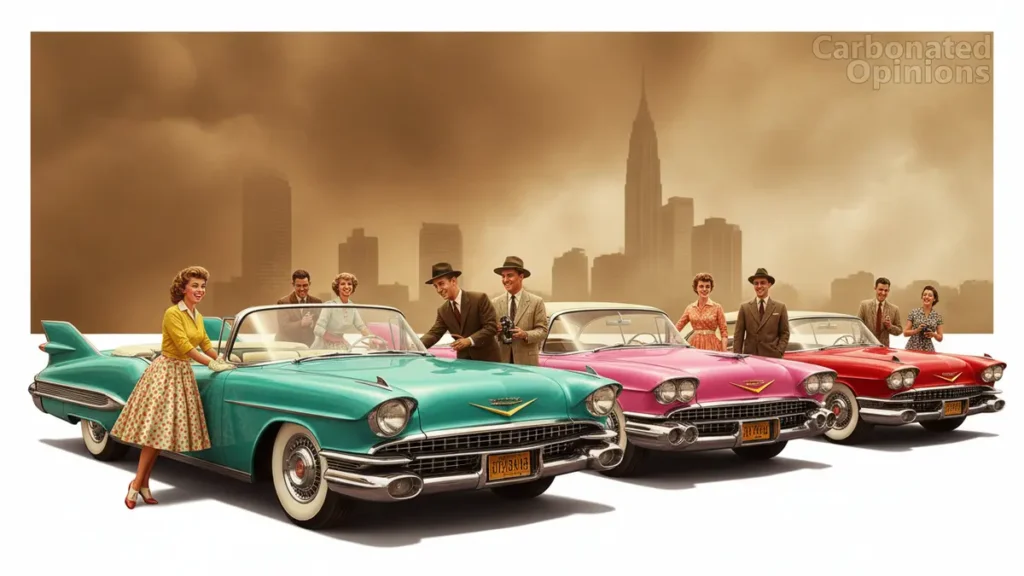
1950s Car Culture History And The Fine Print Nobody Read
Postwar America sold a simple bundle: a job, a lawn, and a car with enough chrome to signal aircraft. 1950s car culture history framed that bargain—optimism was real. So was the clause in microscopic font: some assembly required for breathable air.
The 1950s didn’t just popularize driving; they professionalized it. They taught a nation to measure freedom in miles per gallon and ignore what came out the other end.
Tailfins, Chrome, And The Romance Of The Open Road
Suburbia wasn’t just housing—it was a commuting subscription. Highways stretched, neighborhoods sprawled, and the family car became both ticket and altar. Style often outran sense: tailfins promised rocket-age destiny while doing the aerodynamic work of a decorative lampshade.
In this version of the American dream, “open road” was code for “we paved your social life.” 1950s car culture history is basically a love story between asphalt and ambition, narrated by a V8.
Under The Hood: Why 1950s Engines Loved Leaded Gas
Performance had a chemical helper. Additives like tetraethyllead raised octane, reduced engine knocking, and let manufacturers chase higher compression ratios—more power, smoother bragging rights.
It was the perfect mid-century bargain: take a little metal, sprinkle it into fuel, and watch engines purr. Then watch the atmosphere collect the bill. The 1950s car was a jazz solo on wheels: loud, improvisational, and leaving everyone coughing in the audience.
If you’re craving a domestic metaphor, buying a shiny sedan in the 1950s was like adopting a brass ensemble—great for the show, and it left the living room a little dusty. Except the “living room” was the entire city.
When The Horizon Went From Blue To Brown
Cities didn’t develop “atmosphere” so much as they developed an atmosphere. Smog turned skylines into a permanent sepia filter—romantic, if your idea of romance is wheezing through a postcard. Visibility dropped. Eyes burned. Respiratory problems climbed. This period is a key chapter in the broader story of cars and air pollution 20th century, where convenience consistently outpaced consequence.
And because this was the era of confidence, the problem was often treated like a temporary mood swing: open a window, tough it out, stop complaining. The 20th century was excellent at inventing convenience and then acting surprised when it had exhaust.
Policy Lag And Path Dependence
Here’s the trick about infrastructure: once you build a life around driving, you don’t “just switch.” Roads, zoning, and consumer expectations hardened into a routine that made cleaner air feel like an optional upgrade.
Regulation moved slowly; industry moved quickly; the public stayed busy applauding the latest fins. Pre-EPA air quality standards were, in many places, more vibe than rulebook—earnest suggestions trying to out-talk a thousand tailpipes.
That’s the legacy of 1950s car culture history: design choices that became destiny, and nostalgia that keeps acting like the past was cleaner because it was black-and-white.
Take-Away
The 1950s mastered speed and style, then outsourced the consequences to lungs and skylines. If there’s a modern lesson, it’s this: every “freedom” has a tailpipe, and the bill always arrives late.
Tell us your vintage-car memory—or your best “the air tasted like pennies” smog story—and nominate the next decade for Retrograde Planet.