
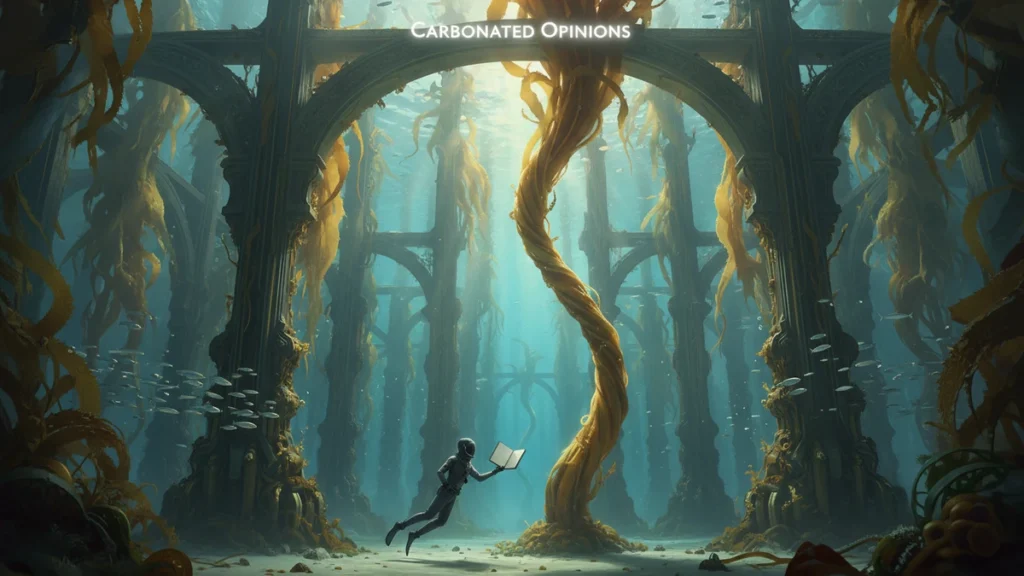
Seaweed: The Ocean’s Green Gossip Columnist
A celebrity walk the plank? Not quite. But if the ocean had a “Most Influential” list, seaweed would be Beyoncé, Oprah, and that one Kardashian who pretends to be low‑key — all rolled into one slimy strand. Quiet, green, and busy, seaweed is basically chlorophyll with a passport: well‑traveled, photogenic, and secretly running the show while plankton takes all the credit.
What’s in a Strand? — Seaweed 101
Seaweed isn’t one plant. It’s thousands of species of macroalgae, which is science’s way of saying “the ocean’s wig collection.”
- Green algae: the eco‑friendly smoothie influencer.
- Brown algae: the moody indie band with kelp forests as their stage.
- Red algae: the drama queen who insists on being exotic and mysterious.
Some seaweeds drift like freeloading backpackers. Others cling to rocks with a holdfast, which is basically seaweed’s version of Velcro. They don’t have roots or flowers, but they still manage to photosynthesis. Translation: they’re freeloaders who turn sunlight into snacks.
Green Power and Other Superpowers
Seaweed performs photosynthesis, which is science’s way of saying: “I eat light and fart oxygen.” It also slurps up carbon dioxide like a hungover frat boy with a Slurpee. When chunks sink, they lock carbon away in the deep ocean — the algae equivalent of shoving dirty laundry under the bed.
Kelp Forests? Think underwater Beverly Hills. Fish, crustaceans, birds, and marine mammals all live there, enjoying fabulous hair days thanks to the constant swish of kelp strands. It’s basically a coastal neighborhood where everyone has gills and nobody pays rent.
From Sushi to Superfood — Seaweed in Human Life
Humans have been eating seaweed for centuries, proving that we’ll snack on anything if it’s salty enough.
- Dried? Crunchy ocean potato chips.
- Fried? Tempura’s green cousin.
- Blended? Smoothie sabotage.
Beyond the plate, seaweed sneaks into cosmetics, fertilizers, and animal feeds. Innovators are even testing it for biofuels and bioplastics, because apparently the future is powered by slimy salad.
But let’s be clear: seaweed is an ingredient, not a miracle cure. It’s not going to fix your Wi‑Fi or make your ex text back.
When Green Goes Rogue — Blooms, Invasives, and Overharvest
Seaweed isn’t always the hero. Sometimes it goes full villain.
- Nutrient overload? Seaweed throws a rave, oxygen drops, fish suffocate, and the party gets shut down.
- Invasive species? Seaweed moves into new neighborhoods, hogs the sunlight, and tells native plants to “get a job.”
- Overharvest? Humans strip the coast bare, and suddenly the shoreline looks like a bad haircut.
Good management matters. Otherwise, seaweed turns from eco‑darling to slimy mob boss.
Can Seaweed Save the Planet? (Spoiler: It’s Complicated)
Seaweed farming looks promising. Farms absorb nutrients, create habitat, and sequester carbon. But scaling up is tricky. Too many farms, and suddenly the ocean looks like a slimy IKEA showroom. Fishermen complain, shipping lanes clog, and carbon accountants start sweating over spreadsheets.
Seaweed is a tool in the climate toolbox — useful, but not the superhero cape we’re all hoping for. Think of it as the sidekick who occasionally saves the day but also eats all the snacks.
Take-away
Seaweed deserves more credit. It feeds people, shelters wildlife, and plays a role in coastal carbon dynamics. But it has limits. If plants had a celebrity list, seaweed would be the indie star who ghostwrites all the hits while kale hogs the spotlight.
So next time you munch on a seaweed snack or spot kelp while snorkeling, brag about it. You’re basically gossiping about the ocean’s green celebrity — the one who saves the planet while looking fabulous in underwater selfies.