
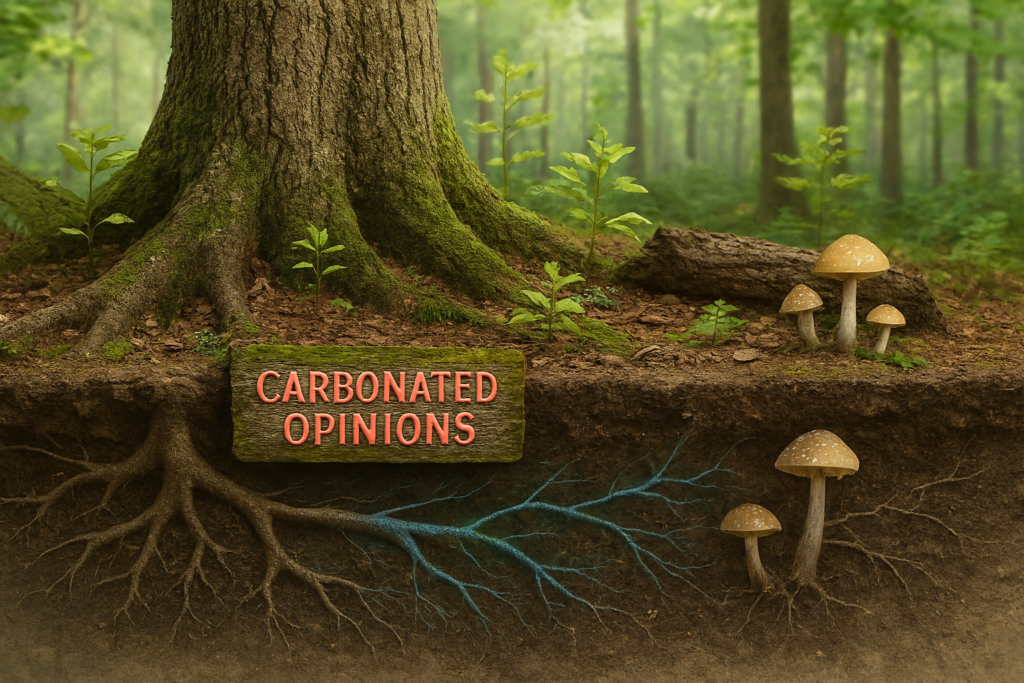
Why Trees Gossip Underground: The Fascinating Truth About the Wood Wide Web
The forest is a neighborhood where nobody owns a smartphone, yet secrets travel faster than gossip at a book club. Beneath the leaf litter and politely decaying logs, a vast mycorrhizal network of fungal threads links roots like a subterranean social network. Trees don’t exactly text each other, but they do trade sugars, warn of pests, and sometimes play Grinch with resources. Welcome to the wood wide web — the original fiber-optic network, but with more dirt and fewer buffering icons.
What’s the secret sauce? Mycorrhizae and mycelium, explained
Plants and fungi have been awkwardly holding hands for hundreds of millions of years. In most cases the handshake is mutualistic: fungi wrap around or slip into roots, forming what scientists call mycorrhizae. The fungus extends the tree’s reach with microscopic hyphae that scavenge water and minerals. In return, the tree delivers sugars made in its leaves.
Think of mycorrhizae as the forest’s Wi-Fi routers — only cuter and less judgmental about your browsing history.
Mycorrhiza is the technical name, and it is gloriously unromantic-sounding for such a crucial environmental partnership.
The wood wide web: how trees actually communicate underground
When fungal hyphae from different roots connect, they can form a common mycorrhizal network. This underground system allows carbon, nutrients, and chemical signals to move between plants. Seedlings sometimes get a boost when a nearby adult tree shares carbon. A tree under insect attack can trigger chemical signals that prompt neighbors to ramp up defenses.
That sounds like gossip with purpose: “Hey, aphids are at the north side — stock up on tannins!”
But let’s be clear: this is not communication in the human sense. These transfers are passive flows driven by gradients, fungal behavior, and plant biology.
The phenomenon is known scientifically as a
mycorrhizal network, often nicknamed the wood wide web — a metaphor that is surprisingly accurate, and only slightly misleading.
“Mother trees” and scientific gossip: myth vs. measured science
Popular science loves a good matriarch. Enter the “mother tree,” allegedly feeding orphaned seedlings out of pure woodland kindness. Some field studies do show hub trees that appear to distribute more resources to nearby young trees. But science, unlike fairy tales, comes with footnotes.
Resource sharing depends on species, soil conditions, seasons, and which fungal species are running the network. Sometimes fungi favor certain plant partners. Sometimes what looks like generosity is simply an efficient reallocation that benefits the network — or the fungus — more than the receiving tree.
Think of it like a neighborhood potluck: it’s hard to tell whether the host is generous or just angling for praise and leftovers.
Why underground networks matter for forests and climate
These underground fungal networks matter for forest health, seedling survival, and climate resilience. After disturbances like logging, fires, or storms, intact mycorrhizal networks can help forests recover faster. In a warming world, connected forests may buffer stress by redistributing resources or early warning signals.
That said, the wood wide web is not a magical fix-all. Drought, pests, and human land use still matter — a lot. Think of fungal networks as infrastructure: powerful, essential, but only effective if the rest of the system isn’t falling apart.
Protecting fungal diversity is like maintaining roads and power lines. No infrastructure, no deliveries. No fungi, no shared sugar economy.
How to support the wood wide web in your own backyard
You don’t need a PhD to be a good neighbor to fungi. Leave fallen wood and leaf litter where it lies — that’s premium fungal real estate. Avoid over-sterilizing soil with harsh chemicals; fungi are sensitive and slow to return once wiped out.
Plant native species that evolved alongside local fungal partners. When replanting, preserve existing soil and roots instead of swapping everything for sterile potting mix. Small actions help keep the forest’s underground routers online.
Take-away
Trees don’t gossip for fun. Their underground chatter is a blend of trade, signals, and ecological hard bargaining. The idea of a cooperative, communicative forest isn’t poetic fluff — but it’s also not a fairy tale of selfless giants.
It’s messy, conditional, and deeply fascinating.
So next time you walk through the woods, tip an imaginary hat to the hyphae. They’re running the original internet — slower than your modem, but with vastly better long-term uptime.
Protect the soil. Welcome the mushrooms. And remember: forests have a low-key social life underground, and we’re all better off when the routers are working.