
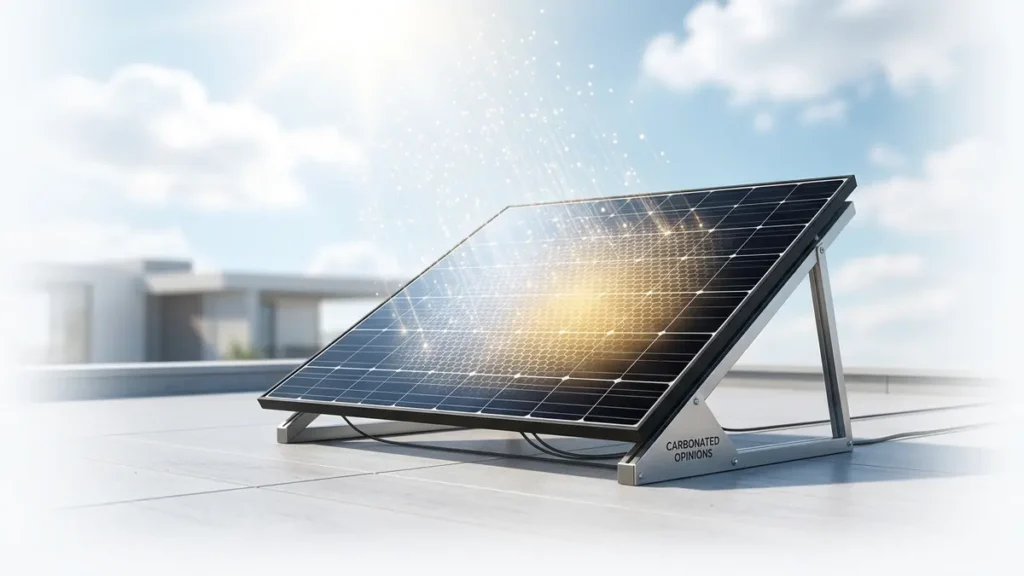
How Do Solar Panels Work
Solar panels look like silent, smug rectangles—until you remember they’re doing something borderline magical: turning sunlight into electricity with no moving parts. The trick isn’t “free energy,” it’s disciplined materials science plus a star doing star things. If you’ve ever wondered how do solar panels work, the answer is equal parts physics lecture and household appliance logic.
At a high level, solar energy basics are simple: sunlight arrives, a panel sorts the useful bits from the useless bits, and the system converts that into power your home can actually use. The rest is just the details we conveniently call “engineering.”
The Photon Conversion Party: Photons, Electrons, And The Photovoltaic Dance
Inside each panel are photovoltaic cells—most commonly silicon—designed for one job: persuade light to donate energy to electrons. In photovoltaics, photons (packets of light) hit a semiconductor and can knock electrons loose. If those electrons have a path, you get electric current.
Think of the panel as a sieve for sunshine. The sunlight arriving is a messy mix—different wavelengths, different energies. The cell can’t “use” every photon like a perfectly efficient fictional machine, but it can separate out a steady stream of usable electrons from a lot of energetic noise.
Now add the “bouncer” at the door: the p–n junction inside the cell creates an electric field, like a velvet rope that tells electrons which direction is “toward the exit.” Marketing loves to imply the electrons are joyfully volunteering; physics says they’re being politely but firmly herded.
Physics vs. Marketing: The panel doesn’t “store sunlight.” It doesn’t “pull power from the air.” It converts incoming electromagnetic energy into electrical energy, and it does it only while the sun is paying the bill.
From Sunlight To Socket: Components That Do The Heavy Lifting
A solar setup is less “one gadget” and more “a small committee.” Each member has a specific task, and none of them get to violate electrical code just because the sun is feeling generous.
- Panels: Make direct current (DC) electricity.
- Mounting/racking: Holds panels at the right angle and survives weather without becoming a neighborhood kite.
- Wiring and protection (balance of system): The unsung infrastructure—switches, breakers, grounding—doing the unglamorous work of not catching fire.
- Inverter: The system’s diplomat. Polite, crucial, and slightly overworked, translating panel-made DC into grid- and appliance-friendly alternating current (AC).
Household metaphor time: if the panel is a faucet turning sunlight into a flow of electrons, the inverter is the plumbing adapter that makes that flow fit your house. Your toaster is not bilingual. It speaks AC.
Irony break: solar is “energy-saving,” yet it requires extra equipment—metal frames, glass, semiconductors, power electronics—to make the savings legible to your refrigerator. Energy efficiency often shows up carrying a toolbox.
Efficiency And Reality: Why Size, Angle, And Weather Matter More Than Wishful Thinking
Solar panel efficiency is basically the fraction of incoming sunlight that becomes usable electricity. Higher efficiency means more power from the same area. Lower efficiency means you need more panel surface—more “sieve”—to catch the same sunshine.
But output isn’t a single magic number; it’s a negotiation with the sky and geometry:
- Orientation and tilt: Panels aimed well at the sun collect more light. Poor angle is like opening your blinds halfway and expecting a tan.
- Shading: A little shade can cause a surprisingly large hit. Solar cells are team players; one underperformer can drag the group down.
- Temperature: Panels generally perform worse when hot. Yes, the thing powered by the sun can be slightly less happy in heat. Physics enjoys irony.
- Weather and seasons: Clouds, haze, and short winter days reduce production. Solar energy is real—just not always punctual.
Physics vs. Marketing: The promise isn’t “free electricity forever.” It’s predictable production that varies with conditions, like rainfall into a cistern. The sun is abundant; your roof area and local climate are not.
Installation And Lifespan — What To Expect Over A Decade
Installation is mostly about making solid choices up front, so you don’t spend the next ten years thinking about your roof in the middle of every storm. Roof installs save space and keep panels close to where the power is used, while ground mounts can optimize angle and simplify access; both approaches must still handle wind and snow loads. Then there’s the paperwork phase—permitting and interconnection—where physics pauses and bureaucracy takes the stage. Maintenance is generally low: keep panels reasonably clean, watch for shading from new tree growth, and ensure components like inverters keep behaving. Over time, panels slowly degrade: they tend to produce a bit less each year. Warranties often reflect that reality with performance guarantees over decades. The takeaway isn’t fragility—it’s that solar is equipment, not a spell. You’re buying a long-lived machine whose main moving part is Earth’s rotation.
Take-Away
Solar panels are a proven, low-maintenance way to turn sunlight into usable power—but their performance depends on physics and placement, not optimism. Treat them like long-term infrastructure: a well-positioned sieve for sunshine, paired with a hardworking diplomatic inverter translating Sun into Socket.
Subscribe for a monthly dose of clear, slightly sardonic explainers — so you can tell smart solar choices from bright-but-flaky ones.