
Intro
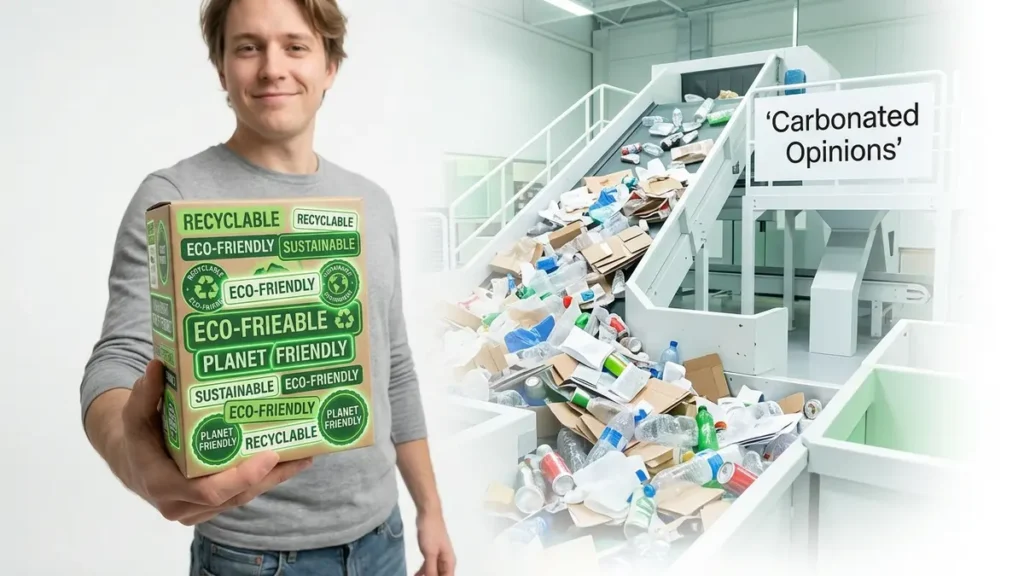
You buy something. The package screams “RECYCLABLE” like it earned a medal. You feel good. That is the point. The label promises climate-friendly glory with almost no effort.
But here’s the catch: the word “recyclable” is flexible. It is a marketing tool, not a guarantee. Many packages that look green never see a recycling plant. That does not always mean foul play. It often means we lack the systems to match the promise.
The Fine Print of Friendly Labels
Labels whisper, rather than shout. “Recyclable” can mean anything from “accepted by most curbside programs” to “technically recyclable in a lab somewhere.” “Widely recyclable” is not a legal definition — it’s a polite suggestion.
“Made from recycled content” sounds virtuous. Check the percentage. One percent counts as a claim. Resin codes — the tiny triangle and number on plastics — tell you what the item is. They do not tell you whether your town will take it. And “compostable” is its own circus: many items need industrial composting, not a home bin.
Recycling vs. Reality: Infrastructure, Contamination, and the Economics
Recyclable in theory does not equal recyclable in practice. Two big reasons: infrastructure and money. Your local recycling center may not accept certain plastics or mixed materials. A coffee cup with a plastic lining is a classic offender. The paper looks recyclable. The lining does not.
Contamination is another villain. Food, grease, and liquids can turn a whole batch of recyclables into trash. Single-stream recycling makes life easy for consumers, but it mixes items and drives down quality. Low-value materials also cost money to ship. If selling the recycled material loses money, it can end up in a landfill anyway.
So a nice “recyclable” badge does not build sorting plants. It does not pay for collection routes. It mainly buys good PR.
Corporate Spin and Greenwashing Tricks
Marketing teams love loopholes. They use mild words, pretty symbols, and one-liners to imply more than they deliver. A pack may trumpet “contains recycled material” while hiding non-recyclable glue, metal strips, or multiple layers that defeat recycling.
This is often like putting lipstick on a landfill: the package looks better for marketing photos, but the waste stream stays the same. And sometimes the label is as useful as a “do not disturb” sign on a hurricane — politely irrelevant when the system is overwhelmed.
Not every claim is dishonest. But the system favors good stories over full transparency. That is where real change is needed.
What You Can Do (Without Becoming a Compost Hermit)
You do not need to become obsessive to make a difference. Start with easy habits. Check your local council’s recycling guide online; it tells you what your area actually accepts. Choose products with clear, higher percentages of recycled content. Avoid obvious mixed-material packaging like foil-lined paper or plastic-paper combos.
Prefer refill stations and bulk buying when you can. Wipe containers clean before recycling to reduce contamination. Ask brands where their packaging goes. Consumers asking questions move markets.
Also support systemic fixes: standardized labeling that tells you exactly what to do, and Extended Producer Responsibility (EPR) policies that make makers pay for disposal. Those changes make a far bigger difference than any shiny label.
Take-away
“Recyclable” on a label can be comforting. It can also mislead. Be skeptical but practical. Learn your local rules, choose simpler packaging, and push for laws that force companies to take responsibility. That way we can turn the recyclable claim from a PR trick into something real — and stop putting a fancy suit on a bad idea.
Packaging didn’t invent litter. It professionalized it.
The story of “recyclable” packaging only makes sense when you zoom out — all the way back to Roman streets, public blame, and the birth of throwaway culture.
→ The History of Littering: From Roman Streets to Fast Food Wrappers