
History of Littering: A Very Old Mess
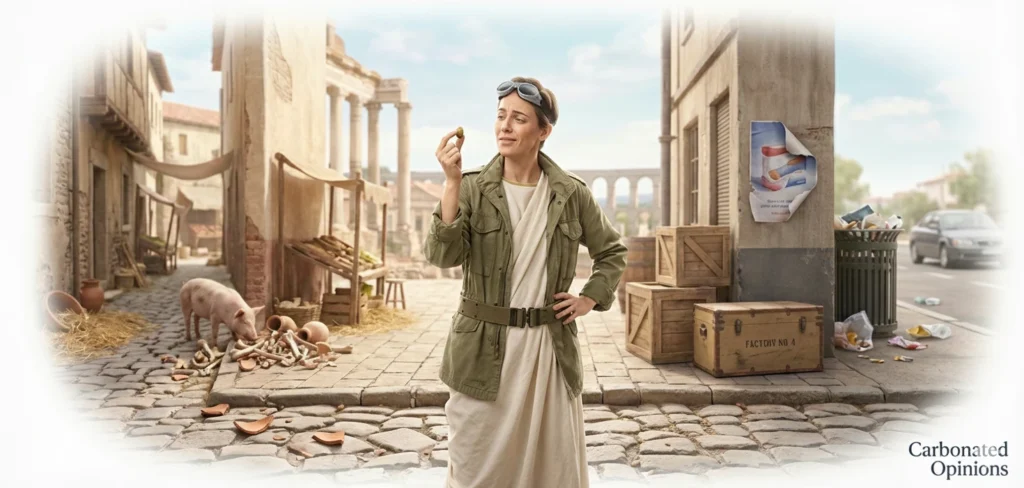
A sarcastic time traveler stands in a Roman forum, chin raised, holding an olive pit like it’s a microplastic artifact. She sighs. “Humans,” she says, “always invent new ways to be messy.” That scene sets the tone: the history of littering is not a modern scandal but an ancient habit with excellent staying power.
Long before plastic wrappers and takeaway cups, people were already outsourcing responsibility to the street. Littering has always been a blend of weak social norms, imperfect public management, and the comforting belief that someone else will deal with it.
When in Rome, Don’t Drop That Olive Pit
Ancient cities often had impressive infrastructure. Aqueducts, paved roads, and public baths defined life in Ancient Rome.
They also had streets dotted with food waste, broken pottery, and yes, olive pits.
Civic cleaning crews existed, and laws regulated dumping — which proves two things: people littered, and authorities were already tired of it. Litter was both an engineering problem and a behavioral one. The takeaway is timeless: a well-built city does not automatically produce polite citizens.
Medieval Streets: God, Plague, and Lower Expectations
Medieval towns combined dense populations with very loose definitions of public space. Pavements doubled as dumping grounds, animal enclosures, and emergency toilets. Waste piled up. Scavenger animals helped — and occasionally escalated the situation.
Moralizing sermons sometimes doubled as public-health announcements. Cleanliness could be framed as godliness, or at least as a strategy to avoid dying spectacularly. Regulation existed, enforcement less so. In short: life was hard, sanitation was optional, and litter blended seamlessly into the background horror.
The Industrial Revolution: Mass Production, Mass Mess
The Industrial Revolution changed the scale of waste. Cheap goods, more packaging, and rapid urban growth overwhelmed municipal services. Convenience became a civic problem.
Factories and shops normalized disposable items. Repair culture weakened. Storage lost its appeal. If something was cheap enough, why keep it? This mindset helped lay the foundation for modern littering — less a moral collapse than a logistical one with branding.
Fast Food, Fast Litter: Twentieth-Century Acceleration
The twentieth century perfected portability, turning litter into a side effect of convenience — a problem that explodes in the age of single-use plastics and disposable packaging culture. Fast food, cars, and advertising made throwing something “away” feel effortless, even when “away” was the roadside.
Cigarette butts emerged as the reigning champion of discarded objects — small, plentiful, and somehow exempt from guilt. Design prioritized convenience over containment, and mobility allowed litter to migrate far from its origin. The result: cleaner kitchens, messier public spaces.
From Policy to Psychology: Why People Still Litter
People litter for boring, predictable reasons: convenience, diffusion of responsibility, and forgetfulness. Research shows accidental litter — unsecured loads, open bins, wind-assisted negligence — accounts for a surprising share.
What works isn’t shame, but design. Effective anti-litter strategies combine infrastructure, policy, and subtle nudges, such as:
- Better bin placement and visibility
- Container design that prevents escape
- Targeted fines paired with norm-setting campaigns
These approaches succeed because they accommodate human laziness instead of pretending it doesn’t exist. If you prefer slogans: litter is history’s sticky note — the things we meant to deal with later and never did.
Take-Away
Littering history explained: it’s a long-running social engineering problem, not just a moral lapse. From emperors flicking olive pits to commuters dropping wrappers, the pattern repeats: new materials, larger scale, same habits.
Small fixes compound. Better design beats better scolding. And if you ever feel uniquely irresponsible for dropping a wrapper, take comfort — Roman emperors apparently did it with imperial confidence. At least you’re participating in a tradition.
If you want more trivia-laced guilt, I’m collecting historical anecdotes about trash. Reply with your favorite — Romans, plagues, or 1950s burger wrappers — and I’ll happily archive it in the footnotes of shame.