
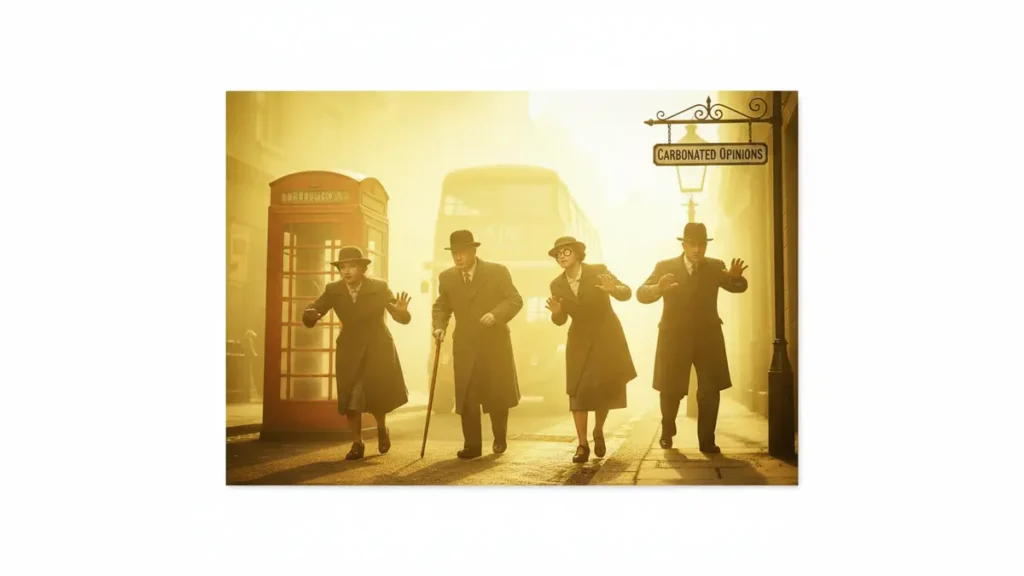
Great Smog of London 1952: The City’s Worst Spa Day
Great Smog of London 1952 unfolded in London, December 1952: cold snap, coal fires, and a temperature inversion that said, “No thanks, I’ll keep the fumes.” The fog arrived like a guest who won’t take the hint—then stayed to rearrange the furniture, cancel the trains, and quietly raise the mortality rate. If you’d paid for the experience, you’d call it a detox. London got it for free. The bill came in lungs.
A Fog With Fangs: Weather, Coal, And The Perfect Toxic Cocktail
The Great Smog of London 1952 wasn’t a mystical Victorian aesthetic; it was chemistry with manners too polite to warn you. Postwar Britain burned low-grade coal high in sulphur—because the good stuff was expensive, and optimism doesn’t heat a flat. A stubborn inversion pinned cold air to the streets and warmer air above it, creating a lid. Under that lid: domestic fireplaces, power stations, factory stacks, and vehicles doing their small but sincere part in the civic choking. Smoke couldn’t rise. So it spread. The smog descended like a soggy duvet stitched by the hellish efficiency of coal. Particulate matter thickened the air, sulphur compounds met moisture, and acids formed like the city had decided to pickle itself. Visibility collapsed to the point that Londoners navigated by memory, touch, and blind faith in curb edges. There’s a special irony in trying to out-heat the weather and losing to your own heating. London discovered the cure for dampness: make the city uninhabitable and the damp will move out on its own. Terrible for the tenants, great for the damp.
Death By Pea Soup: Who Suffered And Why Numbers Moved
“Pea-souper” used to be a cute local term—like a nickname for an uncle who drinks too much. In 1952 it became an obituary format. The people who paid first were the ones with the least spare breath: older residents, infants, and anyone with asthma, bronchitis, heart disease, or lungs already worn down by a lifetime of “normal” London air. Hospitals filled. Bodies followed. Transport stalled; buses stopped; ambulances crawled; markets sputtered. Even funerals struggled, because you can’t efficiently bury the dead when you can’t see the cemetery gates. The death toll is where history shows its paperwork. Early tallies focused on immediate deaths—then later studies expanded the window and found the smog’s delayed damage. Estimates climbed, with research often cited around 12,000 excess deaths. The air didn’t just kill; it injured, and then waited. If you want the neat summary, it’s here: the Great Smog of London wasn’t a “fog event.” It was an urban systems failure with a soft, grey costume.
Policy After The Panic: Smoke Control And The Clean Air Act
After enough coughing, the state discovered a new civic virtue: prevention. The political response eventually hardened into the Clean Air Act 1956, which pushed smokeless fuels and created smoke control areas. It was the beginning of treating clean air as infrastructure, not a nice-to-have for picnics. But policy has a talent for solving the visible problem while quietly relocating the invisible one. Burning coal in homes got replaced or reduced; power generation consolidated and moved outward. Results improved in the city center—while the emissions footprint shifted downwind, away from the people who write memos. Bureaucracies often discover morality only after it becomes statistically embarrassing. In this case, morality showed up once it could commute.
Why It Still Matters: From Pea-Soup To Global Air Pollution
The Great Smog of London 1952 endures because it’s a perfect miniature of how air disasters work: mundane choices, bad weather, delayed consequences, and sudden revelation when the harm becomes impossible to ignore. Today’s air is less theatrical. It doesn’t always arrive with a gothic curtain drop. It’s more like a subscription you never remember signing up for—fine particulates, nitrogen oxides, ozone, chronic exposure. The body count is global, and the lesson remains painfully local: if you can’t see it, you still breathe it. If you’ve ever asked what caused the Great Smog, the short answer is a mix of low-grade coal combustion, stagnant weather conditions, and urban emissions trapped by a temperature inversion. The arc from catastrophe to regulation is real progress, but it’s also a warning label. Fixes can work. Fixes can also export damage. The only truly modern idea is pretending we’re exempt from our own exhaust.
Take-Away
The Great Smog was avoidable, then inevitable, then “unprecedented,” then quietly repeated elsewhere under different branding. London had to rethink how it heats and powers itself—kicking and coughing all the way. Consider your city’s invisible burdens—and tell your local council to keep the smog in history books where it belongs.