
Methane Backpacks for Cows: Climate Fix or Udderly Absurd?
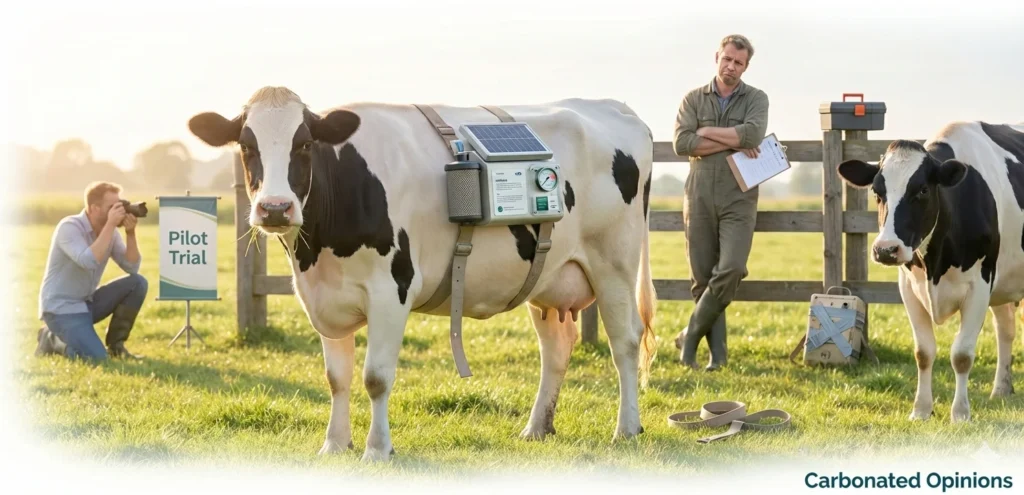
Picture a cow in a sunlit field, chewing and blinking slowly. It has a small device strapped near its back — a methane backpack. The device promises to catch methane from the cow’s burps. Cute image. Clever idea. Slightly absurd — like putting a tiny seatbelt on a goldfish and calling it traffic reform.
Welcome to one of the most eye-catching climate solutions for agriculture: methane backpacks for cows, designed to reduce livestock methane emissions without asking anyone to eat less beef.
What are methane backpacks (and why do cows need them?)
Methane backpacks are wearable devices attached to cattle to capture or measure methane released during digestion. The pitch is simple: strap on a filter, sensor, or capture unit so some gas is collected instead of drifting into the atmosphere.
Methane is a powerful greenhouse gas — far more potent than carbon dioxide over the short term. Cows produce it during digestion through enteric fermentation, a microbial process in the rumen. Most of that methane exits as burps, not farts (nature loves a plot twist).
Because cow methane emissions make up a large share of agricultural greenhouse gas emissions, reducing them could meaningfully slow near-term warming. Hence: backpacks.
Do methane backpacks actually reduce emissions?
In controlled trials, some prototypes show modest success. Researchers report reductions in methane emissions under lab or feedlot conditions. On paper, it looks promising.
Real farms, however, are less cooperative. Cows roll, rub, lie down, squeeze through gates, and generally treat wearable tech like a personal challenge. Devices need power, filters clog, straps loosen, and sensors break.
A backpack that captures 30% of emissions in a trial might capture far less in open pasture. Measuring real-world impact is also tricky — estimating livestock methane emissions requires long-term monitoring, not a press release and a ribbon-cutting.
There’s also the methane endgame. Once captured, what happens next?
- Is it flared?
- Stored?
- Used as energy?
- Accidentally leaked later?
Each option changes the net climate benefit.
Meanwhile, other methane reduction strategies in agriculture tackle the problem at the source. Feed additives, diet changes, certain seaweeds, manure management systems, selective breeding, and microbiome research often deliver more consistent reductions — without strapping electronics to livestock.
The real-world headaches (and unintended consequences)
Scale is the biggest obstacle. Outfitting millions of animals means high upfront costs, constant maintenance, replacement parts, and labor. Farmers operate on tight margins. A device that adds time, hassle, or uncertainty faces resistance — no matter how photogenic it is.
Animal welfare matters too. Straps and hardware must be safe, comfortable, and durable. Poorly designed gear can cause sores, stress, or injury. A climate solution that annoys cows is unlikely to win hearts — bovine or human.
Then there’s the optics problem. Methane backpacks photograph beautifully. They also flirt dangerously with greenwashing: a visible gadget that suggests big action while delivering limited reductions.
Lifecycle emissions matter as well. Manufacturing, shipping, powering, and maintaining devices all produce emissions. If captured methane leaks later, the climate math gets even uglier. Net benefit depends on the full system, not the headline.
Better ways to cut methane emissions from cows
Think of backpacks as one tool — not the hero — in a larger climate toolkit.
More effective approaches include:
- Improving cattle diets to reduce enteric fermentation methane
- Using proven feed additives where safe and affordable
- Capturing biogas from manure for on-farm energy
- Supporting breeding and microbiome research for lower-emission herds
Policy plays a key role. Smart subsidies, targeted incentives, and funding for on-farm trials help scale what actually works. Extension services matter too — farmers need practical solutions that fit daily routines, not gadgets designed for conferences.
If wearable tech eventually proves cheap, durable, comfortable, and clearly superior, it can earn a place. Until then, it shouldn’t monopolize attention.
Take-away
Methane backpacks for cows are a charming image — a fanny pack for one of agriculture’s most productive burpers. But charm is not climate policy.
Real progress on reducing agricultural methane emissions comes from layered, unglamorous work: better diets, improved manure management, smart incentives, and farmer-friendly systems. Smile for the photo, enjoy the absurdity — then ask what else is actually being done.
Because climate solutions shouldn’t stop at accessories.