
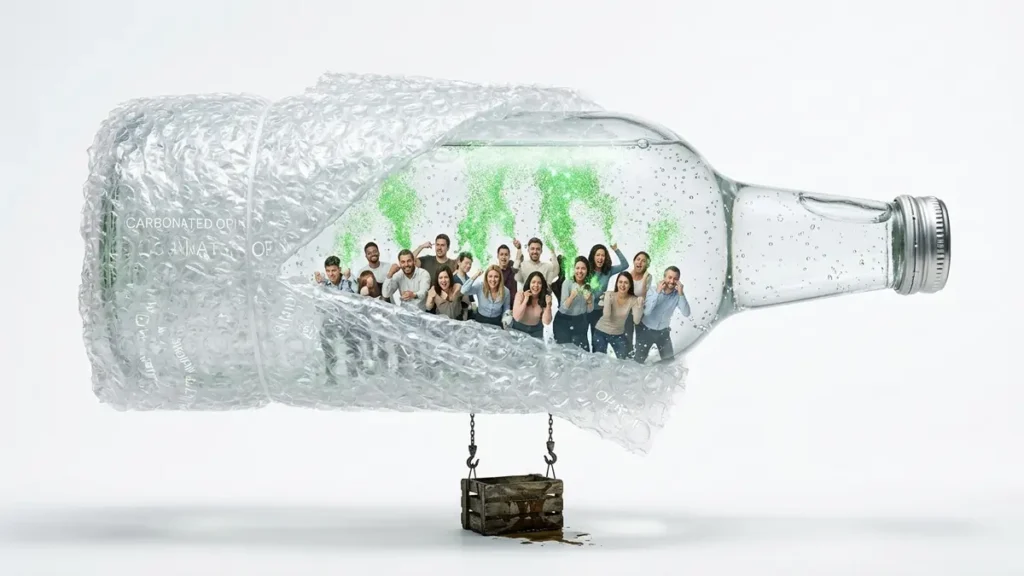
Climate Discourse: Bubble‑Wrapped Rage Meets Fizzy Optimism
Climate discourse right now is a bottle of sparkling water that got shipped in three layers of bubble wrap. It’s loud, it’s “refreshing,” it’s branded within an inch of its life—and somehow nobody’s asking why the crate underneath is dented, leaking, and still going out for delivery. The funny thing is, I don’t even hate the fizz. I’m impressed by it. The sheer athleticism of turning existential dread into something you can quote-tweet between lunch and doom scrolling? Honestly, respect. But when our loudest climate moments are optimized for vibes instead of outcomes, we get a lot of pop… and not much pressure.
Protest Popcorn: When Outrage Is Curated for Crunch
Outrage has become snackable. Not “edible” in a nourishing sense—more like popcorn: hot, loud, engineered for crunch, and somehow gone before you’ve processed why you started eating it. A climate take that fits in a caption with a clean little moral arc will always beat one that ends in “and now we need boring policy decisions.” Because attention economics doesn’t reward follow-through; it rewards the part where the camera finds your face. So the movement starts looking like artisanal soda: carefully branded, carbonated, full of flavor samples, and basically no nutrition. The algorithm hands out fizz to whatever’s most shareable, not whatever’s most solvable. And the grievances that don’t translate into a dramatic beat? They go flat. They get skipped. They don’t trend. Meanwhile, the stakes—actual climate change—keep doing that annoying thing where they refuse to be resolved by a “thread.”
Green Glitter, Not Solutions: The Optics of Polite Fury
There’s a special kind of modern fury that arrives wearing a polite outfit. It’s environmentally conscious language turned into décor: shiny, safe, and impressively easy to display without rearranging anything heavy. You’ve seen the moves. A fast-to-post gesture. An aestheticized regret. A statement that signals concern while carefully declining to name mechanisms, tradeoffs, or who’s going to pay. It’s like putting green glitter on a structural crack and calling it “awareness.” And look, gestures aren’t worthless. They can be a front door. The problem is when they become the whole house. Bubble wrap works the same way. It’s emotional PPE: comfortable to pop, convenient to hoard, and absolutely terrible for actually handling fragile things. It protects you from the discomfort of specificity. It lets you feel engaged without touching the sharp edges—regulation, pricing, permits, grids, land use, the non-glamorous guts of the problem. So we keep a perfectly curated sheen of urgency… without the inconvenience of disruption.
Comment-Section Combustion: Culture War as Oxygen for Climate Takes
Now add the accelerant: culture war oxygen. Once climate gets processed through the culture-war treadmill, nuance becomes a liability. Every sentence has to pick a team. Every proposal has to come with a villain. Every question has to be interpreted as betrayal. This is how you get “climate discourse” that sounds like campaign messaging screamed through a megaphone in a parking lot. It’s not just disagreement—it’s content. And because the culture war is basically an engagement engine with ideological skins, it rewards extremes. If your take can’t be clipped into a dunk, it’s treated as suspicious. If it acknowledges tradeoffs, it’s “selling out.” If it mentions policy, it’s “boring.” If it’s boring, it’s dead. So the spectacle becomes the summit, and the comment section becomes the legislature. Meanwhile the actual culture war keeps doing what it does best: turning shared reality into a loyalty test.
Take-Away: Stop Admiring the Pop
The bubble wrap wins if we only admire the pop. We can like the fizz without mistaking it for progress. Call out performative sparkle when it tries to substitute for substance. Protect the people doing the unsexy work—building, regulating, negotiating, measuring—so they don’t get drowned out by the loudest clip. Turn the fizz into muscle: less aesthetic panic, more sustained pressure. Less “look at me care,” more “here’s what changes, and who’s responsible, and how we’ll know it worked.”