
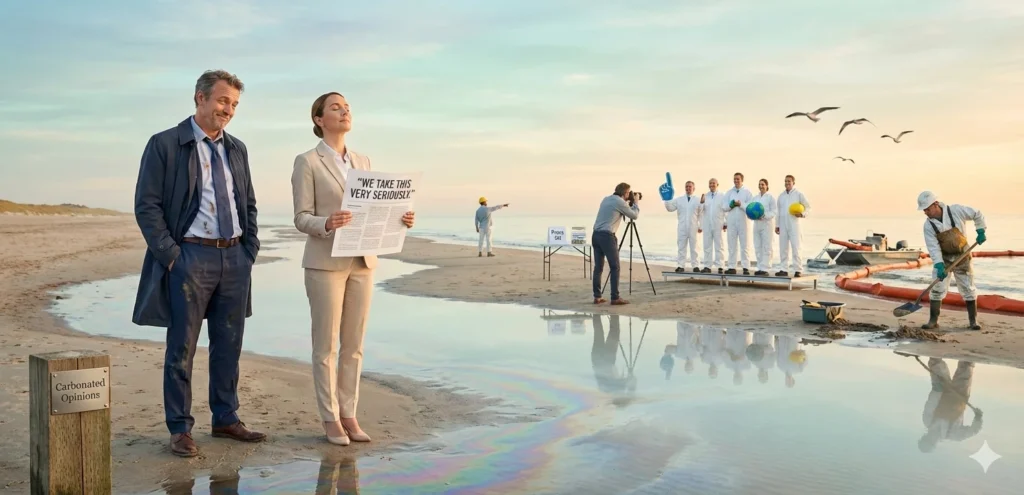
Major Oil Spills List: The Ocean’s Least-fun Theater Season
Oil spills arrive like a tragedy with a corporate matinee: the sea gets sued in absentia, executives read an apology off a laminated card, and the ecosystem takes the sticky note that says “circle back.” If you’ve ever tried to save a white shirt from a permanent, over-caffeinated stain, you already understand the genre. Everyone dabs. The stain stays.
When we talk about a major oil spills list, we’re not collecting horror stories for sport. We’re tallying a business model’s recurring “oops,” plus the bill it quietly hands to birds, beaches, and taxpayers. That’s not inevitability. That’s planning—with better fonts.
The slow-motion train wreck: what an oil spill actually does
An oil spill starts as physics pretending to be simple. Oil spreads into a slick, then breaks into ugly variations: thin sheens, thicker patches, tarry globs. Wind and currents do the choreography; shorelines get the finale.
Ecologically, it’s less “one bad day” than a chain reaction. Birds lose insulation and buoyancy when feathers get coated; they burn energy just trying to stay warm and afloat. Marine mammals inhale vapors at the surface and pick up toxins while grooming. Fish and larvae don’t need dramatic deaths to lose—sublethal exposure can mean weaker immune systems, messed-up reproduction, and food webs that wobble like a cheap table. The long-term consequences seen after big incidents—think Deepwater Horizon effects—show how damage can persist through decades.
Oil also sinks into sediments and marshes where life is small, slow, and foundational. Those habitats aren’t just pretty scenery; they’re nurseries, filters, and buffers. Coat them, and the damage keeps cashing interest.
The PR playbook: from instant statements to long-term denial
The timing is impeccable. Oil hits water; a statement hits inboxes. “We’re committed.” “We take this seriously.” “An investigation is underway.” It’s the PR equivalent of holding a patch kit to a sinking ship and promising to “look into” DNA.
Then comes the ritual: responsibility is expressed in the passive voice, while accountability is outsourced to committees, consultants, and calendar invites. Delay isn’t just a legal strategy; it’s an ecological multiplier. While lawyers debate adjectives, tides keep moving the mess.
And when the cameras leave, denial goes long. Complicated causation becomes a shield: if you can’t prove which dead marsh crab belongs to which corporate press release, maybe nobody has to pay for the funeral.
Cleanup: heroes, hacks, and half-measures
Oil spill cleanup challenges aren’t a mystery; they’re a menu with bad options.
Booms try to corral oil like a polite rope line at a nightclub. They work… until weather shows up.
Skimmers can remove surface oil, but they’re fussy about waves and can’t skim what’s already in the water column or glued to a shoreline.
Dispersants break oil into smaller droplets—sometimes reducing surface slicks, sometimes redistributing the problem into places you can’t see and can’t easily measure. The ocean becomes a blender, and we congratulate ourselves for not seeing chunks.
Manual shoreline cleanup is the human version of dabbing that stain: rakes, shovels, absorbent pads, and volunteers doing grim penance. It’s honorable. It’s also slow, incomplete, and occasionally destructive if “cleaning” means tearing up fragile habitat.
So yes: there are heroes. There are also hacks. And there are half-measures dressed up as innovation because they photograph well.
Who pays, who sighs: liability, policy, and the long tail of damage
After the initial spectacle, the real sport begins: a bureaucratic relay race where the baton is liability and everyone pretends it’s greased. Claims, caps, exemptions, appeals—an obstacle course built by people who can invoice their patience.
Companies may pay fines and settlements. They may fund restoration. But long-term monitoring is where the plot gets quiet: years later, when fishery data looks “noisy” and budgets look “tight,” the environment is encouraged to heal on a schedule set by quarterly earnings.
And when costs slip through the paperwork, they land where costs love to land: public coffers and natural systems. Taxpayers subsidize the cleanup; wetlands subsidize the storm protection; communities subsidize the lost seasons of work. The ocean does not get reimbursed for lost complexity.
Small solutions, big lessons
A major oil spills list is not a destiny board; it’s a design flaw catalog. Fixes exist—boring, effective, and politically inconvenient:
- Stronger regulation that treats prevention like engineering, not optimism.
- Better response planning that assumes weather will behave like weather.
- Dedicated restoration funds that are real money, not remorse.
- Transparent data so “we’re committed” has to compete with measurements.
Civic vigilance helps too. Not the doom-scrolling kind—the paperwork kind: local hearings, enforcement budgets, and keeping spill response plans from becoming decorative PDFs.
Take-away
Corporate shrugging is marketed as the price of modern life. It’s not. It’s avoidable negligence with a communications strategy. The next time a spill earns a spot on the major oil spills list, ignore the stage-managed sorrow and ask the only adult question left: who is paying, who is monitoring, and what changes before the ocean gets another “sorry for the inconvenience”?
Subscribe for more carbonated takes on environmental blunders—and send your local spill-response stories. The sea shouldn’t be the only witness.