
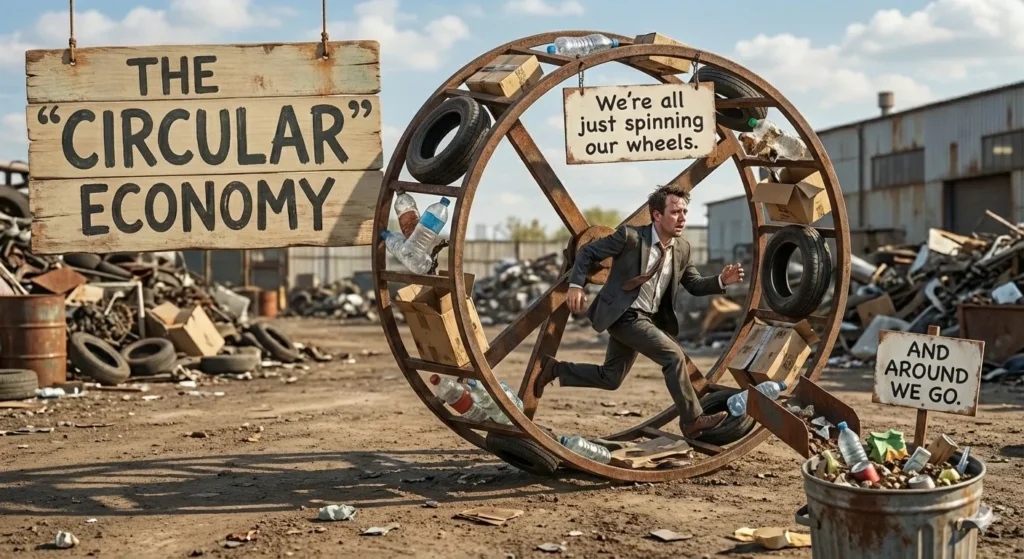
Circular Economy Explained: the Eco-Loop we Keep Forgetting to Close
The first time you hear circular economy explained — or click a link to circular economy — it sounds like the environment finally hired a competent project manager. Everything loops. Nothing is wasted. Materials pirouette gracefully from one product to the next like they’re auditioning for “Swan Lake: Supply Chain Edition.” And then you open your recycling bin and realize it’s hosting a very different event—more like “Conference on Sticky Yogurt Cups and Wishful Thinking.”
The circular economy is a genuinely powerful idea. It’s also the kind of idea humans love to put on slide decks, right next to “synergy,” while continuing to buy a new phone because the old one “felt tired.” So yes: we’re doing a reality check. Bring your optimism, your skepticism, and maybe a rinse cycle.
The Three Golden Rules (and the Fine Print)
At its core, a circular economy has three big principles:
1) Design out waste and pollution. Don’t make products that are destined for the landfill the moment they meet a toddler, a latte spill, or a planned-obsolescence calendar reminder.
2) Keep products and materials in use. Reuse, repair, refurbish, remanufacture—basically, treat stuff like it has a second act that doesn’t involve a dump truck.
3) Regenerate natural systems. Instead of extracting until the planet files a restraining order, shift toward practices that restore soils, ecosystems, and biodiversity.
In practice, the fine print is where the comedy lives. “Designing out waste” is noble until a designer is asked to make a toaster last 30 years. Suddenly we’re all watching an existential drama: Toaster, Season 12—still here, still crumb-trapping, still refusing to die. Policymakers might love durability, but markets love novelty, and novelty loves… breaking.
The idea isn’t mystical; it’s engineering plus incentives plus accountability. We just keep trying to substitute those with inspirational posters.
Where the Circle Gets Bent: Practical Problems
If the circular economy is a perfect loop on a whiteboard, real life is the loop after a long commute: dented, late, and contaminated.
Recycling streams leak for mundane, unsexy reasons. The big one is contamination—food residue, mixed materials, “I’m pretty sure this is recyclable” guesses that turn an entire batch into expensive trash. For circular economy examples, plastics and contaminated food waste show how messy the reality can be. Then there’s downcycling, where material gets “recycled” into something lower quality until it eventually taps out. Plastic, for instance, often has the career trajectory of a washed-up celebrity: one comeback tour, then retirement.
And logistics matter. Collecting, sorting, and transporting materials takes energy, labor, and infrastructure. The “closed loop” looks like enlightenment in a sustainability report, but on a loading dock it looks like bins, forklifts, and someone explaining—again—why a greasy pizza box is not a gift to the system.
This is where Recycling becomes less of a moral identity and more of a technical process with failure modes, budgets, and performance metrics. Which is to say: not a vibe.
Business Models or Buzzwords? The Product-as-a-Service Trap
One of the flashier promises in circular thinking is shifting from owning products to accessing them: leasing, sharing, subscriptions, and “product-as-a-service.” In theory, if companies keep ownership, they have an incentive to make products durable, repairable, and easy to refurbish.
In reality, some firms treat “circular” as a new font for the same old sales strategy. Subscription everything can become a trap where you never own, never escape, and your refrigerator has a monthly fee like it’s auditioning for a streaming platform.
Even well-intentioned models can backfire. If making access easier increases consumption—more deliveries, more turnover, more usage—then you get rebound effects: the efficiency gains don’t reduce impact; they just make it cheaper to do more. Congratulations, your “sharing economy” has reinvented the traffic jam.
And then there’s greenwashing: when “circular” gets filed under Marketing rather than Engineering. You know the type: a product “made with recycled content” that’s still impossible to repair, still wrapped like a Russian nesting doll of plastic, and still designed to quit after two years because commitment is scary.
If the circular economy were dating your appliances, this is the stage where your dishwasher says it wants a long-term relationship—then ghosts you at the first error code.
What Works — and What to Push For
Here’s the part where we stop heckling and start building. The circular economy isn’t doomed; it’s just allergic to magical thinking.
What actually moves the needle:
- Design for repair and disassembly. If a product can’t be opened without breaking it, it’s not “innovative,” it’s just emotionally unavailable.
- Extended Producer Responsibility (EPR). Make producers financially responsible for what happens at end-of-life, so waste becomes a line item, not an externality.
- Repairability standards and right-to-repair. Parts availability, manuals, standardized screws—basic civics for objects.
- Regional material hubs. Shorter transport distances, local sorting capacity, and markets for secondary materials—because “ship it across the ocean to recycle it” is a plot twist, not a plan.
- Better data on material flows. You can’t manage what you can’t measure, and right now we measure a lot of feelings.
This is also where the circular economy stops being showroom prototypes and starts being policy and infrastructure. When jurisdictions implement EPR for packaging, when cities invest in organics processing, when manufacturers publish repair scores—those are the unglamorous moves that make the circle less metaphor and more machinery.
If you’re a citizen (congratulations on your continued existence), your contribution is bigger than rinsing yogurt cups like they’re delicate heirlooms. Ask for repair-friendly products, support right-to-repair and EPR policies, and reward companies that make durability boringly normal. Also: buy less, and keep what you buy