
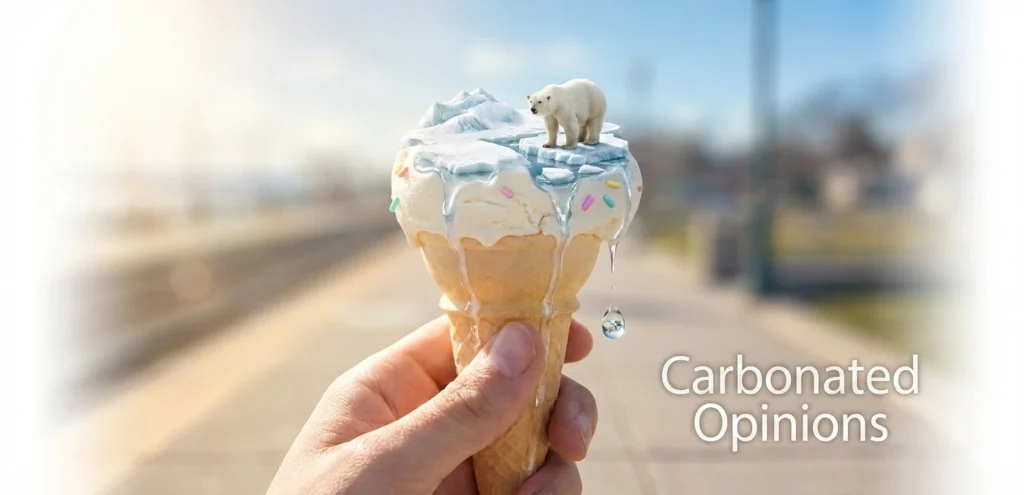
Why is Ice Melting (and Why Your Cone is having a Better PR Team than the Arctic)
Why is ice melting? Because heat moves, energy accumulates, and physics has the bedside manner of a parking ticket. Your ice cream cone on a July sidewalk and the Arctic on a warming planet are both running the same playbook: heat transfer plus feedbacks, with a cameo by humans politely pretending the laws of thermodynamics are “more like suggestions.” This isn’t a guilt trip disguised as dessert. It’s a reality check with sprinkles. The good news: the mechanisms are comprehensible. The bad news: they’re comprehensible.
Why your ice cream melts (and why physics doesn’t care about your feelings)
Your cone begins life as a proud, frozen monument to self-control. Then your hand shows up. Then the air shows up. Then the Sun shows up, like an uninvited relative who insists on “brightening the place.” Melting is mostly a heat accounting problem. Heat reaches the ice cream through three basic routes:
- Conduction: Your warm hand conducts heat into the cone and the scoop. Congratulations, you are now a space heater with opinions.
- Convection: Warm air flows over the scoop, swapping heat like gossip. A breeze can either cool a little (if the air is cooler than the ice cream’s surface) or, in a heat wave, function as a hair dryer.
- Radiation: Sunlight delivers energy without touching anything, like a passive-aggressive email.
Once enough energy arrives, the ice cream doesn’t just “get warmer.” It changes phase, and that’s where physics gets smug. The temperature can hover near the melting point while the incoming energy goes into latent heat—the invisible budget line item that pays to break the crystalline structure and turn solid into liquid. This is why your scoop can look stable for a moment and then suddenly switch to full soap opera: the energy bill comes due.
Albedo, reflectivity, and backsplash: snow vs. sprinkles
If the first section was “heat arrives,” this section is “how much stays.” Enter albedo, the measure of how much incoming sunlight a surface reflects back into space. A vanilla scoop in a white paper cup is basically wearing SPF 50. A dark chocolate scoop in a black cup is sunbathing with the confidence of a man who says he “doesn’t burn.” The darker setup absorbs more solar energy and warms faster. The Arctic works the same way, just with higher stakes and fewer napkins. Ice and snow are bright and reflective. Open ocean and bare land are darker and absorb more sunlight. When ice retreats, you don’t just lose ice—you replace a mirror with a heat trap. And since we’re being honest: soot and other dark particles can lower reflectivity too, like someone dusted your pristine sundae with fireplace ash and called it “artisanal.” To ground this without drowning in equations, here’s the basic vibe:
| Surface | Reflects sunlight? | Tends to… |
|---|---|---|
| Fresh snow/ice | A lot | Stay cooler, melt slower |
| Dark water/land | Not much | Warm up, melt more ice |
For the formal definition, the term albedo is worth knowing—because it explains why “just a little less ice” is not, in fact, “just a little.”
Arctic amplification: when small changes become big scandals
“Arctic amplification” is what happens when the Arctic warms faster than the global average—like the planet is hosting a group project and the Arctic is doing that thing where it panics, overreacts, and pulls everyone’s grade down. The headline mechanism is a feedback loop: Less ice → lower reflectivity → more solar absorption → more warming → even less ice. This is where arctic ice melting explained stops being a polite science lesson and becomes a scandal sheet. The Arctic is the planet’s vanilla scoop—deceptively plain, but remove it and the whole sundae collapses. Warming also changes snow cover, clouds, and how heat is exchanged between ocean and atmosphere. The details are complex, but the direction is not: take away bright, reflective surfaces and you supercharge local warming. And why should anyone south of polar-bear latitudes care? Because the Arctic isn’t a themed attraction. Changes up there can ripple into sea level, ecosystems, and the larger climate system—like tugging one loose thread and discovering your entire sweater was held together by heroic denial.
Permafrost, soggy cones, and delayed messes
A cone doesn’t ruin your day immediately. It starts with an innocent drip. Then another. Then you realize—too late—that gravity has been working overtime and your shirt is now a tie-dye statement piece. Permafrost thaw is climate change’s version of the delayed drip. Permafrost is ground that has remained frozen for long periods, storing organic material that didn’t fully decompose because, well, it was essentially kept in a planetary freezer. Warm it up and microbes resume their work, releasing carbon dioxide and methane. That means warming can trigger extra greenhouse gas emissions from the land itself—a feedback that makes mitigation harder, like discovering your “small leak” is connected to the main water line. There are uncertainties: how fast different regions thaw, how much gas is released, and how ecosystems respond. But the risk is straightforward: thawing permafrost can add fuel to the warming trend, and physics does not do refunds. If you want the clean definition without the emotional damage, permafrost covers the basics.
What physics can’t fix — and what we can do about it
Physics can tell you that your scoop will melt. It cannot tell you to buy a napkin. That part is policy, engineering, and—tragically—character. So what can we do that’s actually relevant, not just performative recycling theater?
- Cut greenhouse gas emissions: fewer heat-trapping gases means less extra energy staying in the system. Unsexy, essential.
- Reduce darkening pollutants like black carbon (soot): it’s the “why is everything getting grimier?” problem with real climate consequences.
- Protect and restore ecosystems that store carbon: forests, wetlands, and soils are the closest thing we have to a functional savings account.
- Vote for adults in the room: preferably the kind who understand that “energy balance” is not a yoga pose.
Individual choices matter most when they scale—through norms, markets, and politics. Buying an EV won’t personally refreeze the Arctic by Tuesday, but it can help shift systems that currently treat atmospheric chemistry like an externality with a cute accent.
Take-away
why is ice melting? Because heat transfer delivers energy, phase changes spend it, and feedbacks—especially albedo—compound the mess. Your cone is a tabletop lesson in thermodynamics; the Arctic is the same lesson delivered with consequences. If you think your cone is bad, remember the Arctic has no napkin and a much worse Yelp rating from polar bears. The physics is relentless, but the response isn’t predetermined: emissions cuts, cleaner air, and better governance can slow the melt and keep the planet’s vanilla scoop from sliding off the sundae. If you like your environmental commentary short, sharp, and slightly fizzy, subscribe to the newsletter. It melts slower than ice cream, mostly because it’s made of electrons and spite.