
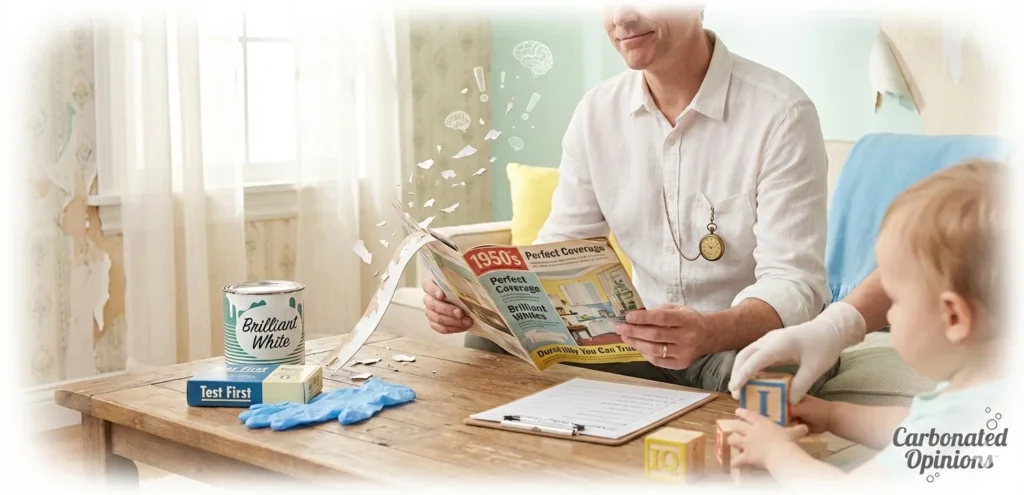
Lead Paint Dangers: A Masterclass in Vintage Regret
I am a sarcastic time traveler flipping through an old home-improvement magazine. The ads promise perfect coverage, brilliant whites, and durability you can trust. Today, those same brushstrokes read like decorative regrets. Asking why lead paint is dangerous now feels less like a safety question and more like a plot twist in a historical drama where everyone ignored the foreshadowing.
Spoiler: the lead paint health effects do not care how charming the wallpaper is.
The Golden Age of Bad Ideas (Featuring Excellent Marketing)
Once upon a time, lead paint was the prom king of coatings. It dried fast. It resisted moisture. It covered sins like a champ. Painters adored it. Builders trusted it. Advertisers slapped smiling families next to it and called it progress.
Public health? Politely gagged in the corner.
White lead pigments appeared in ancient texts, re-emerged during the Industrial Revolution, and went fully mainstream by the 20th century. Homes, ships, toys, playgrounds, furniture — if it could be painted, it probably was. Utility beat caution every time. The result: old house lead paint that still leaks consequences decades later. For the official résumé of this bad idea, see lead paint.
Tiny Toxins, Big Consequences (No Jump Scares, Just Science)
Lead is not flashy. It does not explode. It whispers. It accumulates quietly in bones and organs. Children absorb it faster and suffer more. Even low-level lead paint exposure risks include reduced learning ability, behavioral changes, and long-term developmental harm.
Translation: peeling paint chips are not “character.” They are neurotoxic gossip about your house’s past.
At scale, widespread lead exposure has been linked to population-level drops in IQ and increased rates of violent crime decades later. That’s not a vibe — that’s a societal hangover. The clinical mechanics are covered in grim detail under lead poisoning, should you wish to ruin your afternoon productively.
Where Lead Paint Still Hides (Like a Bad Guest Who Never Left)
Lead paint loves quiet corners and polite neglect. Common hiding spots include:
- Pre-1978 homes: window sills, door frames, trim, and stair rails
- Old playground equipment and outdoor furniture
- Road markings and industrial coatings
- Some artists’ paints and antique fixtures
The real villain is dust. Lead dust travels. It settles. It waits. One renovation, one curious toddler, or one “quick sanding job” can reactivate a chemical time capsule.
If you suspect lead paint, optimism is not a strategy.
| Approach | Likely Outcome |
|---|---|
| Professional lead paint remediation | Higher cost, low risk, long-term safety |
| DIY sanding or scraping | Lower cost now, higher exposure risk, regret later |
Practical steps that do not involve learning the hard way:
- Test first. Use certified test kits or professional inspectors before disturbing surfaces.
- Protect children and pregnant people — always the top priority.
- Use certified abatement professionals for removal or encapsulation. Lead dust does not respect confidence.
- Seal, don’t sand if interim fixes are unavoidable, and follow strict containment and cleanup rules.
Other Vintage Mistakes: A Short Hopscotch Tour of “Seemed Fine at the Time”
- Asbestos: fireproof, lung-hostile
- Leaded gasoline: smoother engines, poisoned cities
- Mercury in hat-making: stylish headwear, chaotic nervous systems
Lead paint fits right in — a well-intentioned shortcut that aged like unrefrigerated milk.
Take-Away
The dangers of lead paint aren’t abstract. They’re practical, measurable, and still quietly embedded in older buildings. Lead paint is the house equivalent of thinking it installed armor but actually smuggled tiny saboteurs into snack time. Consider old paint chips nostalgic confetti with a criminal record.
Inspect. Test. Prioritize kids. Call professionals. Treat lead paint remediation as real maintenance — not a weekend hobby fueled by optimism and YouTube confidence.
Call to action: Check one hidden edge of your home this week. If you uncover a vintage mistake, share it. I’ll toast your discovery with a glass of aggressively lead-free water.
If vintage blunders tickled your dark humor, don’t miss my personal cringe in: eco fails I would rather not talk about but will.