
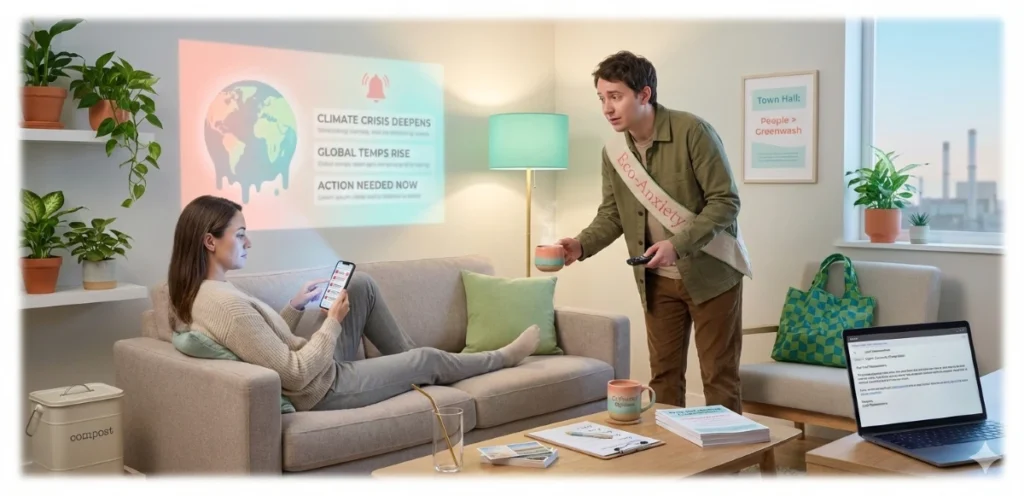
Eco-Anxiety and Other Party Tricks
Eco anxiety meaning (Without the Wellness Poster)
Eco‑anxiety is that awkward party guest who won’t leave. It arrives with a slideshow of melting maps, a soundtrack of bad news alerts, and the firm conviction that we’re all underprepared. If you’ve searched for the phrase “climate anxiety explained,” you already know the setup: justified panic mixed with performative virtue.
This is a rant and a survival guide. Take your tea — yes, even if the guest asks for it at 2 a.m. Eco-anxiety is that friend who shows up uninvited with a deck titled *Everything That’s Wrong* and then asks if you’re hydrated..
Welcome to the Doomscroll: How We Learned to Panic Efficiently
Our information diet is a buffet of headlines. The attention economy rewards outrage. Graphic imagery spreads. Calm gets fewer clicks than fury. The result: chronic, low‑grade dread. The brain learns efficiency. It panics fast and often.
That is why headlines about warming oceans and species loss feel personal. The technical term is eco‑anxiety. The broader backdrop is the slow, relentless juggernaut we call climate change. Both make for excellent late‑night doomscrolling.
Why does anger click? Because algorithms prefer reaction. Anger is shareable. Calm is not. So we get a steady diet of the worst. That trains our minds to expect catastrophe. Cue: more anxiety. Repeat.
Personal Armor: Tiny Rituals that Feel Like Resistance (But Mostly Aren’t)
We adopt tiny rituals to feel less helpless. They work as props. Sometimes they help. Often they’re theater.
- Mindful breathing that lasts until the next breaking news alert.
- Houseplants as emotional decor.
- Eco‑mission creep: swapping one guilty purchase for another, then feeling morally superior.
There’s also compulsive recycling that never questions industrial waste, and the habit of turning virtue into consumable aesthetics.
Some practices genuinely help. Therapy, grounded community work, and focusing on skills that scale are useful. But buying yourself a single reusable straw and assuming you’ve entered the resistance is the classic trap. If you need a phrase to tell anxious friends: “This helps, but it’s not everything.”
Blame the Usual Suspects (And the System That Lets Them Get Away)
Where should your rage land? Not at the person who drives to work. Not at the individual who eats avocado toast. Aim your fury at the machinery that makes those choices the default.
Policy paralysis. Fossilized interests. Narratives that turn survival into boutique activism. Systems shape choices. Subsidies, zoning laws, and corporate lobbying make low-carbon living harder than it needs to be. The result is a world where survival feels like a lifestyle upgrade instead of a baseline right.
That’s not personal failure. It’s political design.
From Paralysis to Petitions (Why Collective Action Beats Solo Stoicism)
Solo stoicism looks glamorous in an Instagram bio. In real life it’s lonely and slow. Collective action does the heavy lifting.
Organizing, petitions, local campaigns, and ballots shift rules. They scale.
Want fewer emissions? Vote for it. Want cleaner transit? Build a coalition. Want industry to stop greenwashing? Names on a petition and people at meetings do more than virtue signaling. Mock the lone‑hero fantasy. Praise the boring work: phone banks, door knocks, and community meetings. That’s where impact lives.
Keeping the Fire Without Burning Out
Sustaining commitment is tactical. Treat this like a survival briefing, not a lifestyle brand.
- Set boundaries: limit doomscroll time. Keep a grief hour, not a grief life.
- Find community: shared outrage is less exhausting and more effective.
- Practice tactical hope: pick actions with measurable outcomes.
Treat anxiety like a smoke alarm — useful early warning, less useful when it screams during toast.
Take‑Away
Accept the grief. Aim the rage at systems. Join the team that shows up.
If you’re tired of doomscrolling, try circulating your outrage into something collective — protests, town halls, or the occasional furious postcard. This isn’t a pep talk. It’s a microscopic call to sane, stubborn action.