
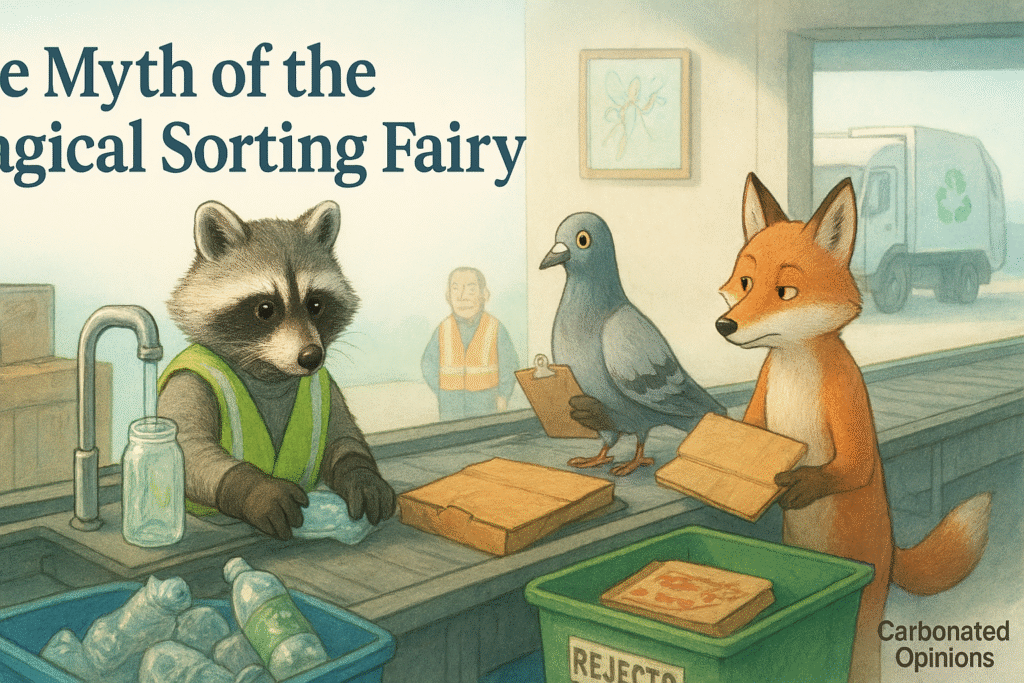
You know that moment: you rinse a coffee cup with a splash of water, whisper a hopeful “You’ll be recycled,” and toss it in the blue bin. It’s cute. It’s human. It’s called wishcycling. And it’s also a tiny betrayal of the actual recycling system.
Why we love the Magical Sorting Fairy
Recycling feels like moral instant coffee. Fast. Easy. Guilt slightly dulled. Companies and curbside programs encourage that feeling. Add a label that says “recyclable” and we cheerfully pass the problem on. We want to believe a tiny Sorting Fairy will swoop in and fix everything. Spoiler: no fairy. Just trucks, machines, and people doing hard sorting. Wishcycling is the recycling equivalent of texting your ex and hoping for a different result. It’s hopeful, dramatic, and rarely productive.
The inconvenient reality of recycling
Recycling is a real and useful process, but it is not magic. At scale, your recyclables get moved, sorted, and processed. Systems vary. Some places use Single-stream recycling, which lets you toss paper, plastic, and metal together. That’s easier for people. But when everything is mixed, contamination rises. A greasy pizza box or a food-soaked container can spoil the whole batch.
The common sins of the blue bin
People put the weird stuff in the bin because they want to help. They do not mean harm. Still, some things cause trouble: oily pizza boxes, leftover lasagna, broken garden hoses, small soft plastics, or anything that falls apart in transit. These items can jam machines, lower material quality, or cause entire loads to be rejected and sent to landfill. When recyclables get contaminated, the cost and effort to sort and clean them climbs. That raises the chance the materials will be downcycled or buried. That defeats the whole point.
What actually helps (do these, not magic)
Small habits beat big intentions. Rinse jars and cans quickly. Flatten cardboard so it takes less space. Keep food and liquids out of mixed recycling. Learn one local rule and follow it. No need for perfection. Just fewer mistakes. If everyone rinsed one jar a week and flattened one box, the combined effect would be huge. A tiny change from many people is stronger than heroic efforts from a few. Take-away Believing your recycling bin will sort itself is like expecting a magic butler to fold your laundry — charming, but in reality you’re left doing the folding (and the guilt). The Sorting Fairy is a myth. Real progress comes from small, steady actions and clearer rules. If you want a tiny challenge: pledge to rinse one jar and flatten one box this week. Tell a friend. It’s less romantic than a fairy, but it works.